
Google Updates Flash Again: Lower Costs and Stronger Reasoning in Gemini 3.8
Google has released the Gemini 3.8 series, including the general-purpose Gemini 3.8 Flash and the cybersecurity-focused Gemini 3.8 Flash Cyber. Key details include:
- Release timing: Announced in a September 3 report, following Google’s launch the previous night
- New models: Gemini 3.8 Flash and Gemini 3.8 Flash Cyber
- Context window: Gemini 3.8 Flash supports a 1 million-token context window
- Pricing: Introductory pricing is $0.75 per million input tokens and $3.75 per million output tokens; standard pricing is $1.50 and $7.50, respectively
- Availability: Available through Google AI Studio, Android Studio, and the Gemini API; developers can also try agentic workflows in Google Antigravity and Stitch
- Enterprise and consumer access: Enterprise users can access it through Gemini Enterprise; AI Pro and Ultra subscribers can use it in the Gemini app, Google Search AI Mode, and Google Sheets
- Cyber access: Gemini 3.8 Flash Cyber will be made available to trusted defenders through the Fairwind program
Reasoning and Coding: First Place on 8 of 14 Benchmarks
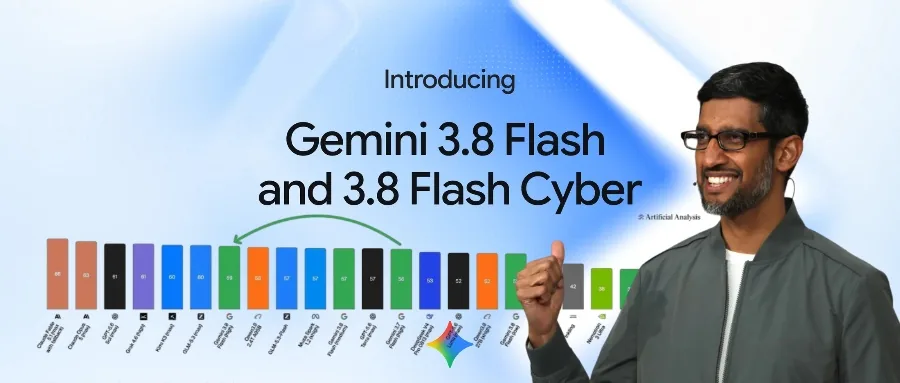
According to the source material, Gemini 3.8 Flash ranked first on 8 of 14 benchmarks, outperforming Claude Opus 5 and GPT-5.6 Sol. The disclosed leading benchmarks include:
- Vals Finance Agent v2 for financial analysis
- Harvey Legal for legal workflows
- Terminal-bench 2.1 for terminal-based coding tasks
- CharXiv for complex chart reasoning
- LVBench for long-video understanding
- HLE-Verified for cross-disciplinary expert problems
- LABBench2 for real-world biology research tasks
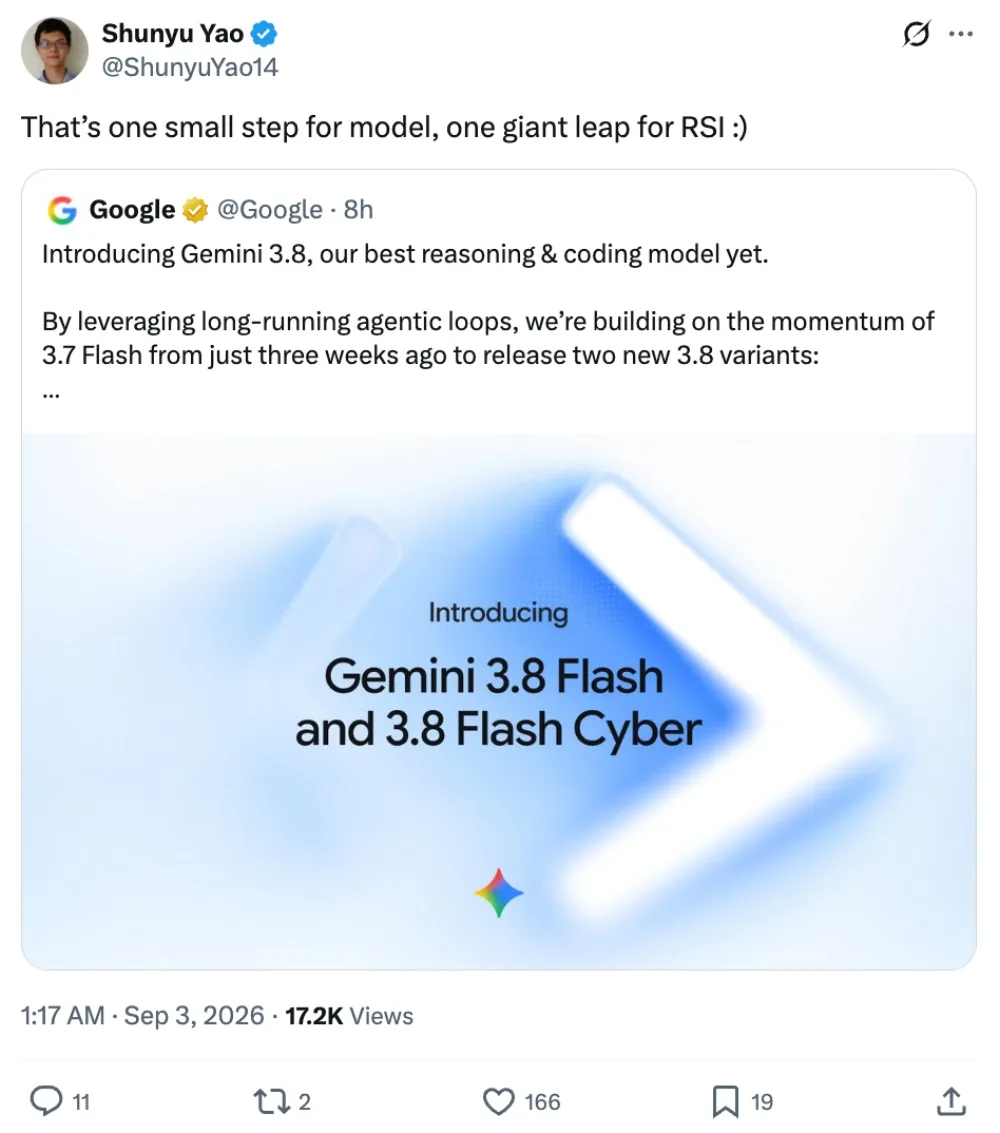
On the Artificial Analysis Intelligence Index, Gemini 3.8 Flash scored 59, matching GPT-5.6 Sol and Grok 4.6 in non-maximum reasoning configurations. In terms of reasoning cost, Gemini 3.8 Flash costs $0.58 per Intelligence Index task in high mode, $0.41 in medium mode, and $0.24 in low mode.
For speed, the model averages about 300 tokens per second in high reasoning mode, with each task taking about 2.5 minutes. In low reasoning mode, task time drops to 0.8 minutes, reaching the Pareto frontier in the trade-off between intelligence level and task duration.
Pricing: Introductory Rates Are About 15% of Opus 5
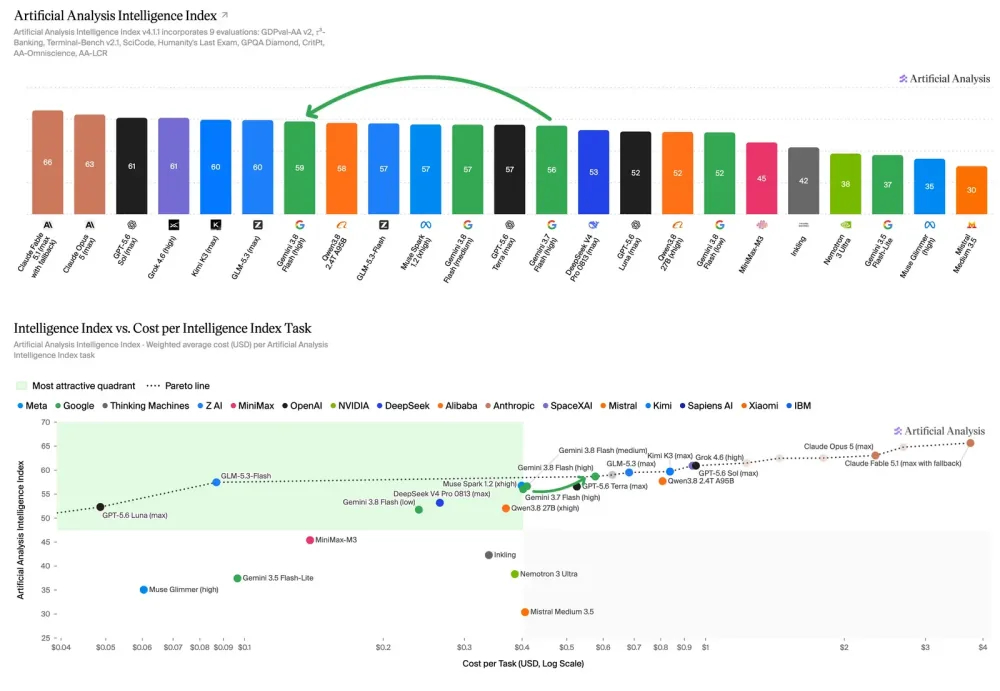
Gemini 3.8 Flash currently uses introductory pricing of $0.75 per million input tokens and $3.75 per million output tokens. Its standard pricing is $1.50 per million input tokens and $7.50 per million output tokens.
| Model | Input Price ($/M tokens) | Output Price ($/M tokens) | Relative to Gemini 3.8 Flash Standard |
|---|---|---|---|
| Gemini 3.8 Flash | 1.5 | 7.5 | 1x |
| Claude Opus 5 | 5 | 25 | About 3.3x |
| GPT-5.6 Sol | 5 | 30 | About 3.3x–4x |
| Terra | 2.5 | 15 | About 1.7x–2x |
| Luna | 1 | 6 | Cheaper |
At the current introductory rate, Gemini 3.8 Flash’s input and output prices are each about 15% of Claude Opus 5 pricing. At standard pricing, Opus 5 is a little over three times more expensive.
Real-World Demos: Fast Execution, but Not Flawless
Google showed several Gemini 3.8 Flash demos:
- 3D castle game: With loop instructions in Google Antigravity, the model built a 3D level from a simple prompt, combining puzzles, environmental storytelling, and textures generated with Nano Banana
- DOS-style Google Maps: A single prompt produced an interactive version with location search, route planning, and street view
- Topographic map tool: Using real U.S. Geological Survey datasets, the model built terrain maps with real-time cross-sections, 2D projections, and scientific explanations
- Hardware Anatomy: A Three.js-based 3D visualization tool that creates physically scaled hardware teardown diagrams and lets users expand layered components with a slider
Developer tests also showed the model’s speed. Chinese AI blogger Chasen tested a “pelican riding a bicycle” task and said the main code was generated in about 10 seconds. However, the result still had visible flaws: the pelican’s feet did not land on the pedals, and the bicycle frame and wheels were misaligned.
Another developer used Gemini 3.8 Flash to generate a pure Three.js model of the DeBerti Design 2019 Ford F-250 “Transformer” work truck, with complete components and interactive controls.
Gemini 3.8 Flash Cyber: Vulnerability Detection and Automated Patching
Gemini 3.8 Flash Cyber focuses on cybersecurity. The source material says it reaches frontier-level performance in vulnerability detection and automated patching, and will be opened to trusted defenders through the Fairwind program.
On CyberGym, an industry benchmark for vulnerability discovery, Gemini 3.8 Flash Cyber outperformed GPT-5.6 Sol, Mythos 5, and GPT-5.5-Cyber. Google also evaluated it on an internal benchmark requiring models to find vulnerabilities in complex codebases spanning 20 programming languages, where it achieved a success rate above 70%.
For patching, Gemini 3.8 Flash Cyber reached 47.2% pass@1 on the external CWE-Bench test, close to the 47.8% result of leading frontier models while costing significantly less. Google’s Chrome security team found that it generated 2.6 times as many correct patches for Chrome vulnerabilities as larger top commercial models.
Wiz reported that, on its internal penetration-testing benchmark, Gemini 3.8 Flash Cyber delivered recall 7.5 to 9.7 percentage points higher than other frontier models, at roughly one-fifth to one-half of their cost. Google Cloud’s vulnerability research team also used the model to find a critical foundational vulnerability in under two hours, a type of discovery that would typically require months of conventional research.
Final Take
Three Flash updates in six weeks suggest that Google is accelerating iteration on its mainline models. With lower pricing, fast output, and stronger multi-step reasoning, Gemini 3.8 Flash looks especially relevant for budget-sensitive developers and high-volume enterprise workloads.
That said, developer demos also show that the model can still miss details in creative or visually complex tasks. Users who need the highest level of polish should evaluate it against their own workloads before switching.
Google DeepMind researcher Yao Shunyu described the launch as “a small step for the model, but a big step for RSI,” referring to recursive self-improvement. That framing suggests the strategic story is not only this model’s benchmark gains, but also Google’s effort to accelerate model iteration through recursive evaluation and optimization.