Key Facts at a Glance
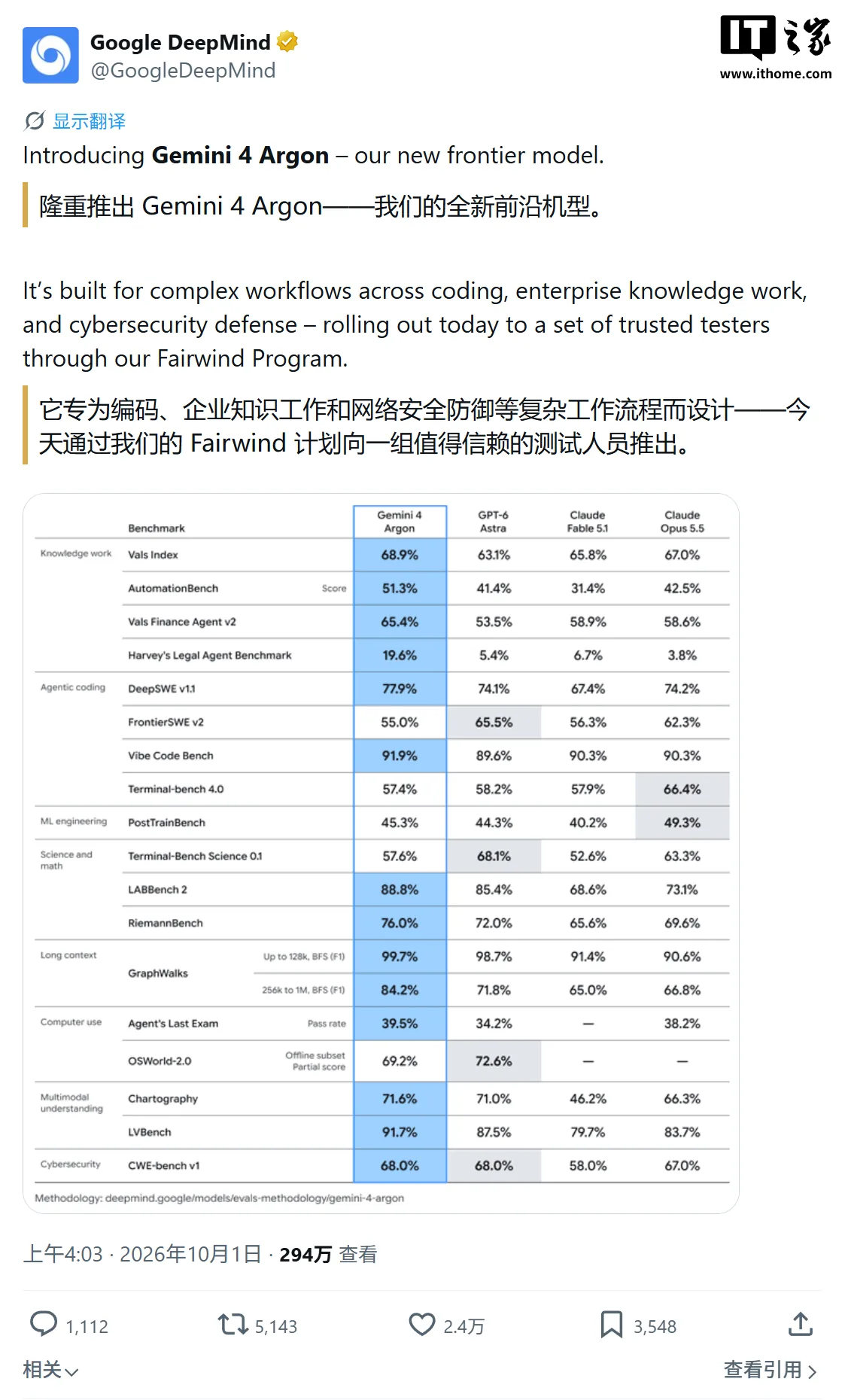
Google officially launched the Gemini 4 Argon model on September 30, 2026, positioning it as the company’s most advanced AI model to date.
- Release date: September 30, 2026
- New version: Gemini 4 Argon (successor to Gemini 3.5 Flash Cyber)
- Public availability: Not yet widely available to the general public
- Initial rollout: Via the Fairwind Program to trusted cybersecurity defenders first
- Access tiers: Initially for paid API customers and Google AI Ultra subscribers; later expansion to enterprises and consumers
- Weight openness: Model weights are not disclosed as open-source
Core Capabilities and Benchmark Results
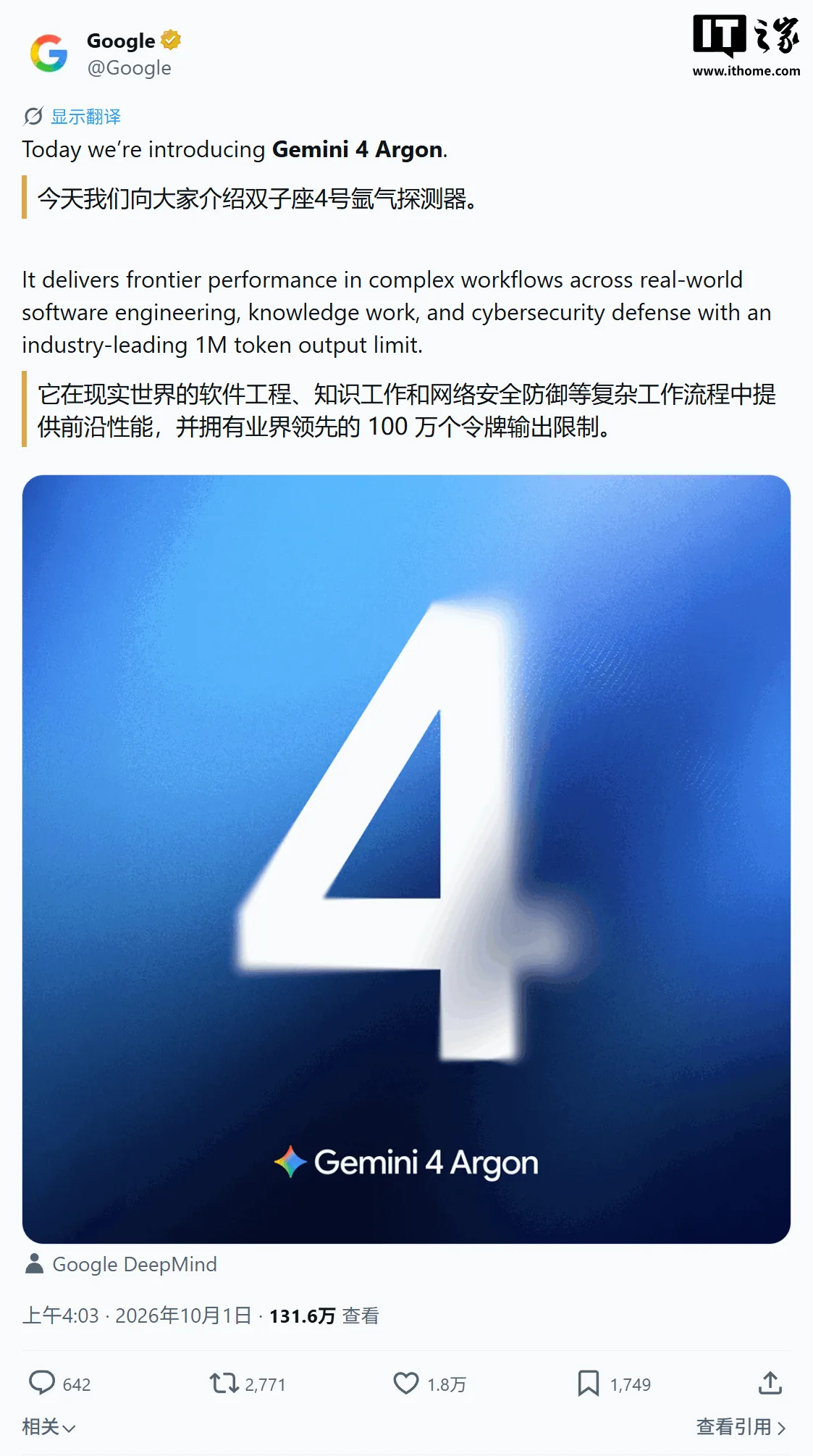
Gemini 4 Argon targets three main areas: long-form software engineering, enterprise knowledge work, and cybersecurity defense. Its technical specs and benchmark scores show significant advancements across multiple dimensions.
- Context window: Up to approximately 1 million tokens per inference—over 15× higher than the previous 64,000-token limit—enabling processing of large codebases and lengthy documents in single passes
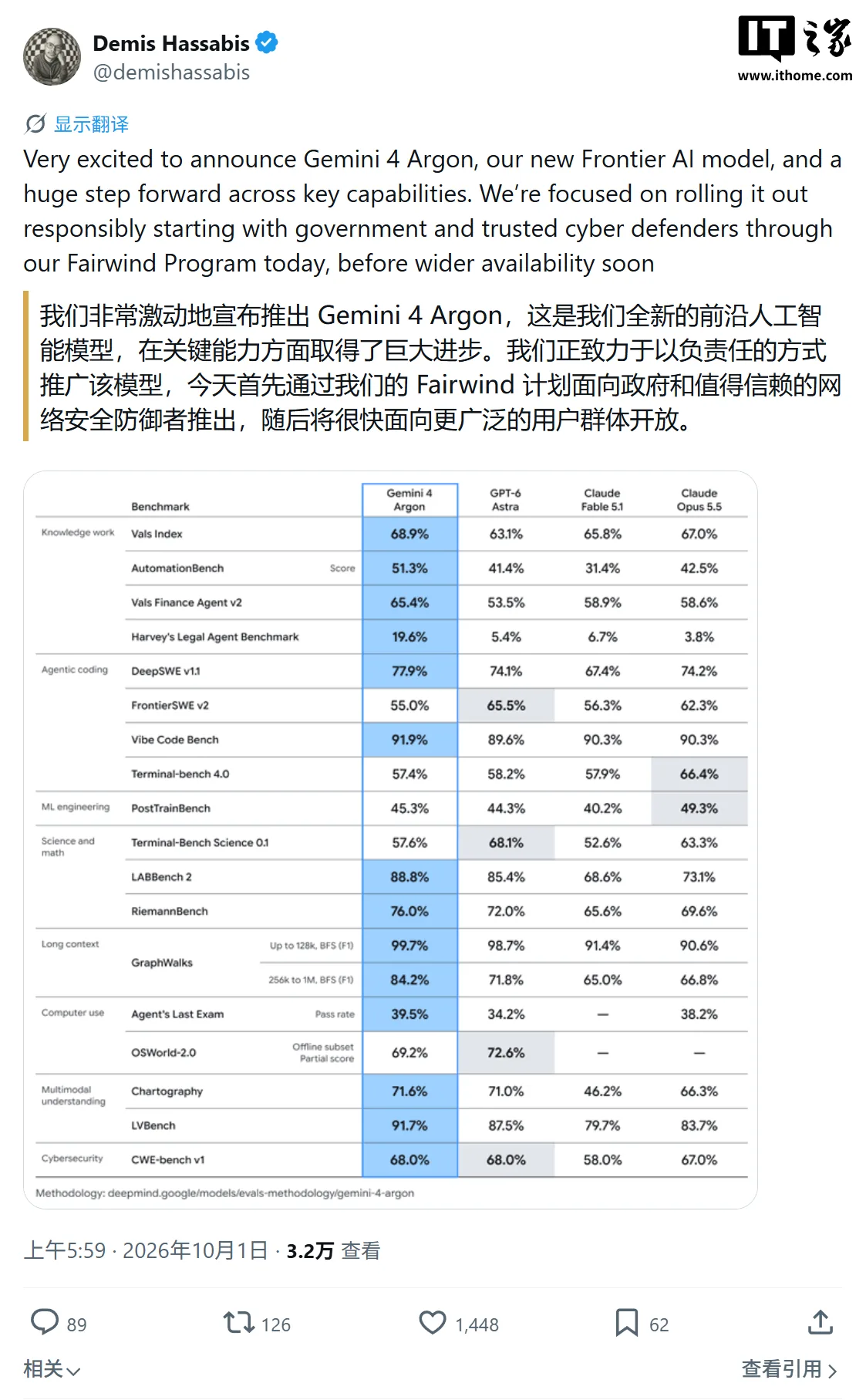
- DeepSWE v1.1 benchmark: Achieved 77.9% score, outperforming Claude Opus 5.5 (74.2%) and GPT-6 Astra (74.1%)
- CWE-bench v1 security test: Scored the top 68%, tying for first place, measuring the model’s ability to patch real-world security vulnerabilities
- Professional task benchmarks: Leads in finance and legal domains according to Google
The large context window serves as Gemini 4 Argon’s primary differentiator, directly enabling its strong performance on DeepSWE and supporting enterprise workloads involving extensive documentation and multi-stage workflows.
Model Comparison Table

| Benchmark | Gemini 4 Argon | Claude Opus 5.5 | GPT-6 Astra | Notes |
|---|---|---|---|---|
| DeepSWE v1.1 | 77.9% | 74.2% | 74.1% | Real-world software engineering test |
| CWE-bench v1 | 68% (tied for 1st) | Not disclosed | Not disclosed | Vulnerability patching capability |
| Context window | ~1,000,000 tokens | Not disclosed | Not disclosed | Previous generation: 64,000 tokens |
Who Should Act Now?
Early adopters with clear use cases:
- Enterprise developers handling multi-thousand-line codebases: Google Cloud API integration can test context-length advantages immediately
- Cybersecurity professionals: Fairwind Program participants will validate practical vulnerability-response workflows
- Google AI Ultra subscribers: Premium access through subscription tier begins now
Recommended to wait:
- Individual users: Most personal workloads don’t require million-token context; wait for Q4 public release to evaluate ROI
- Latency-sensitive applications: No latency or inference speed data was provided; hold off if real-time response is critical
Final Thoughts
Gemini 4 Argon signals a strategic shift in the AI arms race—from raw parameter competition toward contextual specialization. As all major players pursue smarter reasoning, Google’s “wider rather than deeper” approach may redefine expectations for enterprise-scale development workflows over the coming quarter.