
GPT-6 Astra Launches on OpenRouter: Flagship Model Now Accessible
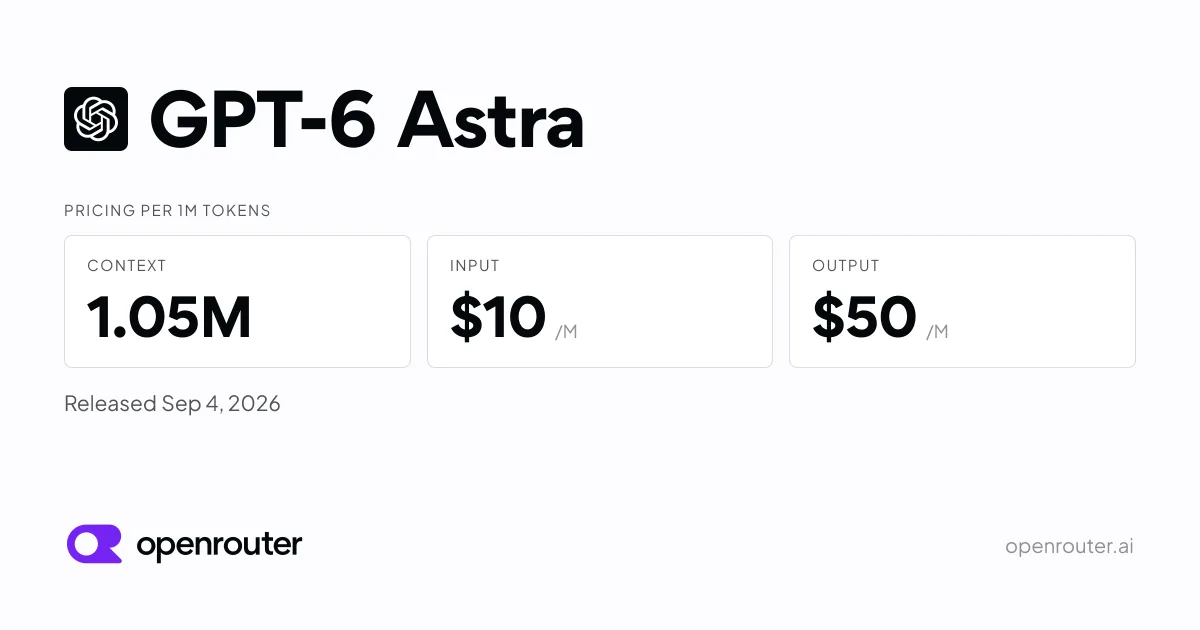
OpenAI’s flagship end-to-end model, GPT-6 Astra, officially launched via OpenRouter on September 4, 2026. As the company’s primary offering for high-complexity tasks, key facts include:
- Release date: September 4, 2026
- Platform availability: OpenRouter
- Input/Output pricing: $10 / $50 per 1M tokens
- Context window: 1 million tokens
- Throughput: 62 tokens per second (P50, highest among providers)
- Latency: 2.10 seconds (P50, lowest among providers)
- Accessibility: API-only—model weights remain closed
GPT-6 Astra positions itself as OpenAI’s latest breakthrough for solving complex end-to-end workflows, particularly excelling at long-horizon agentic tasks requiring multi-step reasoning and tool integration.
Core Capabilities and Performance Metrics
Astra sets new benchmarks across multiple dimensions. Its 1M token context window enables processing of full-length documents, cross-source information synthesis, and long-range dependency modeling—ideal for tasks like reasoning over entire technical specifications or integrated webpage content analysis.
Performance-wise, its throughput of 62 tok/s (P50) ranks highest among all available providers, while its latency of 2.10s (P50) ranks lowest. The standout throughput and latency metrics form the key surprise of this release: most large-context models trade speed for capacity to manage costs, yet Astra achieves both high throughput and low latency at 1M token capacity.
On reliability, OpenRouter implements multi-tier failover: when an upstream provider fails, the system automatically reroutes requests to healthy nodes (subject to user-configured request filters). Developers can programmatically retrieve per-provider uptime statistics via the Endpoints API and customize load-balancing strategies.
Pricing and Capability Comparison
| Metric | GPT-6 Astra | Industry Competitors (Reference) |
|---|---|---|
| Input price | $10 / 1M tokens | $3–$15 / 1M tokens |
| Output price | $50 / 1M tokens | $15–$75 / 1M tokens |
| Context window | 1M tokens | 128K–2M tokens (varies) |
| Throughput (P50) | 62 tok/s | ~40–55 tok/s (typical) |
| Latency (P50) | 2.10s | 2.5–4.0s (typical) |
| Target use | Long-chain agentic tasks, complex analysis | General chat, standard generation |
Note: Table data strictly reflects OpenRouter’s published specifications for GPT-6 Astra. Competitor benchmarks are compiled from publicly available industry figures; no specific model names are implied.
Note that while Astra’s pricing sits at the upper-mid range, its performance premium may be offset by throughput gains in time-sensitive deployments—higher throughput equates to more requests processed per unit time, amortizing wait-time costs.
Who Should Try It Now? Practical Advice
Early adopters should include:
- Developers building multi-step autonomous agents (e.g., agents orchestrrating browser sessions with local tool calls)
- Research/engineering teams generating structured reports from complete PDF/HTML documents
- Production services with strict latency requirements where consistent throughput matters (leveraging Astra’s top-tier P50 metrics for SLA planning)
Consider waiting if:
- Your use case involves single-turn Q&A or short-text generation: existing cheaper models suffice, and Astra’s high output pricing ($50/1M) drastically increases cost
- Budget-constrained startups: 1M-token context remains non-essential for most prototypes—wait for price erosion or secondary versions
A Final Note
GPT-6 Astra signals a shift in end-to-end agent competition, where computational efficiency—measured in throughput and latency—matters as much as raw reasoning ability. As models mature, engineering optimization becomes inseparable from algorithmic innovation.