
OpenAI Unveils GPT-6 Astra: Symbolic World Models Drive a Benchmark Breakthrough
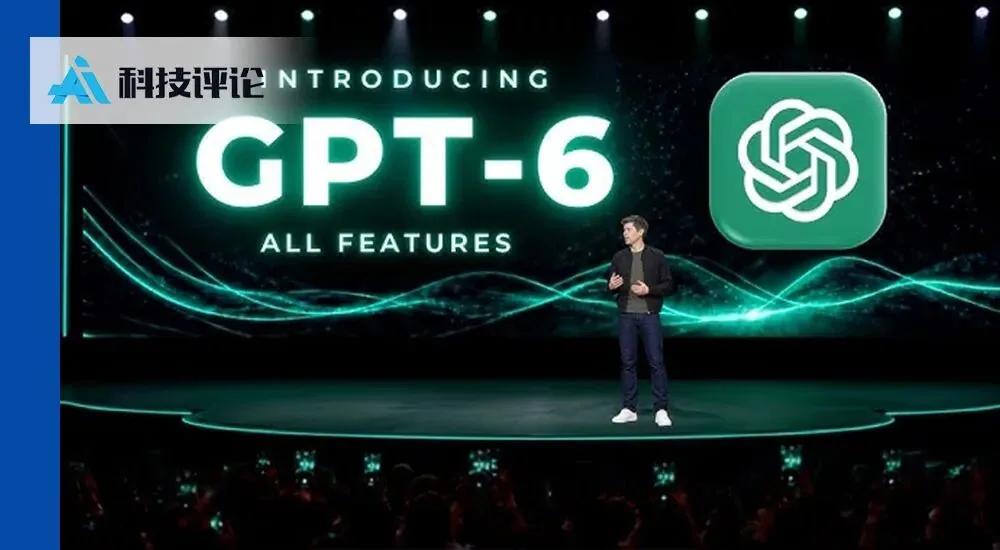
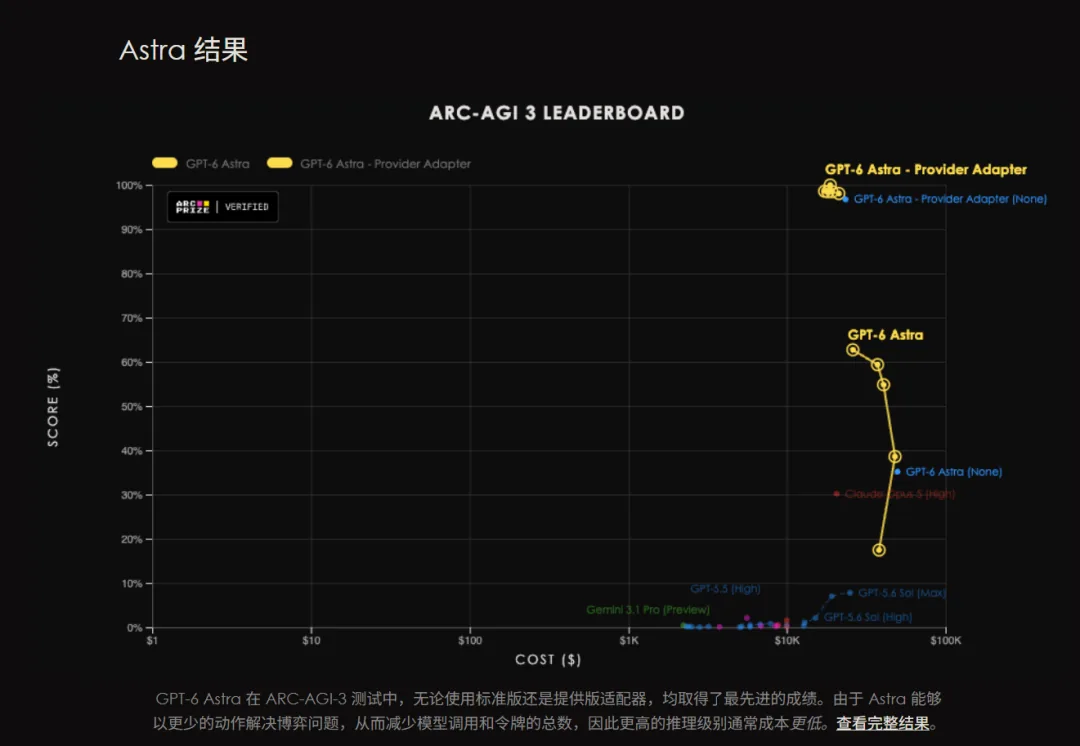
OpenAI has recently presented GPT-6 Astra, described in the source material as its strongest model so far. The model is said to have made notable progress in computer operation, scientific inquiry, and safety defense, but the most debated result is its near-100% score on ARC-AGI-3. The benchmark is framed as a high-level test of AI “intelligence,” built around changing visual-pattern puzzles that require an agent to explore unfamiliar environments, infer goals, and reason on the fly rather than rely on memorization.
Key facts:
- Model name: GPT-6 Astra, preceded by GPT-5.6 Sol
- Core result: GPT-5.6 Sol scored 38.3% on ARC-AGI-3, while GPT-6 Astra approached 100%
- Efficiency: GPT-6 Astra used 51.7% fewer actions than humans on average and was more efficient than humans in 96% of levels
- Technical approach: a Symbolic World Model, which abstracts the environment into logical symbols and causal codes
From Brute-Force Trial and Error to Structured Simulation
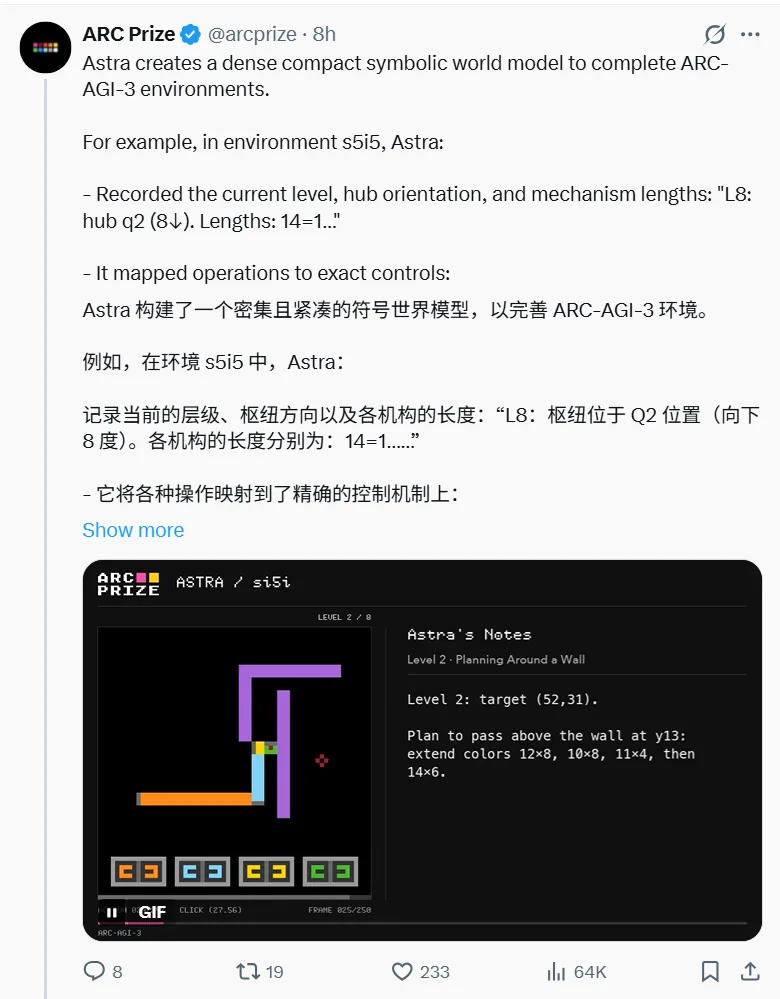
Unlike earlier approaches that often relied on brute-force trial and error—splitting game screens into pixel blocks and repeatedly trying actions—GPT-6 Astra appears to use more structured symbolic reasoning. According to the source, when entering an unfamiliar visual game, it creates its own DSL, a domain-specific algebraic notation system, to record hidden rules, planned action sequences, and even pixel trajectories mapped onto coordinates.
The value of this symbolic record is that it reduces ambiguity compared with natural-language descriptions and makes deterministic reasoning easier. The model then builds an internal “virtual sandbox,” using generated Python-style logic to simulate possible actions before acting. For example, it may infer that “if A is pressed, the figure rotates 90 degrees left,” verify the logic internally, and only then execute the step in the actual game. This planning process helps explain why it can solve levels with fewer actions.
The source also notes that earlier high-end reasoning systems often depended heavily on external Harness frameworks for screen translation, state tracking, and result verification. These setups can introduce latency, remain disconnected from model-weight training, depend on cloud environments and external scripts, and are hard to deploy on edge devices. GPT-6 Astra is described as beginning to internalize some of these Harness-like capabilities into the model itself.
The $360 Cost: Benchmark Success Is Still Expensive
The result is impressive, but the cost is a major caveat. The source states that GPT-6 Astra consumes $360 in compute for each game run. Completing a full test would cost $18,000, or about RMB 135,000. By comparison, a human may solve a visual puzzle in a few minutes; measured only by the brain’s roughly 20W metabolic power, the electricity cost is less than half a cent. Even including real hourly compensation for test participants, the cost is $12.78 per game.
| Test subject | Cost per game/question | External assistance |
|---|---|---|
| GPT-6 Astra | $360 | Uses a custom vendor adapter base and related support mechanisms |
| Human participants | $12.78 | No |
ARC Prize discussions also point to a shared technical recipe behind many high-scoring systems: lossless memory, programmatic analysis, explicit hypothesis testing, persistent state, and low-cost internal computation. Teams such as PRO-LONG, Tycho, and Prime Agent have reportedly achieved scores above 90% on ARC-AGI-3 with similar Agent Harness approaches. In other words, today’s high scores are not simply proof of a standalone model’s raw intelligence; they are often the result of a model working together with external frameworks, context compression, long-running dialogue, and internal computation mechanisms.
AGI, or Just a Master of Visual Puzzles?
Research and industry interest in symbolic world models is growing, with the source mentioning work and attention from Harvard, MIT, and Google DeepMind. Meanwhile, OpenAI president Greg Brockman’s phrase “AGI is here” was widely circulated, but ARC Prize Foundation president Greg Kamradt pushed back. From a benchmark-design perspective, he argued that the score may be real, but it remains far from proving artificial general intelligence.
The essence of general intelligence is the ability to adapt to unknown worlds. Humans can keep learning in unfamiliar environments and transfer experience to new tools, rules, and social systems. An AI approaching a perfect score on visual-pattern puzzles does not automatically mean it can transfer that ability to open-ended domains such as autonomous-driving decisions or drug discovery for a novel virus. Another concern is opacity: as GPT-6 Astra’s reasoning process becomes harder to inspect, developers may struggle to tell whether it truly understands the rules or has found a more efficient shortcut.
Practical Takeaway: Research Teams First, Broad Deployment Later

- Who should explore now: AI research labs and large-model engineering teams can study Harness-style development patterns for logical inference and tool-chain prototyping.
- Who should wait: Industry application developers and general users. The current cost, reliance on support systems, and black-box reasoning limit near-term deployment.
Closing Thoughts
GPT-6 Astra’s symbolic world model suggests that AI is moving from pattern matching toward more sophisticated causal reasoning and internal simulation. For now, however, it looks more like an exceptional exam-taker in a specific test environment than a universal learner that can adapt to any world. Between benchmark success and genuine AGI, major challenges remain in generalization, cost reduction, and interpretability.