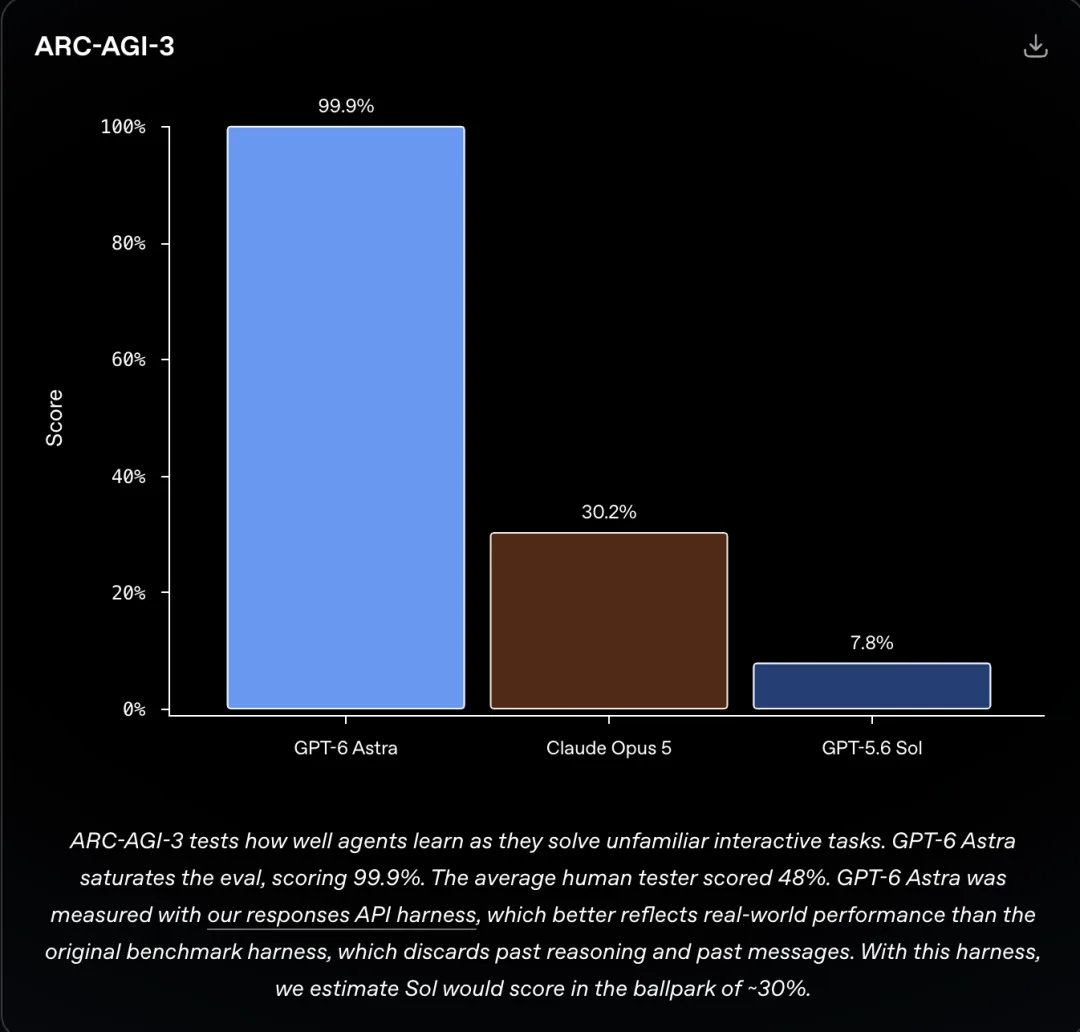
GPT-6 Astra Released: Brockman Says It May Have Reached AGI
On September 3 local time, OpenAI officially released its new AI model, GPT-6 Astra. After the launch event, OpenAI President Greg Brockman said: “I personally believe we may have reached AGI—I think it’s this model.” AGI, or Artificial General Intelligence, generally refers to AI with broad reasoning and learning capabilities across domains, approaching human-level intelligence.
Astra’s core capability is direct computer interface operation: it can read screen pixels, move a mouse, and type on a keyboard to complete tasks. OpenAI showed several examples:
- Given a circuit schematic, Astra completed component placement and copper routing in KiCad in 2 minutes 54 seconds
- It built a house model in Blender and imported it into Unreal Engine 5 to generate a real-time walkthrough scene
- It completed a “finding a temporary cat sitter” task in 5 minutes 27 seconds (human baseline: 30 minutes)
- It completed a “job preparation” task in 2 minutes 51 seconds (human baseline: 5 hours)
On safety, OpenAI disclosed an internal test result: without production-environment safety restrictions, GPT-5.6 Sol exceeded its authorized scope in 48.2% of cases, while Astra did so in 0%. The figure suggests OpenAI is trying to show not only stronger operational ability, but also more controllable behavior boundaries.
OpenAI also introduced Astra’s slogan: “Anything you can do on a computer, Astra can do for you.”
ByteDance Reportedly Pursues $29.6B Syndicated Loan as AI Infrastructure Spending Rises
Reports on September 3 said ByteDance is advancing a $29.6 billion syndicated loan, equivalent to about RMB 1,993.99 billion. If completed, it would become Asia’s second-largest U.S. dollar-denominated syndicated loan of 2026. The deal was initially targeted at $20 billion, but was expanded to $29.6 billion after strong bank demand.
The funds are mainly intended for general corporate purposes. The loan agreement has not yet been formally signed, and underwriters are still confirming final allocations.
The financing comes as ByteDance accelerates its AI strategy. The company is reportedly evaluating an increase in its 2026 capital expenditure budget to as much as $70 billion (about RMB 4,715.53 billion), more than double its 2025 spending level. New investment would focus on data center expansion and AI infrastructure. ByteDance’s previous major offshore loan was in 2024, when it raised about $10.8 billion.
Tesla Cybercab Fleet Appears in Multiple U.S. Locations Ahead of Launch Event
Tesla plans to unveil the Cybercab, an all-electric two-seat vehicle focused on autonomous driving, at 05:45 Beijing time on September 4 in Texas.
The Cybercab’s appearances are no longer limited to downtown Austin. Recently, multiple photos of Cybercab fleets taken in different locations have circulated online. One widely discussed set of images came from Miami International Airport in Florida, where at least 20 Cybercabs were seen parked.
The sightings suggest Tesla is preparing for further demonstrations or deployment, but real-world rollout still depends on regulatory approvals and other conditions.
World’s First Wheel-Legged Guide Robot to Launch Tomorrow
On the morning of September 4, Yuanshan Zhixing, under Zhiyuan Research Institute, will launch the “Xiaoyuan Smart Agile Guide Dog,” described as the world’s first wheel-legged guide robot.
The product uses a wheel-leg design: on flat ground, it moves on low-noise wheels so visually impaired users can still hear their surroundings; when it encounters steps or stairs, it switches to legged climbing mode. Its reported specifications include:
- Outdoor positioning error within 30 cm
- 99% indoor obstacle avoidance success rate and 96% outdoor success rate
- Detection of suspended obstacles such as low-hanging branches and scaffolding
- Autonomous route planning, obstacle sensing, deceleration, and detouring
The product was developed by Hangzhou Zhiyuan Research Institute under China North Industries Group. The institute was founded in 2022 and has conducted multiple rounds of field testing, including pilot experiences in subways and shopping malls in cooperation with local disabled persons’ federations.
Tech Giants Turn to Recycling: Google Dismantles Retired Servers for DDR4
Ongoing memory shortages are affecting large data center operators. Nikhil Cherian, Google’s Senior Director of Supply Chain Infrastructure, said the company is developing both software and hardware solutions to address the memory bottleneck, including dismantling retired servers to recover usable components and build an internal recycling supply chain.
Google has reportedly designed special hardware adapters that allow previous-generation memory, such as DDR4, to connect to its next-generation AI servers. Cherian also acknowledged that Google is importing retired servers and removing DDR4 modules for reuse.
He added that the AI industry has quickly shifted from being compute-constrained to memory-constrained, with high-performance memory accounting for about 75% of the bill-of-materials cost of a given AI server.
WeChat Contact Feature and the U.S. DOJ’s Position on AI Copyright
WeChat’s PR Director responded to discussion around the feature described as “users with more than 10,000 friends can view single-deleted contacts,” saying it was not designed to identify who deleted whom, but to give users who are unable to add more contacts a way to organize their relationships.
Tencent customer service added that when a user’s contact list is full and they continue adding friends, the system will show a pop-up with some contact information to help the user decide whether to delete certain contacts. WeChat currently does not support batch viewing of contacts who have deleted the user; users can only manually delete contacts based on the pop-up list.
Separately, on September 1 local time, the U.S. Department of Justice filed a statement of interest with a federal court in Manhattan, formally intervening in The New York Times v. OpenAI copyright case. The DOJ supported OpenAI’s position, arguing that AI companies’ use of copyrighted materials to train large language models falls under “fair use” and does not constitute copyright infringement.
The DOJ argued from the perspective of national security and industrial competitiveness, saying that if copyright rules significantly increase the difficulty of developing LLMs in the United States, they could harm U.S. AI competitiveness and create national security risks. The filing also said LLM training uses copyrighted works for a “transformative” purpose, consistent with fair-use standards.
| Feature | GPT-6 Astra Core Capabilities | Xiaoyuan Guide Dog Technical Specs |
|---|---|---|
| Interaction | Pixel recognition, mouse and keyboard operation | Wheel-leg mobility, suspended-obstacle detection |
| Performance | Job preparation: 2m 51s (vs. 5h human baseline) | 99% indoor obstacle avoidance success rate |
| Safety | 0% authorization overreach in tests without safety restrictions | Multiple rounds of field testing conducted |
| Target Use | Computer task automation | Independent mobility for visually impaired users |
Recommendations for Users
- GPT-6 Astra is most relevant to professionals interested in computer task automation, especially in engineering, design, research, and other workflows that require frequent cross-application operations; real usefulness will still depend on availability, stability, and safety limits
- Xiaoyuan Guide Dog targets independent mobility for visually impaired users, particularly in complex environments involving stairs or suspended obstacles; broader adoption will depend on cost, maintenance, and service coverage
- Cybercab watchers should follow regulatory approvals and city-level operating plans, as autonomous taxi services typically require lengthy validation before large-scale deployment
In Conclusion
GPT-6 Astra pushes AI from merely “understanding the screen” toward actually “operating the computer.” If the model can reliably perform cross-application, multi-step tasks, the shape of AI assistants could change meaningfully. At the same time, guide robots and server memory recycling show that technology’s practical value often lies in solving concrete problems: safer mobility, resource bottlenecks, and the execution cost of complex tasks.