
GPT-6’s 3D Hype Reversed: From “Generating 2,234 Parts” to “Using Existing Models”

The 3D creation frenzy sparked by GPT-6’s release has been debunked. The widely circulated human anatomy webpage case—allegedly generating 2,234 human body parts by GPT-6—was in fact using an existing professional 3D dataset. GPT-6’s strength lies not in generating complex assets, but in orchestrating tools, scenes, and interactive logic.
Core facts:
- GPT-6’s actual capability: Build Three.js scenes, call Blender via Computer Use, but produces coarse models
- Hyper3D Rodin’s strength: Handle complex shapes, detailed surfaces, complete meshes, and textures for real-world objects
- Key reversal data: Rodin generated 18 new body parts with 46 selectable regions; GPT-6 alone produced only a “transparent mannequin with monochrome matte material” version
From Human Anatomy to Street Scenes: A New Agent Workflow
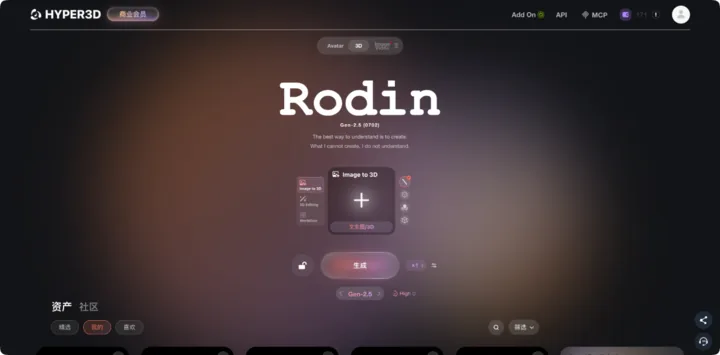
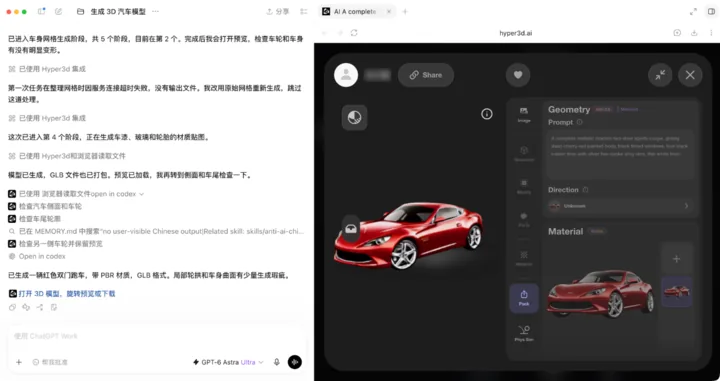
Hyper3D MCP decomposes the generation process into familiar LLM tool calls: submit task, query progress, inspect result, split components (via BANG), download model. Codex (GPT-6 interface) treats this as routine as search or code execution.
Deployed workflows include:
- Human Anatomy Viewer: 18 Rodin assets, 46 selectable regions, 12-second auto demo
- Disassemblable Steam Beetle: Deep green enameled shell + brass edges + rivet textures; BANG拆解 gears/pistons/boiler
- Orange Cat Bullet Time: Single cat + single fish, replicated 8 fish trajectories + green cinematic lighting
- Guangzhou Arcade Street: 5 independent assets (2 buildings, breakfast cart, stone lion, banyan tree pot), staged装配
- Shadow Puzzle Game: Deer-antler teapot projection + silhouette matching + seal feedback; 3 levels reuse same model
Rodin Gen-2.5 vs GPT-6: The Material Detail Gap

| Capability | Hyper3D Rodin Gen-2.5 | GPT-6 (direct) |
|---|---|---|
| Human Form | Integrated muscle/skeleton/blood vessel structure | Transparent mannequin with organs placed separately, anatomically inaccurate |
| Material | PBR: full records of color, bump, metalness, roughness | Uniform monochrome matte, severe detail loss |
| Disassembly | BANG recursive split: auto-generates interactive parts | No split function, only whole-body movement |
| Detail Level | Continuous contours, muscle fiber texture, organ surface roughness | Clearly cheap at a glance, low冲击力 up close |
Key term: PBR (Physically Based Rendering) is a rendering technique that simulates real-world light reflection to achieve photorealistic surfaces.
Who Should Try Now? Who Should Wait?
Ready to adopt:
- Educational website builders: Need detailed organ/skeleton models for teaching
- Indie game developers: Need custom props (e.g., deer-antler teapot) without searching marketplaces
- E-commerce/product visualization: Need rapid generation of high-fidelity PBR-enabled assets
Wait first:
- Workflows needing frequent real-time scene editing: Hyper3D focuses on generation, not editing
- High-frequency bulk generation: MCP workflow requires waiting for status feedback
Final Thoughts
With 3D generation no longer requiring manual asset procurement but becoming a standard Agent tool call, the production start point shifts from “finding models” to “describing needs”. Skymedia (Hyper3D’s parent company), through CAST—which won SIGGRAPH 2025 Best Paper—and its evolved WorldGen, is closing the loop from “AI generation” to “industrial readiness”—not just for objects, but entire scenes. This collaboration’s true significance may lie beyond the demo, pointing toward what happens when 3D finally joins text/image/video as a native agent capability.