
Huawei Cloud Three Core Launches: Timeline and Key Info
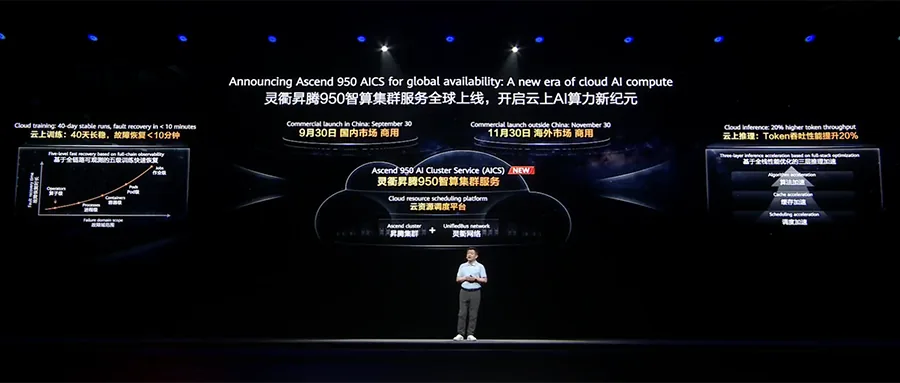
At the 2026 Huawei Connect Conference, Huawei Cloud introduced several new infrastructure offerings for the agent era:\n
- Lingqu Ascend 950智算 Cluster Cloud Service: Available for Chinese customers on September 30; global rollout for overseas markets on November 30\n- CMS Memory System for Agents: Expected Q1 2027 in China; features PB-scale memory storage and TB-level memory read throughput\n- AgentArts Enterprise Agent Platform: Fully commercialized in China;海外 launch scheduled for December 30\n- SCALE Partner Support System: Includes SMECE Enterprise Compute Engine and DCS AI Solution; launched on-site
Key specs: The Ascend 950 ultra-node supports 1024-card high-speed interconnection and scales to 100,000-card clusters. Cluster availability exceeds 99.5%, with fault recovery under 10 minutes for 10,000-card systems. The Lingqu network enables ultra-high bandwidth communication.
Agent Memory and the New Infrastructure Paradigm
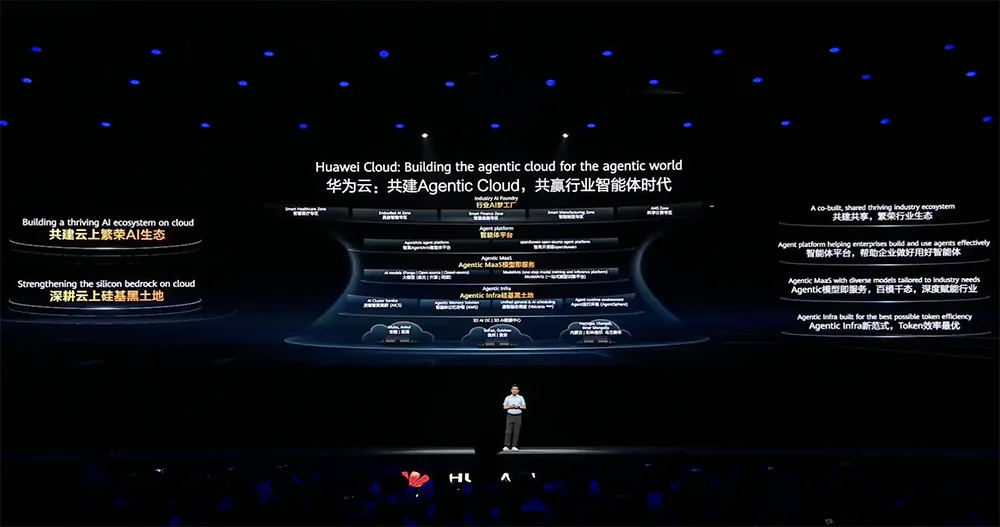
Agents require efficient memory to avoid redundant computation and improve efficiency. Huawei’s CMS Memory System delivers PB-level memory capacity, AI-native semantic storage modules, and TB-level memory read speeds.
The memory module, based on Huawei’s self-developed chip, connects directly to NPU and HBM via Lingqu bus, dynamically adjusting SSD tier ratios for optimal performance and energy efficiency. Partner优艾智合 demonstrated the module via its robot Xiao You.
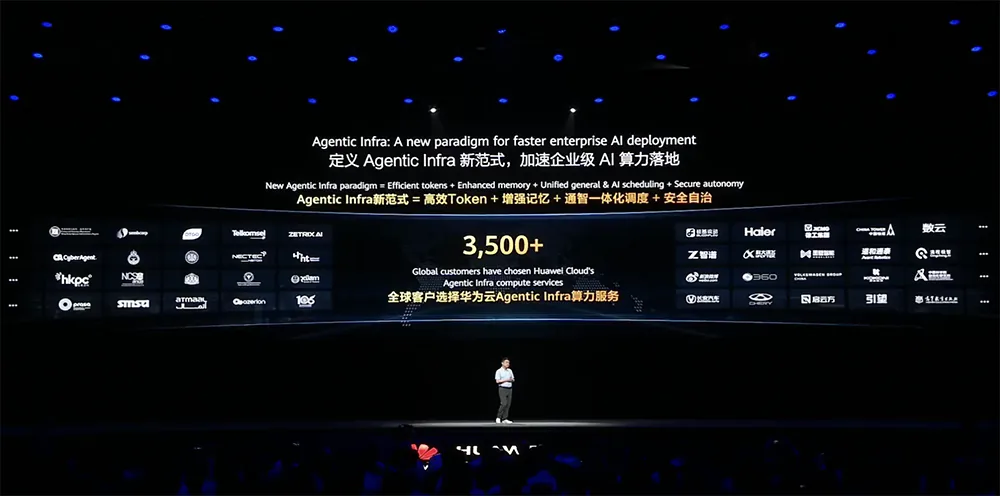
Huawei Cloud introduced the Agentic Infra paradigm, covering efficient token processing, enhanced memory, homogeneous/heterogeneous compute orchestration, and autonomous secure runtime environments. CEO Zhou Yuefeng noted: “Being intelligent isn’t just about fast reaction—it’s about good memory.” This analogy highlights the evolution of infrastructure for AI agents.
Notably, while the cluster demonstrates “40-day continuous training stability”, its Token throughput improvement remains at just 20%+ year-over-year—indicating that real-world scalability still depends on ecosystem maturation rather than chip-level breakthroughs.
Ecosystem and Real-world Deployments: From Kingsoft Office to Nanjing Iron and Steel
As of the event, over 3,500 customers use Huawei Cloud’s Agentic Infra compute services, and AgentArts (including open-source) serves more than 100 Chinese enterprises.
Kingsoft Office leveraged AgentArts and Agentic Infra to build a full-stack architecture integrating WPS 365 and WPS Comate capabilities. Joint projects include the Wuhan Cloud smart city flagship initiative.
Industry implementations demonstrate methodological effectiveness:\n
- Nanjing Iron and Steel achieved end-to-end intelligent supply chain and production from mining to smelting
- Guangdong Medical Group deployed large language models and specialized drug-research agents using Ascend ultra-nodes and Kunpeng supercomputing
- Shenzhen Hekou College focuses on operator innovation, auto-tuning tools, and Ascend talent development
Vice Chairman Tao Jingwen introduced the DIMAK engineering framework, supporting three key transitions: General Intelligence → Enterprise-specific Intelligence → Trustworthy Action → System-level Enterprise Intelligence.
SCALE Partner Framework: Five Dimensions to Break Implementation Bottlenecks
Huawei VP Chen Lei unveiled SCALE, addressing five partner challenges:\n
| Dimension | Solution | Core Capabilities |
|---|---|---|
| Scenario Solutions | SMECE Engine | Hard/soft compute isolation; 63 concurrent business streams per card; 2-14x utilization uplift; hardware-grade security |
| DCS AI Solution | 80% data processing cycle reduction; 30% higher inference throughput; model gateway scheduling | |
| Joint Innovation | Reference Architectures | 48 value scenarios; OpenLab integrated testing |
| Joint Marketing | Pilot Points | Demonstrable, verifiable, replicable |
| Consistent Service | O3 Partner Platform | Tool alignment;协同 maintenance; standardized training |
Key tools: AI-assisted configuration cuts design time from hours to minutes; AI-driven predictive maintenance enables proactive operations.
Springondo has launched a smart factory digital platform integrating Huawei infrastructure and its own industrial expertise.
Who Should Pilot Now? Implementation Guidance
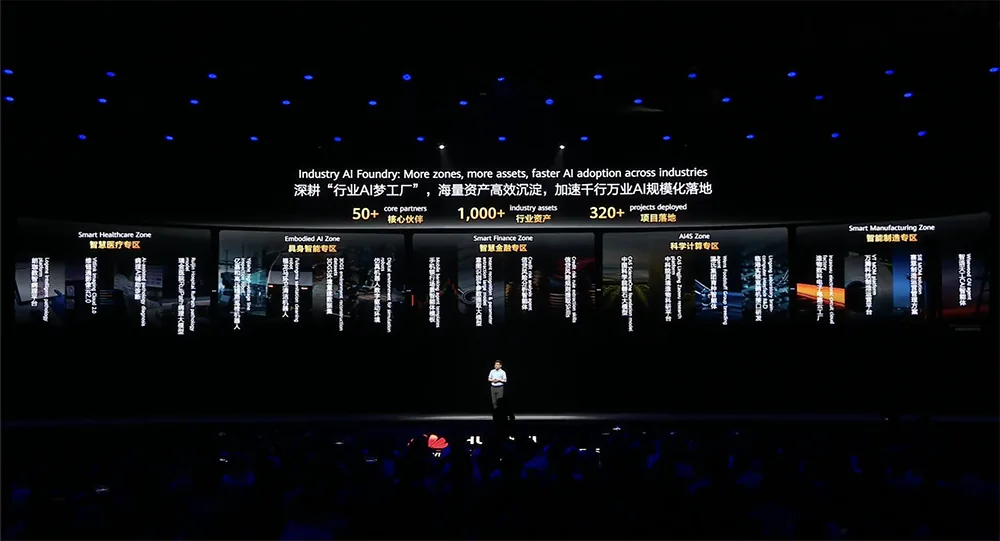
- Deploy sooner: Enterprises with validated AI value scenarios (document intelligence, manufacturing optimization, AI drug discovery); research institutions needing highly available compute clusters\n- Wait and watch: Early-stage explorers lacking clear AI adoption paths; applications with strict real-time latency requirements demanding >20% performance leaps
Final Thoughts
The agent-scale bottleneck has shifted from technical feasibility to ecosystem coordination capability. Huawei’s “non-overstep, non-miss” positioning and DIMAK framework aim to transition AI from standalone demos to system-wide value—where success lies not in raw compute metrics but in partner enablement and secondary innovation capacity.
(1,428 words)