
Core Upgrade: On-Device Local LLMs Officially Deployed

On September 9, 2026, Huawei officially confirmed that the Pura X View and Mate XT 2 Premium Master series smartphones now support on-device local large model download and deployment. This feature is delivered via the HarmonyOS 7.0.0.102 SP8 system update, with users able to inspect local model versions, parameter sizes, and service scenarios directly in device settings. The upgrade incurs no additional cost and opens automatically upon system compatibility checks.
Key factual highlights:
- Release date: September 9, 2026 (official announcement date)
- Eligible devices: Pura X View, Mate XT 2 Premium Master editions
- System version: HarmonyOS 7.0.0.102 SP8
- Model options: Two on-device LLM variants available for voluntary download
- Network requirement: Fully offline operation; service availability unaffected by connectivity
- Architecture: Pure endpoint AI inference, no cloud dependency required
On-Device AI Capabilities: Dual-Model Architecture for Varied Needs
Huawei’s latest on-device AI deployment implements a dual-model architecture, allowing users to select based on storage capacity and usage requirements:
Multimodal Enhanced Model (~6GB): Designed for高频 lightweight tasks
- Local image generation and speech synthesis
- Camera AI super-resolution enhancement
- Intelligent album retouching
- Human voice synthesis for reading and announcements
Multimodal Mixture-of-Experts Model (~15GB): Handles complex orchestration
- Local MoE (Mixture-of-Experts) architecture
- Complex instruction understanding and task decomposition
- Application-layer control interfaces
- Offline photo organization with intelligent categorization
MoE (Mixture-of-Experts) is an efficient architecture that uses gating mechanisms to dynamically activate subsets of parameter experts during inference, maintaining high quality while substantially reducing computational load.
Model Comparison: Storage Versus Capability Trade-offs
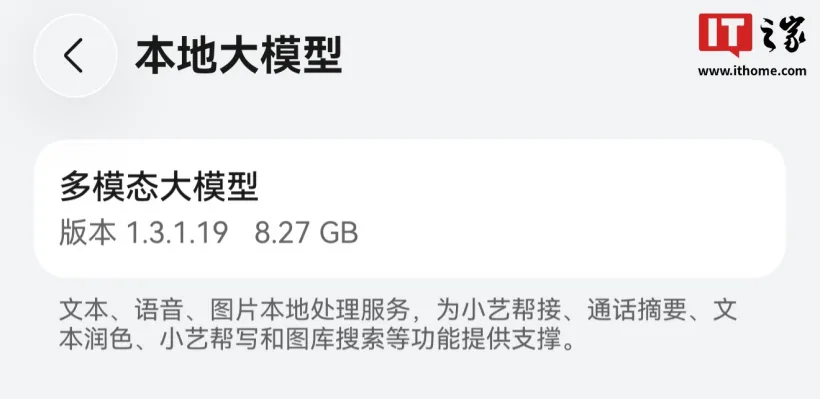
The two models show clear differentiation in storage and functional weighting:
| Model Name | Storage Footprint | Core Capability Focus | Typical Use Cases |
|---|---|---|---|
| Multimodal Enhanced Model | ~6GB | High-frequency lightweight services | Real-time camera optimization, batch photo processing, voice announcements |
| Multimodal MoE Model | ~15GB | Complex task understanding and execution | Offline photo categorization, multi-step command interpretation, cross-app task orchestration |
Notable counterintuitive point: HarmonyOS 7.0’s on-device AI service does not pre-install large models by default; instead, it provides a voluntary download interface. This means users can first trial the 6GB base model, assess storage impact and functional fit, then decide whether to install the 15GB advanced variant—a progressive deployment strategy that prevents unnecessary storage pressure.
Practical Guidance: Match Selection to Usage Patterns
- Users recommended to upgrade immediately: Creators relying heavily on camera capture and image management with sufficient storage (≥20GB free space recommended); business professionals frequently using voice announcement features.
- Users advised to delay: Those with constrained storage (e.g., 128GB base variants) and minimal photography/video processing needs;普通 users lacking clear demand for offline AI capabilities.
- Key note: Models are managed independently within system settings post-download, supporting separate uninstallation and updates—no system instability concerns from installation errors.
Final Thoughts
On-device LLM deployment marks a pivotal shift from “cloud-dependency” to “end-cloud collaboration”. By standardizing local AI capabilities across devices via HarmonyOS 7.0, Huawei establishes a practical framework for high-privacy scenarios while laying technical groundwork for broader industry adoption of endpoint AI ecosystems.