
Core Event: Physical AI Coordination Framework Report Released

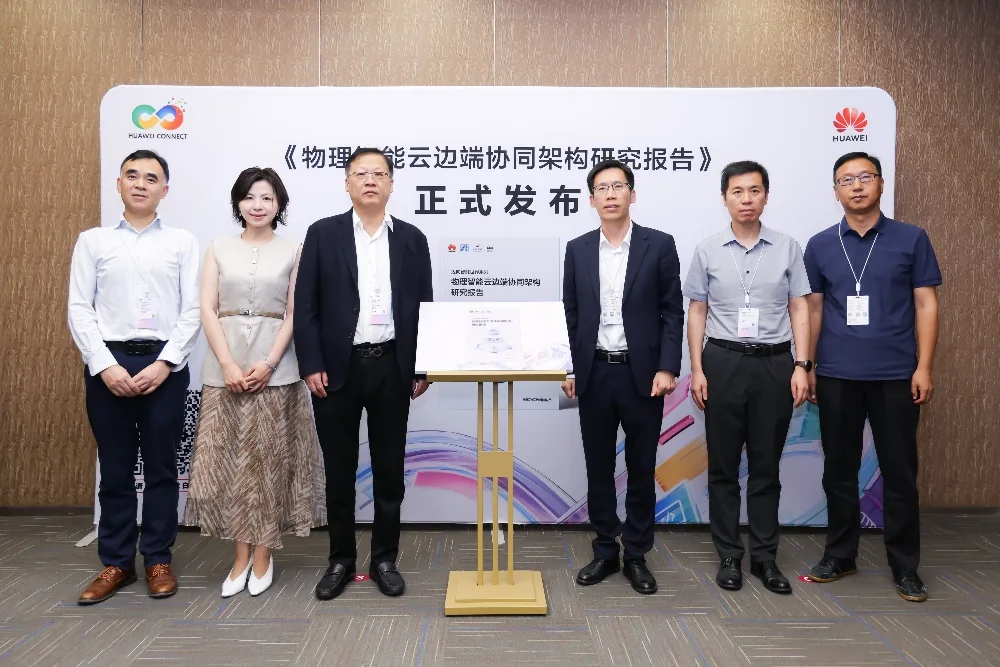
On September 18, Huawei, together with the China Academy of Information and Communications Technology, the Shenyang Institute of Automation of the Chinese Academy of Sciences, the Global Computing Consortium, and EY China, released the “Physical AI Cloud-Edge-End Coordination Architecture Report” at HUAWEI CONNECT 2026.
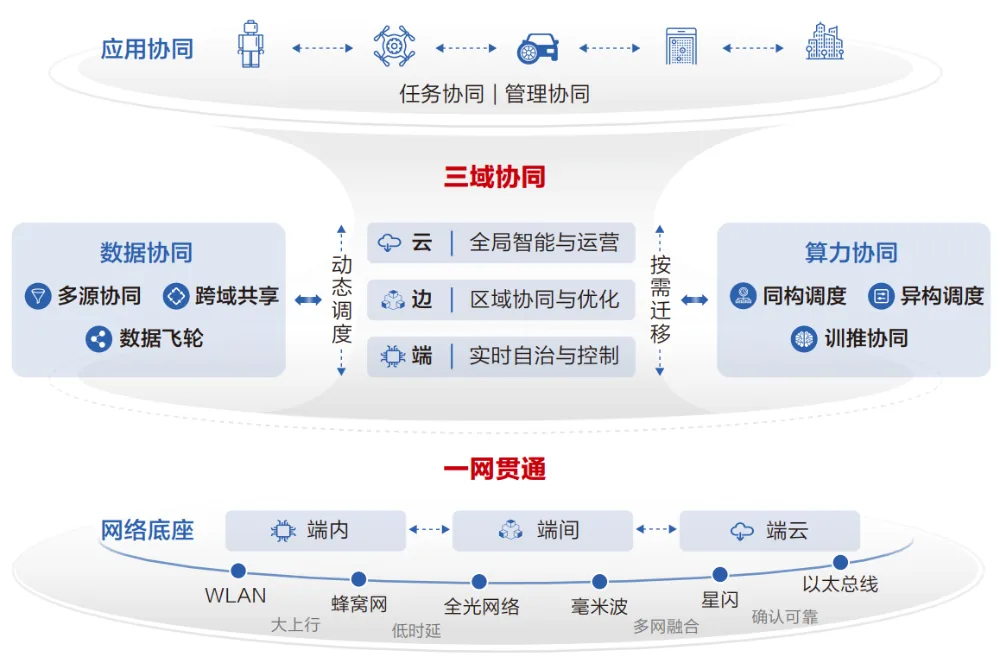
The report identifies the key bottleneck in physical AI规模化 deployment and proposes a systematic solution centered on the core proposition of “three-domain synergy and one-network integration"—application, data, and computational domain synergy, supported by an integrated network spanning end, edge, and cloud using TSN, 5G-A,urrences, and Industrial Ethernet.
Key highlights:
- Three-domain synergy: Application (task splitting and scheduling), data (multi-modal data alignment and sharing), and compute (heterogeneous resource orchestration) coordination
- One-network integration: End-inner network for millisecond-level transmission, end-to-end network for multi-device collaboration, and end-cloud network for uplink/downlink data and command flow
- Three-phase rollout: Near-term (end+cloud-focused for retail, inspection); Mid-term 2028–2030 (regional autonomy with “one brain for multiple robots”); Long-term (dynamic coordination for distributed intelligent networks)
Why Coordination Is the Bottleneck
The report defines physical AI as the capability system where AI performs perception, understanding, reasoning, planning, action, and feedback闭环 in real physical environments—carried by robots, autonomous vehicles, smart spaces, and industrial automation equipment.
Its core challenge is the tradeoff between “real-time performance” and “complexity”:
- End-side limits: computing, power, cost, and space constraints
- Cloud-side limitations: large model inference latency cannot meet millisecond-level industrial control requirements
- Task heterogeneity: the six layers (perception, decision, execution, coordination, learning, operations) operate at vastly different frequencies—no single node can complete the闭环
A striking contrast reveals the reality gap: Only 4% of humanoid robots shipped in China in 2025 were deployed in actual industrial logistics work, while 42% went to R&D/education and 19% to interactive displays—even as investment surged, with 218 disclosed deals totaling over RMB 57.7 billion in the first five months of 2026, exceeding the full-year 2025 total of 357 deals.
Huawei’s IC New Business Incubation Division President Zhai Guangle noted: “Bolt runs 100m in 9.58 seconds, robots achieve 9.36s; but robots struggle to tighten screws on production lines.” Performance (speed, height) can be stacked at single points; capability (precision, adaptation) requires system-level coordination. Precision manufacturing needs 0.1–0.2mm accuracy requiring synchronized vision, touch, force, and dexterous hands—beyond single-device capability.
How Coordination Solves the Puzzle
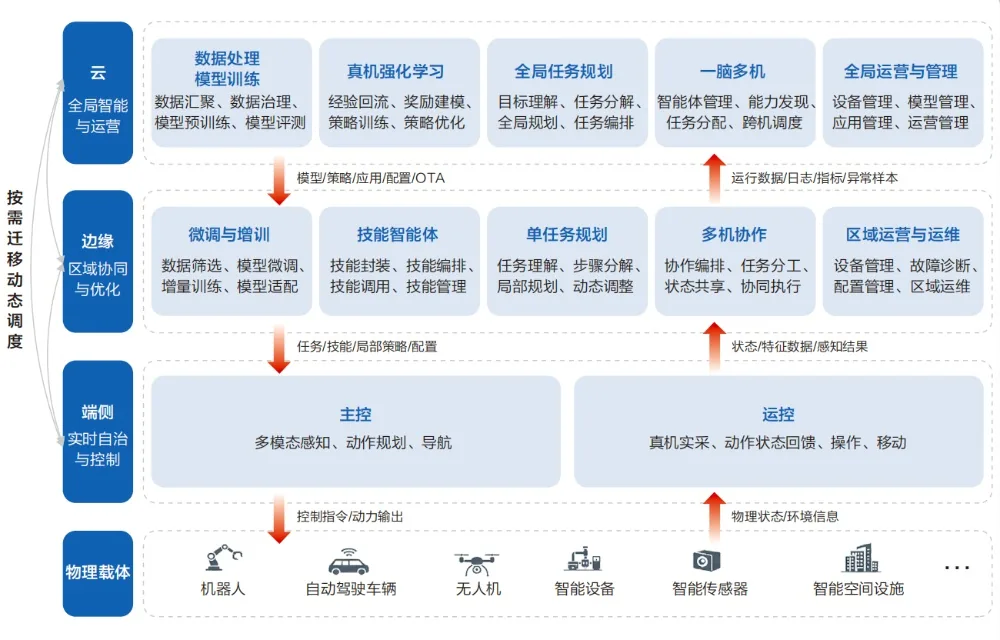
The report proposes a layered architecture:
- End-side: Micron/millisecond-level real-time perception and high-frequency motion control—solving “speed” and “safety”
- Edge-side: Regional hub for data aggregation, local model fine-tuning, multi-robot coordination, and offline autonomy—solving “stability” and “connectivity”
- Cloud-side: Global brain for model development, trajectory planning, and operations—solving “strength” and “intelligence”
Network integration is the foundation. The report emphasizes integrating four technologies:
- Wi-Fi 7 (StarLink/星闪): Microsecond latency and ultra-reliability for in-robot sensor-controller wireless interconnect
- Industrial Ethernet (e.g., EtherCAT): Sub-microsecond jitter for deterministic synchronization of precision production equipment
- 5G-A: Massive uplink bandwidth and millisecond latency for sensor data回传 and global command delivery
- TSN: Unified wired backbone providing deterministic scheduling and time synchronization for all traffic types
Through layered coordination, the architecture reduces reliance on single-point computing while simultaneously achieving deterministic latency, complex reasoning, multi-robot coordination, and global optimization.
Real-world Implementation
The framework has already been put into practice. Huawei, with the National-Humanoid-Robot Innovation Center, unveiled “Qilin Training Field” at WAIC 2026—the nation’s first heterogeneous humanoid robot training ground.
Its core is the “real-machine data feedback—cloud training—edge/end model deployment” flywheel:
- Cloud: Ascend large-scale AI compute for pre-training
- Edge: Real-time inference support
- End: Low-power chips for physical motion control
- Continuous data回流 from deployed robots fuels iterative training
Robots trained via this pipeline are now deployed in automotive manufacturing, smart retail, urban sanitation, and special operations, validating applications across industrial, civil, and special-purpose domains.
Deployment Recommendations
Targeted guidance:
- Start now for structured professional scenes—manufacturing and logistics enterprises can pilot inspection and Material handling; coordinated architecture lowers performance barriers for individual devices
- Hold off for open complex scenarios—home services and urban delivery require additional evolution; Huawei’s Wang Jianwei estimates 3–5 years before large-scale deployment
Final Thoughts
Physical AI is not a single-technology race but a systems-scale工程 spanning chips, foundation models, communication networks, real-world data, and industry applications. The report establishes a shared truth: single-point optimization cannot close the full technology chain; the key competitive differentiator lies in coordinated system architecture and continuous evolutionary capability.