
Core Announcement
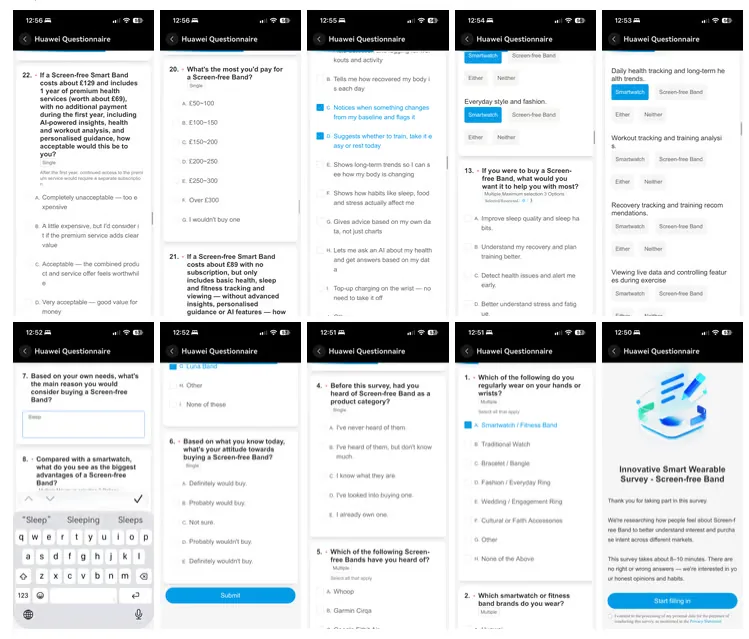
Huawei is conducting a user survey to gauge market interest in a potential screenless health band. The questionnaire appeared around September 18, 2026, targeting Huawei smartwatch owners—the most concrete signal to date that such a product may be in development. No specific launch timeline or pricing is disclosed:
- Release date: Not announced
- Product name: Not revealed
- Price point: Survey seeks user willingness to pay, but no official figures
- Pre-order availability: No channel information yet
- Subscription model: Survey explicitly tests resistance to recurring fees, suggesting possible subscription-based service
Survey Details and Competitive Landscape
The questionnaire, delivered via the “Devices” tab in Huawei’s mobile app, consists of 28 questions covering critical decision factors:
- Acceptable price range
- Desired battery life
- Strap material preferences
- AI feature requirements
- Familiarity with competing products
Competitors mentioned include Whoop, Garmin Cirqa, Google Fitbit Air, Amazfit Helio Strap, Polar Loop, Hume Health Band, and Luna Band. Whoop stands out as the protocol example for subscription-only health monitoring, operating on a hardware-upfront + monthly-fee model.
An unexpected insight emerges: Huawei directly asks respondents about resistance to subscription fees. This contrasts sharply with industry norms where health bands traditionally rely on one-time hardware sales. Altman-style betting that users will accept recurring charges for wellness data remains unproven at scale.
Market Context and User Education Gap
Screenless health bands prioritize continuous sensor data collection over visual feedback:
- Continuous monitoring of heart rate, SpO2, sleep metrics
- Data visualization and insights delivered exclusively through companion apps
- Lower hardware cost, extended battery life, minimal interaction friction
While such devices command loyal followings in North America, awareness remains low in China. Among listed competitors, only Fitbit Air and select Amazfit models attempted Chinese market entry with limited traction. Huawei’s real challenge is not technical capability but shifting user perception that a screen is essential to device completeness—a cognitive hurdle as significant as engineering constraints.
Reader Recommendations
- Ideal for: Huawei smartwatch owners seeking a secondary monitoring device (e.g., for elderly family members, athletes who prefer unobtrusive wear), or users tired of screen glare/battery anxiety
- Better to wait: If you prefer absolute ownership without ongoing fees, hold off until Huawei clarifies whether full functionality is accessible via one-time purchase
Final Thoughts
The wearable health market is shifting from “display-centric gadgets” to continuous data infrastructure. Huawei’s subscription-aware survey signals strategic reconsideration in a saturated hardware landscape—and underscores that competitive differentiation will increasingly hinge on service retention, not feature stacking.