
Core Announcement: HunYuan Hy4 Preview Released
On August 28, Tencent released and open-sourced HunYuan Hy4 preview, its next-generation large language model after the official Hy3 release. The new model focuses on longer-chain productivity tasks, including software engineering, office analysis, game development, and scientific research.
Key facts:
- Release date: August 28
- Model version: Hy4 preview
- Total parameters: 770B; activated parameters: 49B
- Context length: expanded to 1M tokens
- Availability: WorkBuddy, CodeBuddy, Yuanbao, ima, Tencent Cloud TokenHub, and OpenRouter
- Pricing: RMB 6 per million input tokens, RMB 18 per million output tokens, and RMB 0.3 per million cached-hit tokens
Compared with Hy3, Hy4 preview increases total parameters from 295B to 770B, activated parameters from 21B to 49B, and context length from 256K to 1M. Tencent also said Hy4 preview took part in optimizing its own training methods, data strategy, evaluation system, and low-level operators, improving inference throughput by 31.8% over the baseline through multiple rounds of experiments.
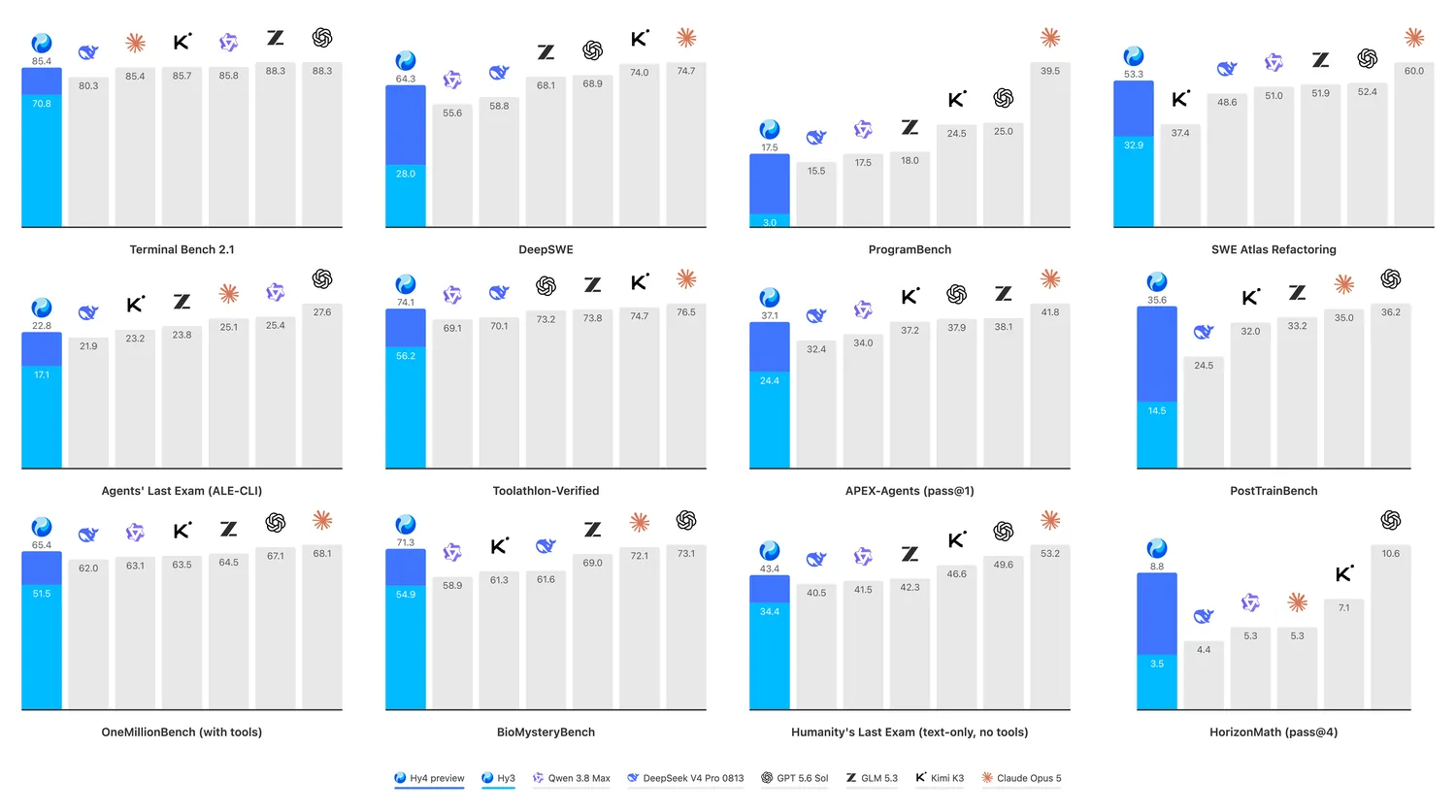
Tencent organized 163 experts to blind-test 203 engineering tasks. According to Tencent’s published data, Hy4 preview scored 2.99/4 on average, slightly above Kimi K3’s 2.94 and GLM 5.3’s 2.92.
Capability Check: Long-Chain Agent Behavior in Real Tasks
The test team used three complex tasks to examine Hy4 preview in practice: multi-source expense auditing, building a Canvas-based web game, and developing a Three.js 3D racing game.
In the expense-auditing task, the model processed 12 separate materials in 3 minutes and 27 seconds, then produced a structured Markdown audit report. It cross-checked evidence, matched policies, and calculated amounts across six reimbursement claims. The six claims totaled RMB 5,364; the model approved RMB 4,294, reduced RMB 230, and returned RMB 840 for additional documents.
It accepted RB-003 by linking email evidence with trip records, and it correctly interpreted RB-004’s so-called “approval” email as a request to complete IT assessment before purchase approval. Its notable slip was classifying an August 12 claim under the v2 policy that took effect on August 15. Because the relevant rule did not change between versions, the final amount and conclusion were not affected.
For the Canvas game Deep Sea Evolution, Hy4 preview delivered a playable version in 32 minutes and 1 second. The output included a 30.5KB game.ts, an index.html, and a standalone file that could be launched by double-clicking. The game supported inertia-based movement, three fish sizes, eating-and-growth mechanics, collision detection, start and result screens, and extras such as combos, pause, mute, and local high scores.
Before delivery, the model ran 15 Node logic tests and 14 Chromium end-to-end browser tests, covering startup, keyboard and mouse input, eating, growth, death, restart, pause, and mute. It also fixed issues such as unnatural fish entry animation and a “nearly caught but never reached” chasing gap of 20 to 30 pixels.
The Three.js project Midnight Port showed a more typical engineering failure mode. The first build took 1 hour and 39 minutes and involved 27 file edits. It produced a racing game framework with 14 sequential checkpoints, 164 collision boxes, three AI drones, a rainy neon harbor scene, and a real-time HUD. However, the initial project depended on a local server. After the temporary server stopped, double-clicking index.html failed because of browser loading restrictions, leaving the user with a white screen.
After receiving feedback, Hy4 preview did not rewrite the game. Instead, it repackaged the dependencies and produced a 0.57MB standalone file in 20 minutes and 8 seconds, allowing the game to launch directly. During debugging, it also fixed AI drones colliding with obstacles, laps continuing to accumulate after race completion, and severe overexposure in the rainy night scene. The overexposure issue was traced to UnrealBloom parameters; increasing the threshold from 0.55 to 0.78 restored the intended nighttime look.
Parameters and Pricing Strategy
Hy4 preview continues Tencent’s “affordable and cost-effective” positioning while making a clear jump from Hy3 in model scale:
| Metric | Hy3 official release | Hy4 preview |
|---|---|---|
| Total parameters | 295B | 770B |
| Activated parameters | 21B | 49B |
| Context length | 256K | 1M |
| Input price (RMB/1M tokens) | — | 6 |
| Output price (RMB/1M tokens) | — | 18 |
| Cached-hit price (RMB/1M tokens) | — | 0.3 |
The disclosed pricing puts Hy4 preview at RMB 6 per million input tokens, RMB 18 per million output tokens, and RMB 0.3 per million cached-hit tokens. Together with its rollout across WorkBuddy, CodeBuddy, Yuanbao, and ima, as well as access through Tencent Cloud TokenHub and OpenRouter, the strategy is clearly to lower the adoption barrier and increase real task usage.
Tencent also disclosed that in the second quarter, new AI businesses including HunYuan, Yuanbao, CodeBuddy, WorkBuddy, and Xiaowei had a combined net impact of about RMB 10.5 billion on Non-IFRS operating profit. Tencent stated that compute is allocated first to self-developed model training, then to inference needs for products such as WorkBuddy, with the remainder made available externally through Tencent Cloud.
Practical Takeaways: Who Should Try It

Good early candidates:
- Tencent Cloud API users who need long context or multi-step engineering workflows
- Teams building office automation, code review, or evidence-chain verification systems
- Developers who want to prototype frontend or game concepts with limited resources
Use with caution:
- Scenarios where policy versioning, factual premises, and key evidence must be checked with high precision still need human review
- Complex engineering tasks that require stable delivery should include testing, acceptance checks, and rollback plans around model-generated output
Final Note
Hy4 preview’s significance is not only its parameters or benchmark scores, but whether its “find the problem, run experiments, fix and iterate” loop can carry real work. It still makes mistakes, but the important shift is that it can often continue from errors instead of merely producing a one-shot answer.
Whether HunYuan can move into the top tier through continuous iteration will ultimately depend on whether these capabilities translate into sustained product usage and commercial returns.