
Core Announcement: E-Series GPU IP Debuts with Neural Core Integration
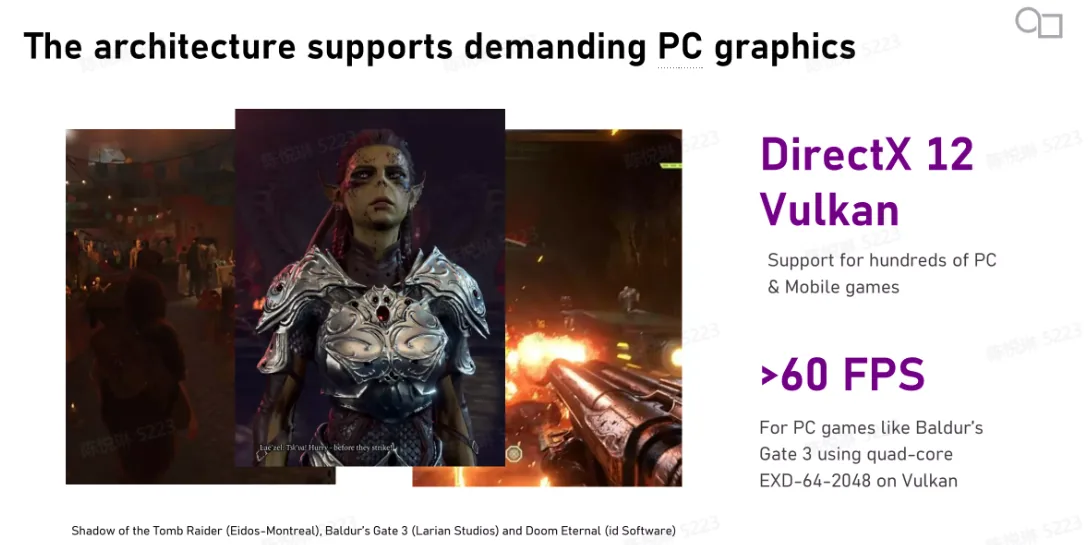
Imagination Technologies recently held a product showcase for its E-Series GPU IP, launching a new GPU solution targeting terminal AI compute. The series emphasizes unified architecture integrating graphics, compute, and AI capabilities. Key facts:
- Release timing: Recent showcase (no specific date disclosed)
- Key product: E-Series GPU IP (single-core and multi-core variants)
- Availability: Demonstration complete; no量产 timeline announced
- Weight openness: Not disclosed; software stack emphasized for cross-generation reuse
Architecture Breakthrough: Neural Core Embedded, Data Movement Reduced
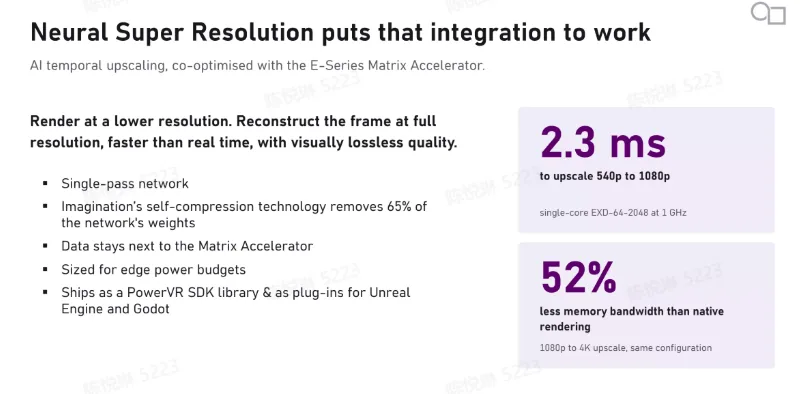
The most notable innovation is deep integration of Neural Core—a dedicated matrix computation unit—into the GPU’s heterogeneous architecture. This redesign eliminates off-chip DDR memory transit for AI upscaling: unlike traditional GPU+NPU splitting that writes intermediate results to shared DRAM, E-Series enables GPU-alone rendering and neural super-resolution reconstruction.
Key performance metrics:
- Single-core E-Series upscales 540p to 1080p in just 2.3 milliseconds
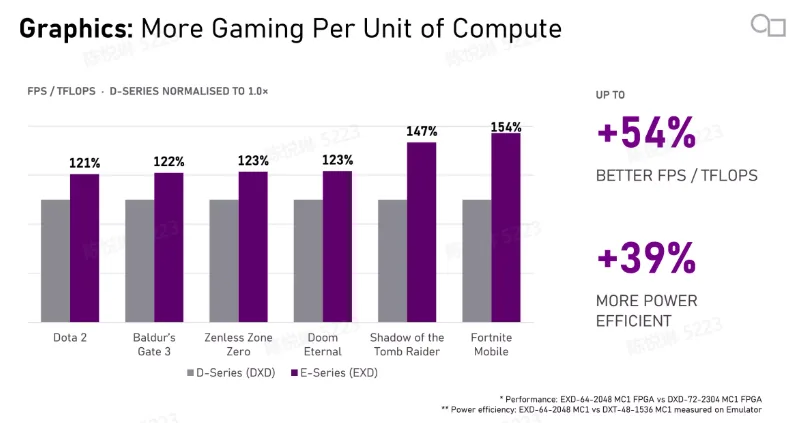
- At 4K upscaling: bandwidth consumption reduced by up to 54%, frame rate reaches 2.5× of baseline
- Peak power efficiency gain: 39% more performance per watt
Three optimizations drive these gains: TBDR (Tile-Based Deferred Rendering) keeps intermediate data on-chip; self-developed neural super-resolution algorithm compresses weights by over 50%; ALU execution reorganization enables “maximized data reuse, minimized unnecessary data movement”.
AI Inference Breakthrough: 4.7× Prefill Performance Leap
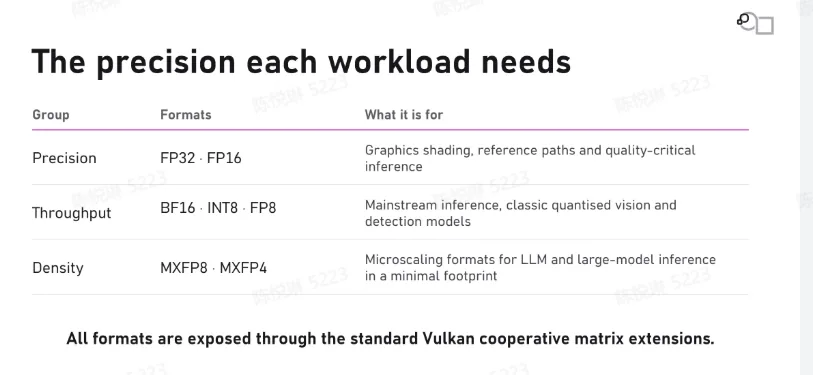
E-Series first introduces hardware support for LLM-relevant MXFP8/MXFP4 low-precision formats. This bit-width reduction directly boosts matrix operation throughput, especially benefiting Prefill stage—which processes input context to generate the first token and directly impacts TTFT.
Performance comparisons:
- Prefill stage: 4.7× improvement vs. previous generation
- Multi-modal convolution computation: 4.4× of prior iteration, handling vision/sensor workloads
Decode stage benefits from reduced weight data volume, though actual bandwidth depends on SoC memory subsystem configuration. AXI interface enables LPDDR/GDDR/HBM support with up to 768GB/s read bandwidth.
Software Stack and Heterogeneous Coordination: GPU as Part of System
E-Series retains GPU versatility: developers use OpenCL/Vulkan for kernels or higher-level frameworks like Llama.cpp, ONNX, PyTorch. Imagination’s unified cross-generation software stack ensures optimizations carry forward.
In real SoC deployment, CPU/GPU/NPU form a collaborative trio: CPU manages task coordination and workflow, GPU handles graphics plus AI acceleration, NPU serves fixed low-power inference. E-Series adds mailbox-based inter-processor communication, shared memory for reduced data copying, and SDK integration support.
Usage Recommendations
Early adopters should consider:
- Consumer SoC designers balancing graphics and AI performance in limited die area
- Agent PC and edge computing vendors prioritizing TTFT latency and efficiency
- Automotive/robotics firms seeking unified architecture to cut software maintenance
Consider waiting for:
- Embedded systems with exclusively fixed NPU workloads: standalone NPU may offer lower cost
- Super-high-end applications needing HBM3E: 768GB/s max bandwidth approaches GDDR6 but falls short of HBM3E capabilities
Final Thought
As AI workloads shift from cloud to edge, SoC designers face the challenge of computational integration. Imagination’s decision to expand GPU responsibilities rather than add separate NPUs targets end-to-end AI system cost reduction—not raw performance leadership, but lower total cost of ownership across design complexity, validation cycles, and long-term maintenance.