
One: Core Event - A Java-Centric Explanation of Agent Concepts

The article “Javaer Transitioning to Agents: What is an Agent” published on Juejin(juejin.cn) does not announce a new model, product, or software release. Instead, it provides a conceptual framework tailored for Java developers to understand Agent systems. No code library, API, or pricing information is released in this piece; it is purely educational content.
- Source: Juejin Developer Community open article
- Availability: Full text freely accessible
- Technology Stack: References Spring AI and other Java ecosystem tools as examples
Two: The Essence of Agent - Intersecting Two and Four Core Elements

The article defines an Agent as “a system where large language models participate in decision-making, interact with the environment via tools, and advance toward goals based on feedback.” This sharply distinguishes it from ordinary Chatbots or pre-defined Workflows:
- Goal: e.g., explain how to use pagination parameters for an order query
- Observation: content from already-read documents forming the current state
- Action: searching documents, reading content, calling external services
- Feedback: tool invocation results deciding whether to proceed or terminate
A critical counterintuitive point emerges: LLMs themselves cannot automatically access project directories, databases, or historical conversations. This contradicts many developers’ intuitions about LLM capabilities—the model is merely a decision participant, not an executor. Behind tools still lie familiar Java Service methods; the difference lies only in who decides the call order (dynamic vs. hardcoded).
The article uses a fictional “order interface documentation” example: the system first searches for “order,” reads the documentation, discovers a reference to a public specification, then automatically invokes the tool to read the spec, and finally integrates the answer. This loop—Observe → Choose Action → Execute & Get Feedback → Decide Next—constitutes the Agent’s basic execution flow.
Three: Key Concept Clarification for Java Developers
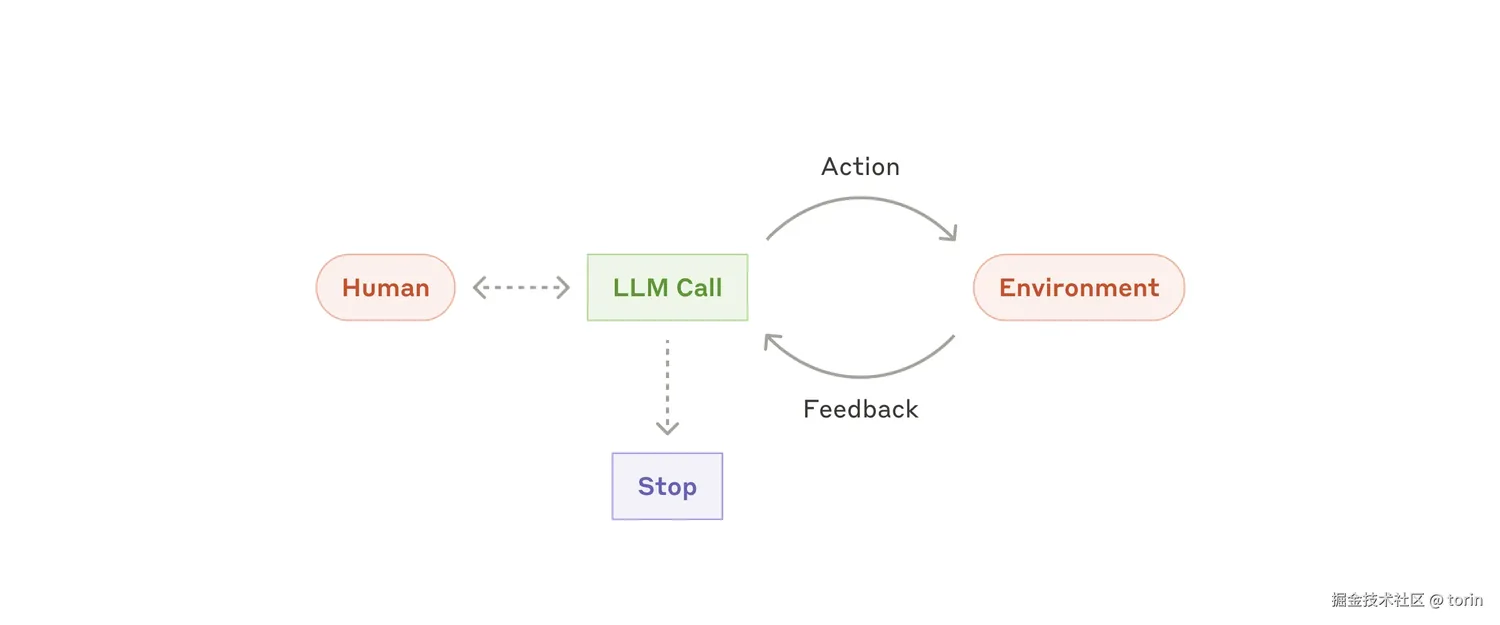
The article clearly distinguishes easily-confused terms like RAG, memory, Tool Calling, MCP, and Skills:
| Concept | Function | Java Developer Analogy |
|---|---|---|
| RAG | Provide answering basis: retrieve documents → construct context → model generates | Document search service based on keywords or vectors |
| Memory | Application-layer saving and on-demand retrieval of historical info | DB storage of conversations, must be explicitly loaded to context |
| Tool Calling | Structured request: model declares “which tool to call + parameters” | Similar to Dubbo service metadata description |
| MCP | Unified protocol for external tool service access | Similar to gRPC/MQTT adapter layer |
| Skills | Task guidance and operational procedures | Similar to business process configuration files or Strategy pattern |
A common misconception requires special caution: Using RAG in a fixed Q&A workflow ≠ Agent. The article stresses that an Agent’s core is whether subsequent actions are dynamically selected by the model based on task state and feedback. Pre-defined workflows may loop and retry, but paths are still scheduled by program code—not Agent behavior.
Four: Practical Recommendations - When to Adopt Agent Architecture
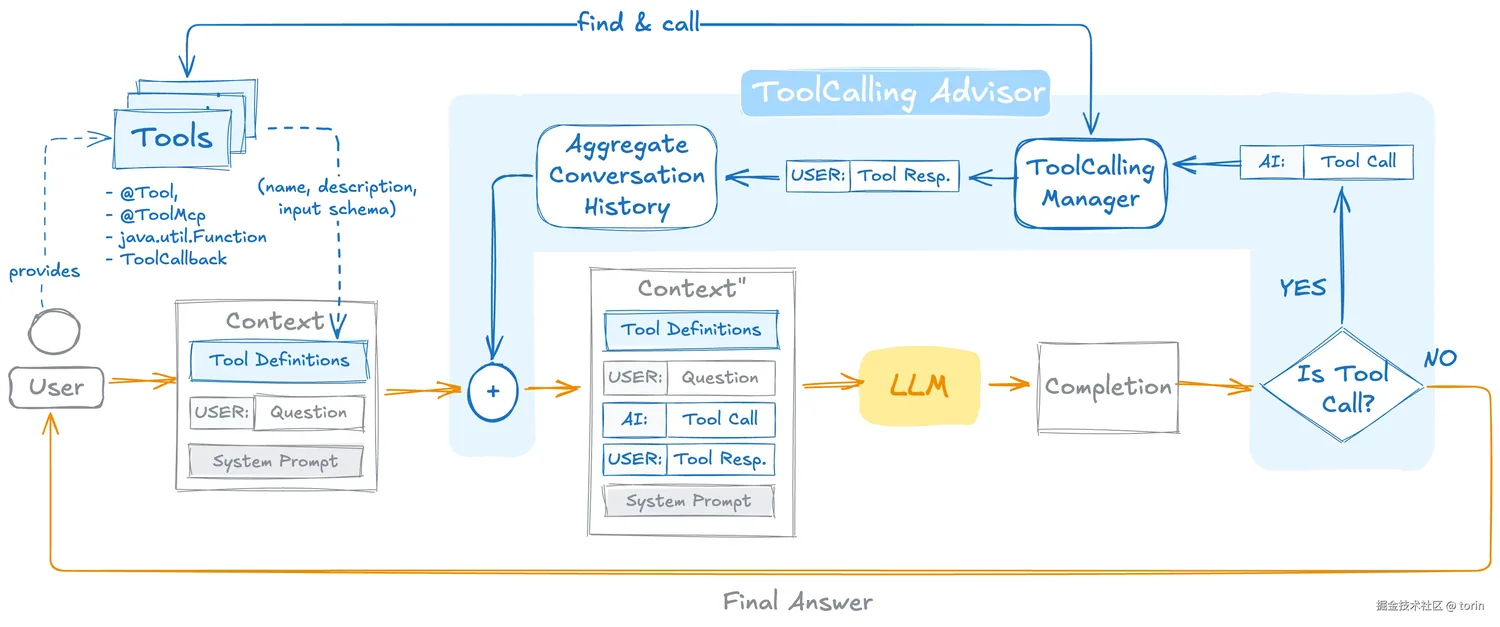
Based on the article’s analysis, the following guidance is offered:
- Ready to try now: Exploratory tasks with non-fixed paths requiring multi-round verification, such as “diagnosing why order queries are slower today”—needs dynamic decision on which logs to inspect based on metrics
- Recommended to wait: Fixed, repetitive tasks with deterministic rules, such as “daily order count summary”—普通代码/工作流更易维护
- Architecture boundary reminder: Agent does not change permission models; tool execution still requires program authorization; Agent does not guarantee correctness—even multiple rounds may amplify initial misjudgments
Five: Final Thoughts
Agent is an elegant solution, yet not a universal panacea. It is fundamentally an engineering pattern for collaboration between model and program: the model handles understanding and decision-making; the program handles execution and constraint. Java developers need not re-architect existing systems;只需 in tool definitions and context management wrapping them with appropriate adapters—that’s precisely why the adoption barrier remains low for this community.