
Jensen Huang on AI and Math Skills: Forgetting Multiplication Tables Isn’t a Problem, Humans Should Focus on Higher-Order Abilities
Core Event and Stance
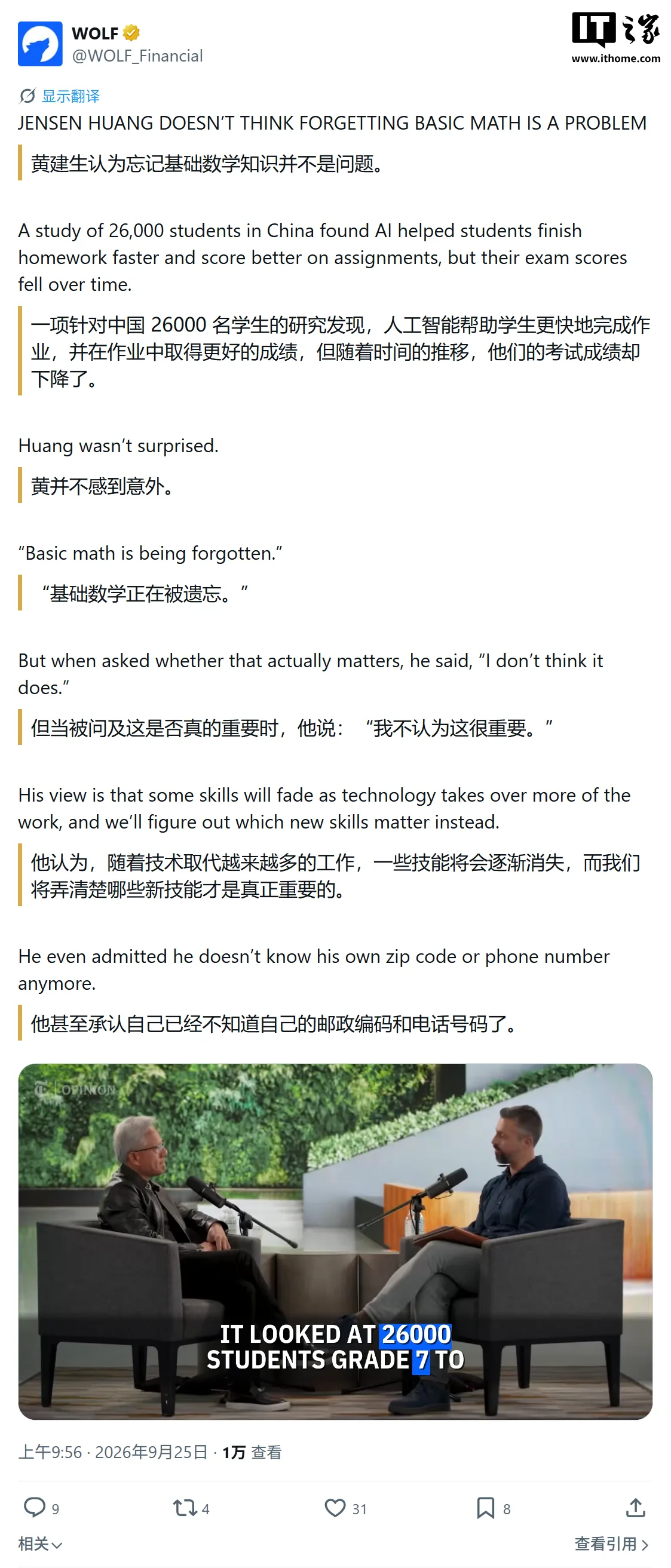
NVIDIA CEO Jensen Huang addressed growing public concern about AI undermining foundational math skills in an interview with The New York Times’ Ezra Klein on September 25, 2026. His stance is unequivocal: forgetting basic mathematics due to AI reliance is not a problem, and he considers it “completely unimportant.”
Key facts:
- Date: September 25, 2026 (reported by IT Home)
- Setting: Ezra Klein Show podcast, The New York Times
- Trigger: A study of 26,000 Chinese students showing AI improves homework but harms exam performance
- Huang’s position: Acknowledges possible “knowledge retention deficit” but states he “is not anxious”
- Core argument: Basic computation can be outsourced; humans should develop higher-order capabilities
Research Findings and Counterintuitive Data
Huang referenced a study of 26,000 Chinese students revealing a paradoxical trend:
- Positive: AI显著提升学习效率——students complete homework faster and achieve better homework scores
- Negative: Over time, these students show declining exam performance
This divergence—better task execution yet poorer assessment results—is the linchpin of Huang’s discussion. He suggests the mismatch stems from redefining educational goals: when AI handles rote calculation, traditional exams measuring computational speed no longer reflect true learning.
He illustrated the trend broadly: “Try having a child do long division now—the multiplication table is all but forgotten, forget square roots… Basic mathematics is being gradually forgotten. But does it matter? I think not. Completely unimportant.”
Analogy: The Routine of Externalized Memory
Huang backed his argument with personal experience—humans have long outsourced memory to external tools:
- “I genuinely cannot remember my home address… Nor do I remember my phone number. I’ve forgotten all that, and I’m completely comfortable with it.”
This isn’t an exception but an evolutionary pattern: just as people rely on navigation instead of mapping routes, or search engines instead of memorizing formulas, forgetting arithmetic is the natural consequence of technology接管 repetitive tasks. He emphasized that AI acts as a “capability amplifier”—freeing human resources for higher-value domains.
He did note, however, that AI may erode some “fine-grained mental flexibility,” but predicted society will evolve toward more adept “systems thinkers”—individuals who grasp interconnected systems and perform multi-layered reasoning.
Capability Shift: From Calculation to Creation
Huang outlined a framework for irreplaceably human skills:
- Narrative ability: constructing coherent stories and meanings
- Aesthetic sense: perceiving and creating beauty
- Empathic capacity: understanding and sharing others’ emotions
He argues education must prioritize these AI-inimitable traits. As machines efficiently produce “correct answers,” human value lies in identifying “questions worth answering,” contextualizing problems, and embedding solutions with human meaning.
Actionable Takeaways
- Educators and parents: Prioritize evaluation of student-crafted outputs and AI-output critique over computational speed or formula recall
- Students: For exams, maintain calculation fluency; for long-term growth, use AI to explore complex questions and practice interdisciplinary integration
- Corporate trainers: Reduce mechanical computation training; expand systems modeling and cross-domain collaboration modules
In Conclusion
Huang’s remarks confront a profound technology paradox: as tools grow smarter, how do humans define their irreplaceability? His answer revives an elementary truth—the value of capability lies not in execution itself, but in choosing what to execute and why. In the AI era, humanity’s true moat may lie not in computational precision, but in the depth of meaning-making.