
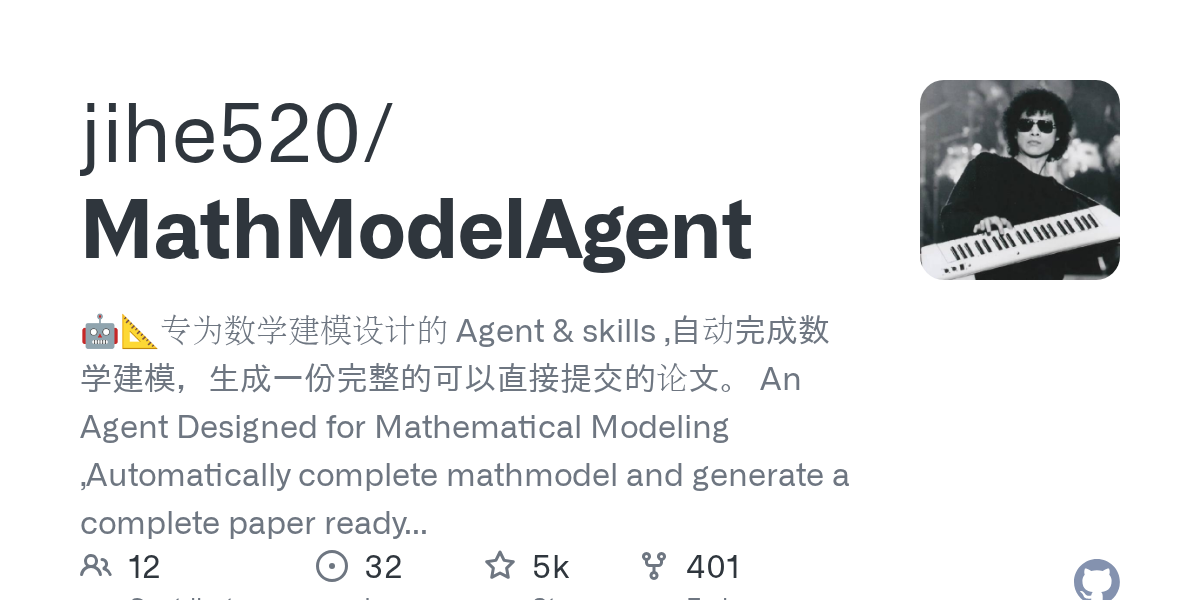
A project called MathModelAgent has quietly surged to the top of GitHub’s Python trending list today — its 5,144 stars proving that when AI systematically tackles the traditional challenge of “mathematical modeling,” the impact is no less significant than any major model release.
It’s not just another chatbot. It’s a complete automated workflow: from understanding the problem, selecting a model, writing code, and generating charts, to typesetting a submission-ready PDF paper — all without human intervention.
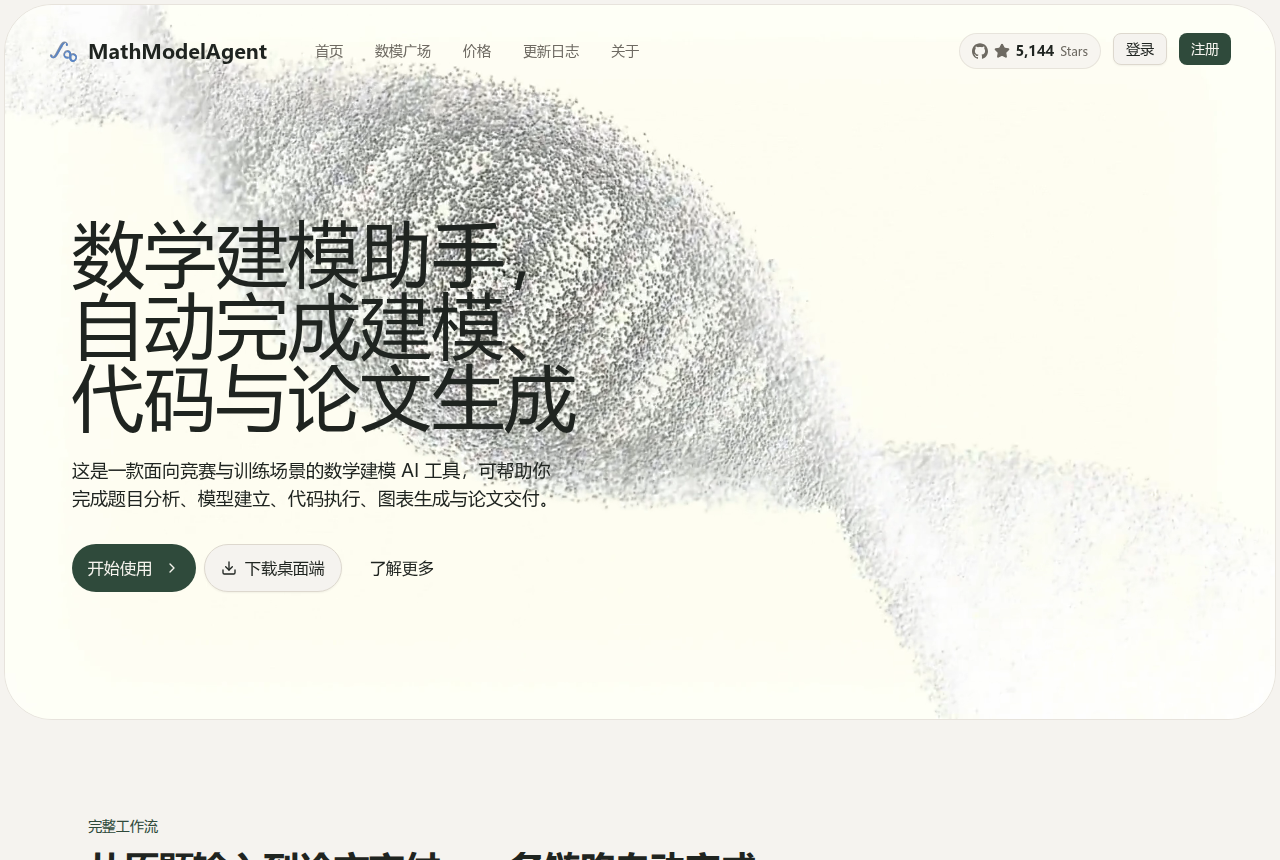
What Can It Do? — End-to-End Modeling Automation
Open its command-line interface, type in a task description, and the multi-role Agent system on the backend springs into action:
- The Modeler analyzes the problem background and constructs a mathematical model (e.g., AHP, ARIMA, neural networks, etc.)
- The Coder writes reproducible solution code in Jupyter Notebook, supporting both local and cloud execution
- The Writer handles automatic typesetting using Typst, with 17 built-in templates for major competitions (National Contest, Huashu Cup, MCM/ICM)
Throughout the process, it automatically checks for errors, re-runs, and corrects results, followed by a 9-step verification pipeline (including text leakage detection, numerical consistency checks, and PDF visual inspection) to ensure the output paper meets submission standards.
Three Steps to Get Started — Launch in 10 Commands
No matter your preferred environment, the project offers clear paths:
Docker (quickest): Just three commands
1
2
3
git clone https://github.com/jihe520/MathModelAgent.git cd MathModelAgent docker-compose upLocal Deployment: Requires Python, Node.js, and Redis — suited for users who want to dive deep
Desktop Edition: Download the installer directly, enter your model API Key, and you’re ready to go
Once launched, visit http://localhost:5173, type /1start-mathmodel 完成这个数学建模任务 in the left panel, wait about ten minutes, and a complete competition paper will be generated in the backend/project/work_dir directory.
Technical Design: Lightweight but Precise
What makes this project particularly noteworthy is its “philosophy of subtraction”:
- The author deliberately avoids dependencies on complex agent frameworks, opting for an agentless workflow design — each modeling stage is an independent SKILL (skill module), connected through lightweight orchestration rather than heavy framework bindings
- Supports any LLM via unified access through litellm, meaning you can use Claude, GPT, Chinese domestic models, or even open-source models — keeping costs under control
- Four-tier fault tolerance: limited retry → fallback model switching → evaluator oversight → feedback-driven re-run, ensuring stable and reliable output
The SKILL-based modular design keeps the project’s future iteration costs extremely low. The author explicitly states in the README that going forward, the focus will remain on SKILL-layer optimization, with no further development of the underlying harness framework — and this restraint actually makes it more reusable and extensible for the community.
Who Should Try It?
- Competition participants: A handy assistant tool when MCM or National Contests are approaching, saving substantial time on foundational work
- Modeling instructors: Useful for classroom demonstrations, quickly showcasing the complete real-world modeling pipeline
- Researchers: Reference its workflow design approach to build your own domain-specific Agents
Compared to similar projects, it doesn’t feature an overly complex UI or plugin ecosystem, but its strength lies in its end-to-end completeness. If all you need is a submission-ready modeling paper, it may be the closest open-source project on GitHub to achieving that goal right now.
In the AI era, when algorithmic capability is no longer the sole bottleneck, how efficiently you can organize knowledge into reproducible workflows is the real moat.
MathModelAgent is attempting to answer this question — it doesn’t chase flashy features, but earnestly compresses what traditionally takes 3 days of work into under 1 hour.
It’s open source and free, but the author reminds users: for personal learning only, not for commercial use.