Kimi K3 Enters OpenAI Enterprise Ecosystem, Marking First Chinese LLM in B2B Procurement
On September 30, 2026, U.S.-based AI infrastructure company Baseten announced a partnership with OpenAI, making Kimi K3 the first open-source model to be integrated as a B2B inference provider within OpenAI’s enterprise marketplace. Enterprise customers can now invoke Kimi K3 and GLM 5.3 via Codex or the Responses API.
Key facts:
- Launch date: September 30, 2026 (OpenAI enterprise ecosystem integration)
- Access methods: Codex console and Responses API
- Model type: Open-source large language model
- Parameter count: 2.8 trillion (officially claimed)
- Context window: 1 million tokens
- Multimodal capability: Native visual understanding support
Breaking OpenAI’s Enterprise Ecosystem Barrier
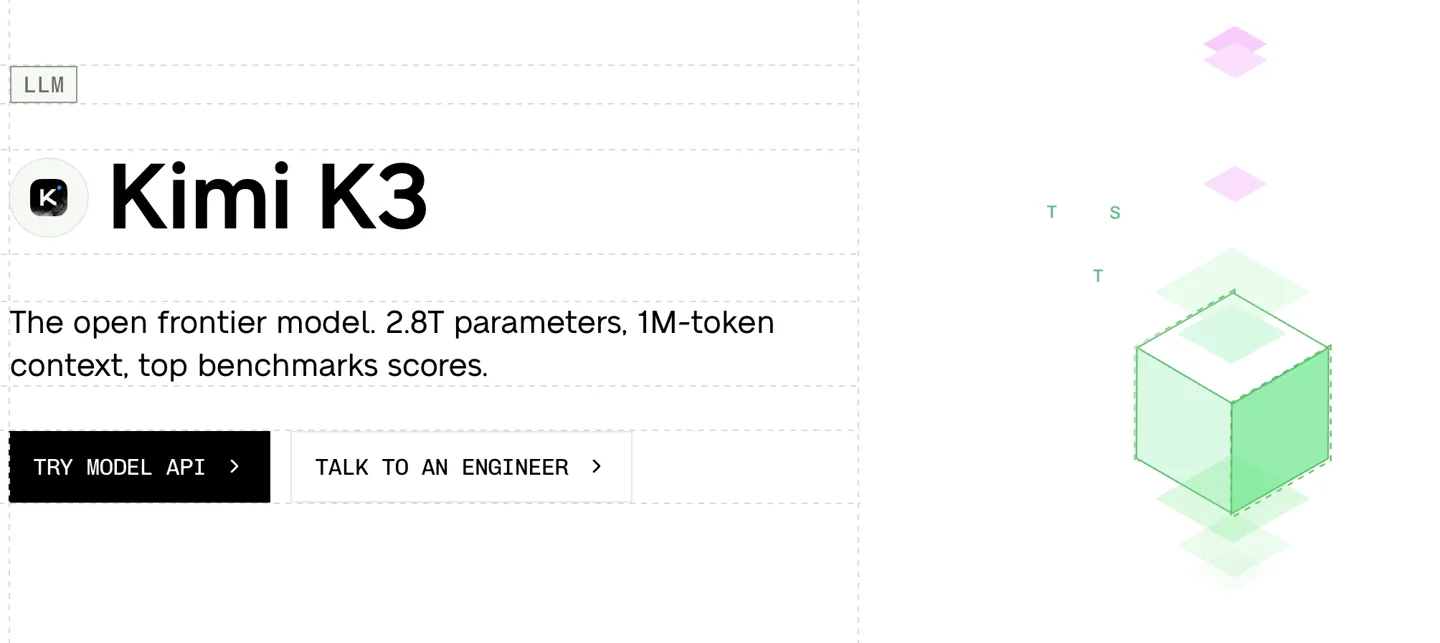
This collaboration marks the first time a China-developed open-source model has entered OpenAI’s enterprise procurement framework. Previously, OpenAI’s enterprise ecosystem was dominated by its proprietary GPT series, with high barriers for third-party model integration. By opening its Codex platform as a distribution channel, OpenAI enables standardized enterprise-grade inference for open-source models.
Developed by Moonshot AI, Kimi K3 is claimed as the world’s first open-source model with 2.8 trillion parameters. The model supports a 1-million-token context window—capable of processing roughly 750,000 characters of text at once—making it suitable for extended coding tasks or multi-document cross-analysis. Its native multimodal architecture enables image understanding alongside text processing.
Technical Comparison
The table below reflects claimed specifications from official sources (no inferred values):
| Model | Parameters | Context Window | Vision Support | Open-Source | Enterprise Channel |
|---|---|---|---|---|---|
| Kimi K3 | 2.8T | 1M tokens | Native | Yes | Codex/API |
| GPT-4 Turbo | Un disclosed | 1M tokens | Supported | No | Native OpenAI |
| GLM 5.3 | Un disclosed | Un disclosed | Supported | Yes | Codex/API |
Notably, Kimi K3’s 2.8 trillion parameter count significantly exceeds mainstream open-source models like Llama 3.1 405B or Qwen 2.5 70B. However, concrete industrial metrics—including inference latency, throughput per watt, or throughput-cost ratio—remain unverified by independent third parties.
Enterprise Adoption Guidance
Suitable for immediate evaluation:
- Legal, financial, or research institutions handling voluminous document analysis
- Organizations seeking cost-efficient inference with multi-model redundancy
- Companies requiring vision-language tasks with strict data retention policies (Baseten states American-hosted inference with Zero Data Retention)
Recommended to delay evaluation:
- Real-time, millisecond-level latency-sensitive applications (ultra-large models may incur overhead)
- Multinational enterprises subject to specific China data cross-border transfer regulations (models run on overseas infrastructure)
Final Thoughts
Historically, Chinese large models relied on self-built ecosystems or third-party international platforms for validation. This integration via OpenAI’s mature enterprise channels represents a structural breakthrough achievable only through open-source standardization. Yet the true competitive frontier has shifted: beyond parameter-scale races, the contest now centers on building enterprise-grade reliability and governance infrastructure.