
Product Timeline and Key Details
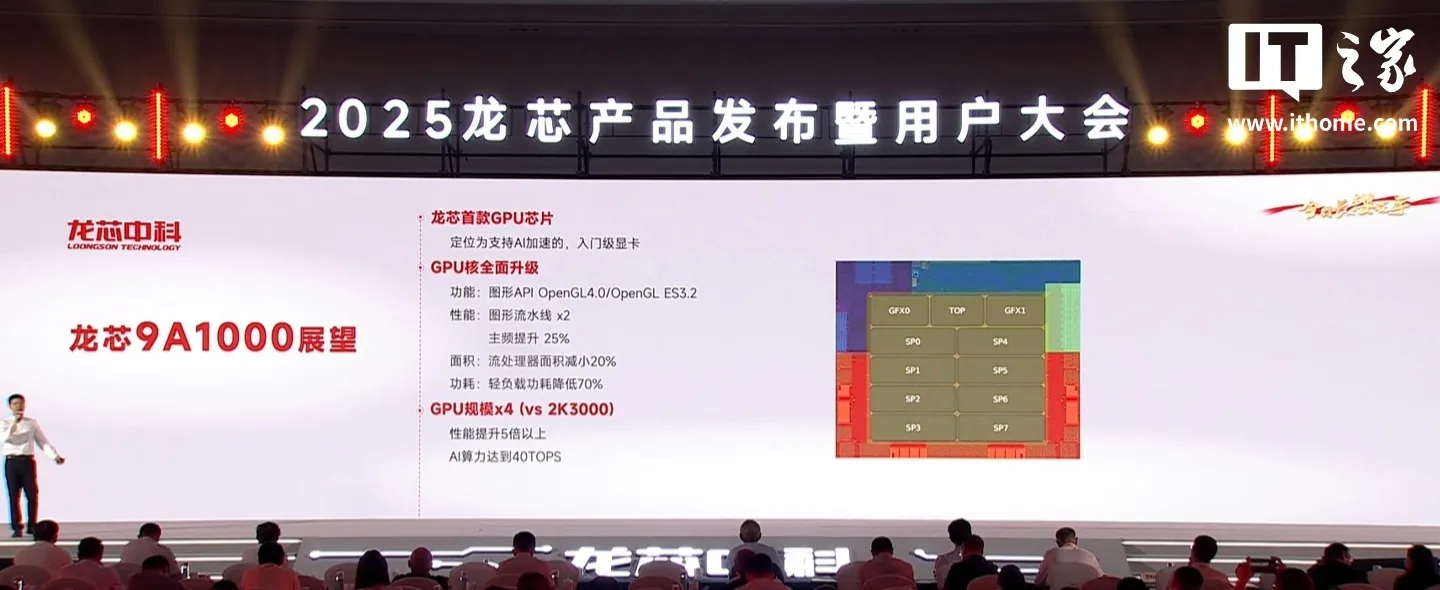
At its H1 2026 earnings briefing, Loongson said that its first GPU product, the 9A1000, is expected to go on sale in the first half of next year. Its final price will depend largely on LPDDR4 memory prices.
- Positioning: Functions as both a graphics card and an AI accelerator
- Graphics: In the open market, its display capability is broadly benchmarked against AMD’s RX 550; competitiveness will depend on Windows support
- AI capability: Delivers 40 TOPS and can meet the needs of most embodied AI applications, according to Loongson
- System progress: Loongson aims to achieve an initial bring-up of a 3B6600 + 7A3000 + 9A1000 system within the year, subject to the timely return of the 3B6600 chip
- Developer availability: A further three to six months may be needed before developers can access the platform
A Dual Role: Graphics and AI Acceleration
The 9A1000 is positioned as an entry-level graphics card with AI acceleration support. Loongson says its GPU core has been comprehensively upgraded and supports OpenGL 4.0 and OpenGL ES 3.2. The company also cites x2 graphics pipelines, a 25% higher clock frequency, a 20% reduction in stream-processor area, and 70% lower power consumption under light workloads.
Compared with the 2K3000, the 9A1000 has an x4 GPU scale and delivers more than five times the performance, according to Loongson.
| Category | Disclosed detail |
|---|---|
| Graphics APIs | OpenGL 4.0 / OpenGL ES 3.2 |
| Graphics benchmark | Broadly comparable to AMD RX 550 in the open market |
| AI compute | 40 TOPS |
| GPU scale | x4 versus 2K3000 |
| Performance gain | More than 5x versus 2K3000 |
| Power efficiency | 70% lower power consumption under light workloads |
Hu Weiwu, Loongson’s chairman and general manager, said the 9A1000 is more competitive in specialized markets with high requirements for technological autonomy. In the open market, however, its prospects will be closely tied to whether Windows adaptation can be completed. Loongson said it will seek to develop a Windows driver for the product.
Some users have already begun developing intelligent agents based on the 9A1000. That suggests the chip is intended not only for display output, but also for local AI workloads in vertical applications such as embodied intelligence.
Ecosystem Work and Future R&D
The 9A1000 technically supports hardware configurations in which a CPU is paired with multiple GPUs, allowing it to work alongside Loongson CPUs as part of a broader system. Loongson previously said that the 9A1000 had taped out on a domestic high-autonomy process line and would enter testing.
For mobile and embedded ecosystems, Loongson has established a dedicated team in Shenzhen to adapt LoongArch for OpenHarmony and Android, and has already produced a basic version. Some OpenHarmony applications are available. Android support, however, is currently aimed at relatively fixed-use cases such as industrial tablets and commercial display terminals, including hospital registration kiosks. Direct use in mainstream smartphones and tablets remains unrealistic.
Loongson has also started development of its sixth-generation high-performance CPU core. It is intended for the next generation of Loongson 7000-series CPUs, though specifications have not yet been finalized. The company currently has no plan to develop a router-specific chip.
Takeaway
The 9A1000 strategy is not solely about pursuing general-purpose graphics performance. Instead, it combines entry-level graphics, AI acceleration, and Loongson’s self-contained computing ecosystem. Its disclosed power, scale, and performance figures indicate an effort to balance efficiency with system-level integration.
Windows driver support remains a decisive variable for users that depend on the Windows ecosystem. For industrial terminals, embodied AI, and deployments with strong autonomy requirements, the 9A1000’s AI-acceleration role may be more immediately relevant.