
Clear Launch Details
Beijing Butterfly Effect Tech announced on September 28:
- Manus 2.0: Globally released for overseas users, now live on web, desktop, and mobile, built on the self-developed Cascade Agent framework
- Cue Smart Assistant: Concurrently launched, positioned for personal life scenarios; iOS version pending App Store approval
- Domestic Version Status: Still under development, with a dedicated team forming for the China market
- Partnership Progress: Ongoing collaborations with Chinese AI model vendors and ecosystem partners
- Cue Access: Currently in early access; free with invitation code MEETCUE (limited to first 1,000 users), who also receive shareable codes
Technical Architecture and Feature Details
The core of Manus 2.0 is its proprietary Cascade Agent framework, designed for “lightweight on-demand capability”, meaning specialized modules are invoked only when needed. Official test data shows Cascade achieves 23.2% fewer tokens, 28.2% faster task completion, and 32% lower runtime cost compared to traditional approaches—demonstrating that efficiency gains and cost reduction can be achieved simultaneously, Proof of genuine engineering progress.
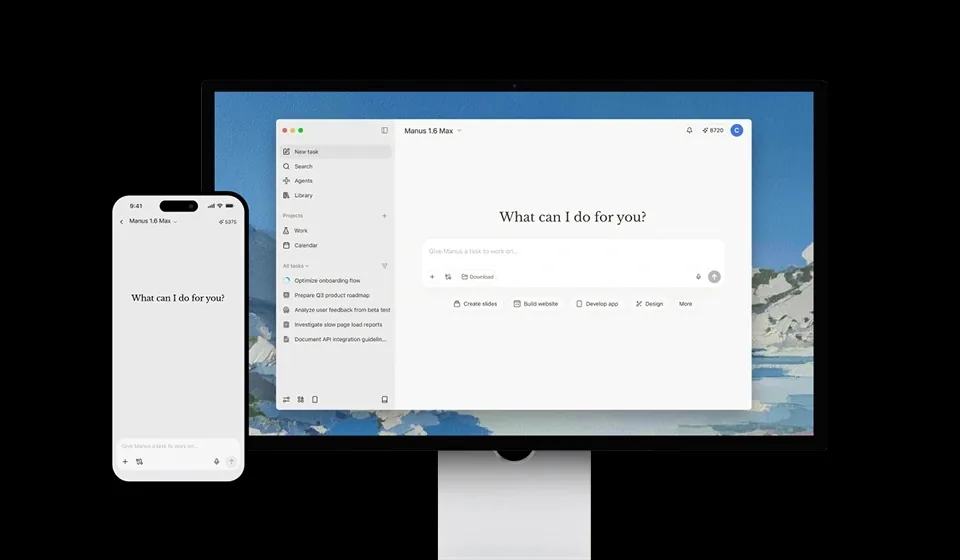
The desktop app has evolved into Manus Studio, described as a shared workspace between humans and AI, covering eight use cases: documents, spreadsheets, PDFs, slideshows, websites, code, games, and video editing.
Automation now extends beyond scheduled tasks to event-triggered workflows—triggered by new emails, ad data anomalies, calendar events, Slack messages, or Notion updates. Remote control and Computer Use permit users to delegate a Manus agent to operate a remote computer within a dedicated, isolated workspace, using only files and apps explicitly approved by the user.
Cue: A Multi-Agent System for Personal Use
Cue is a standalone app with desktop and mobile support, sharing the same underlying infrastructure as Manus but targeting different use cases. Each Cue Agent possesses a unique digital identity—email, phone number, wallet, and computer—enabling independent actions: messaging, budget-constrained payments, and task fulfillment.
A standout feature is multi-Agent collaboration: several Agents can join a shared group chat, dividing responsibilities around a shared goal—such as research, contact-list compilation, and draft writing. Cue also attempts offline service integration, like ordering food or joining a queue after scanning a QR code at a restaurant.
The cloud computer feature allows users to purchase dedicated runtime environments for multiplayer game servers or long-running automation, continuing execution even with the laptop lid closed. Game development supports template-start with a Max Ultra mode claiming enhanced visuals, gameplay, and responsiveness, plus web publishing and multiplayer support (racing, combat,竞技, and 3D).
Product Comparison (Manus 2.0 vs Cue)
| Dimension | Manus 2.0 | Cue |
|---|---|---|
| Target User | Professionals, developers, creators | Individual users, daily service consumers |
| Core Capability | Document/code/video/game automation | Messaging, payment, task execution, group coordination |
| Trigger Mechanism | Scheduled + event-based | Event-driven + manual commands |
| Deployment | Web/desktop/mobile | Desktop + mobile (iOS pending) |
| Runtime | Local + cloud hybrid | Shared infrastructure, cloud extension |
Practical Adoption Advice
- Try now if: You’re an overseas creator, freelancer, or developer using AI productivity tools; early-access invitation holders can sign up for Cue to explore multi-Agent task handoff scenarios
- Wait if: You’re targeting the China market; the domestic version has no announced timeline, and non-native English speakers may face usability delays until localization and local service integrations arrive
Final Thoughts
Cascade’s triple optimization of token usage, speed, and cost establishes a new benchmark for lightweight Agent architectures; Cue’s shift of “digital persona” concepts from enterprise to personal life could catalyze a differentiated ecosystem in China—if collaborations with domestic AI models succeed.