
Manus 2.0 Launches:_five major upgrades clearly outlined

On September 28, Manus officially released version 2.0, featuring a core upgrade to its proprietary Cascade Agent framework and introducing four new capabilities: cloud PC, remote control, video editing, and the personal AI assistant Cue. This update delivers measurable performance improvements: Task token consumption dropped by 23.2%, completion time shortened by 28.2%, and operational costs reduced by 32%. All features are now live, with the Cue personal AI assistant currently in early access and available for free via invitation code.
Cascade Agent framework reengineered: an efficient, low-cost AI execution engine

The Cascade Agent framework forms the technical core of this update. By optimizing algorithms and streamlined computation pathways, the framework significantly reduces resource consumption for large models executing complex tasks. According to Manus official data, the new framework demonstrates strong performance across multiple scenarios. Notably, the Sonnet 5.5 model achieved a score of 70.6% on Terminal-Bench 4.0 code testing—far exceeding the previous generation’s 10.3%. This reversal of fortune for Agent-based optimization highlights a key insight: while Anthropic’s Sonnet 5.5 showed marginal gains in standardized benchmarks, Manus’s framework-level improvements deliver real-world efficiency advantages in vertical use cases, suggesting that Agent architecture is emerging as a viable path to提升模型实用性.
The upgraded Manus Studio now supports multi-modal content creation including documents, spreadsheets, websites, and videos. Its video editing feature allows users to manually adjust素材 on the timeline before handing tasks back to AI for continuation, balancing human oversight with automated processing. Remote control enables smartphone commands to authorized computers for file retrieval or app operation. Automated workflows can be triggered by inbound emails or calendar changes, while cloud PC provides a persistent execution environment for long-running projects.
Manus Studio and Cue: from tools to autonomous digital avatars
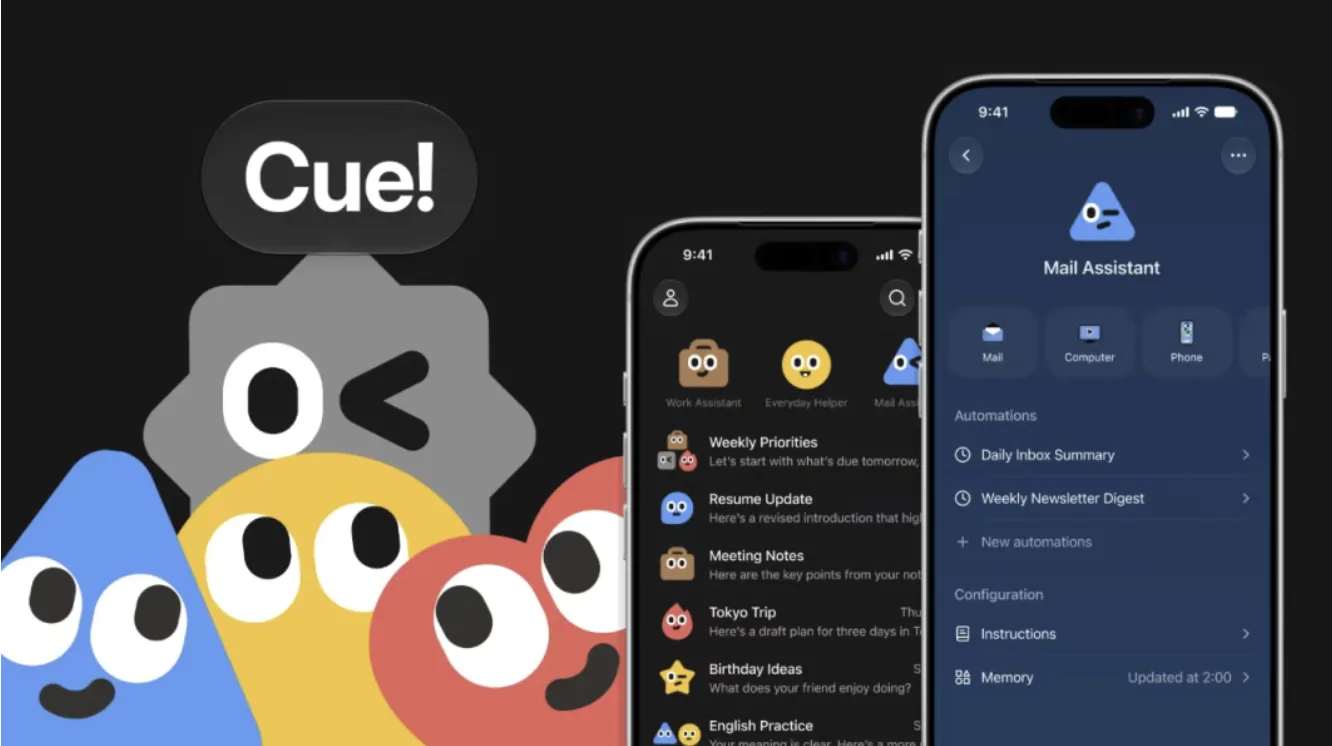
Manus Studio functions as an integrated creation platform targeting professional creators. Though sharing conceptual overlap with AI research协作 tools like Claude Science and GPT-6, it focuses squarely on commercial content generation workflows. In contrast, the newly standalone Cue assistant represents a more ambitious leap: each Cue instance can operate with an independent email, phone number, digital wallet, and virtual computer, executing actions such as making payments or taking calls within user-defined budget constraints and enabling inter-assistant collaboration.
| Product Module | Core Capability | Supported Platforms | Commercial Status |
|---|---|---|---|
| Cascade Agent framework | Token reduction 23.2%, time saved 28.2%, cost cut 32% | API, integrated into Studio | Live |
| Manus Studio | Multi-format content creation with AI collaboration | Web + local | Live |
| Remote control | Smartphone commands on authorized computers | Mobile + desktop | Live |
| Cloud PC | Persistent runtime environment | Multi-platform access | Live |
| Cue assistant | Independent digital avatar, budget enforcement, inter-agent collaboration | Mobile + desktop | Early access (invitation-only free) |
Practical recommendations: know who should adopt now—and who should wait

Early adopters and power users in content creation, remote collaboration, or automation-heavy workflows stand to benefit immediately. If your daily tasks involve cross-platform document consolidation, video editing, or event-triggered automation, Manus 2.0’s integrated toolset offers direct productivity gains; Cue remains invitation-only at launch, so developers or enterprises should first benchmark API integration with Cascade Agent to evaluate tangible ROI.
Final notes
Manus’s upgrade标志着 Agent architecture transitioning from academic concept to scalable deployment, with its efficiency metrics approaching practical usability thresholds. As AI assistants gradually match human capabilities in tool usage, the industry’s focus is shifting from model parameter contests toward sustainable, cost-efficient AI operation in real-world contexts.