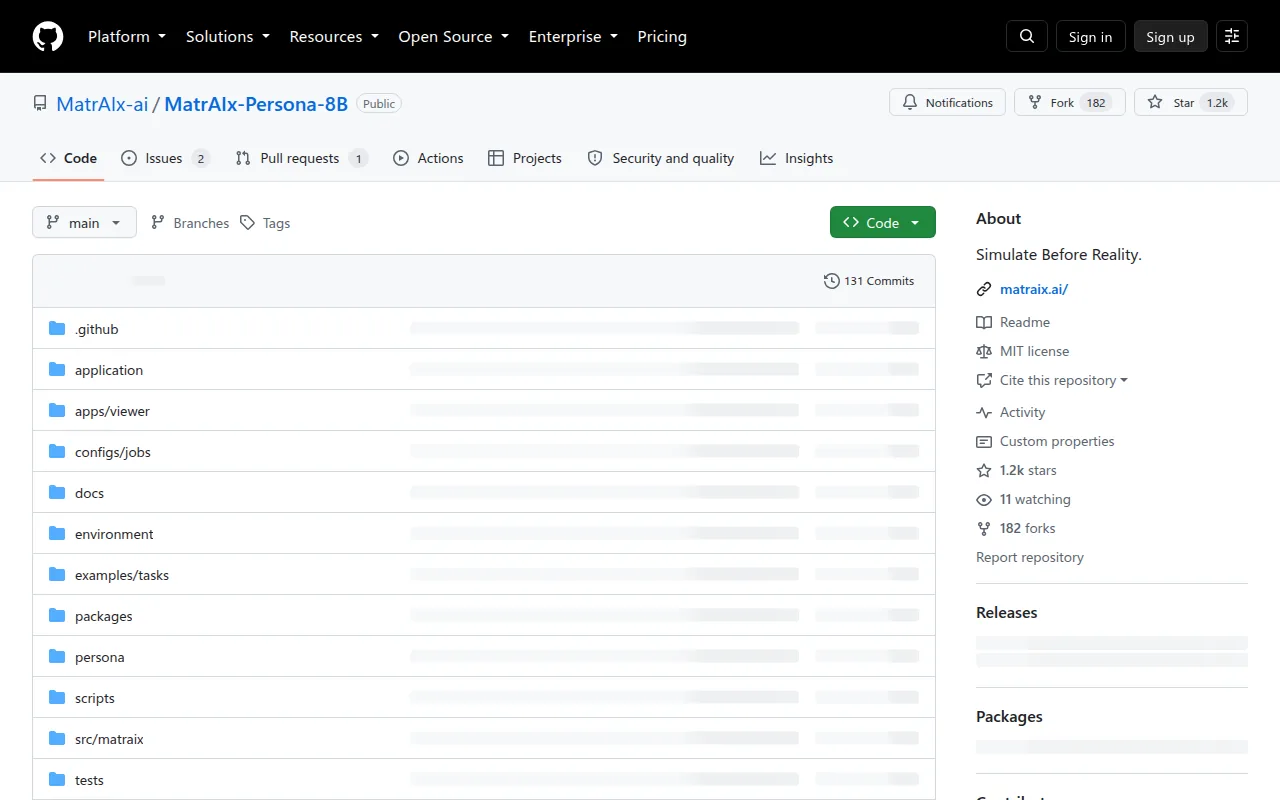
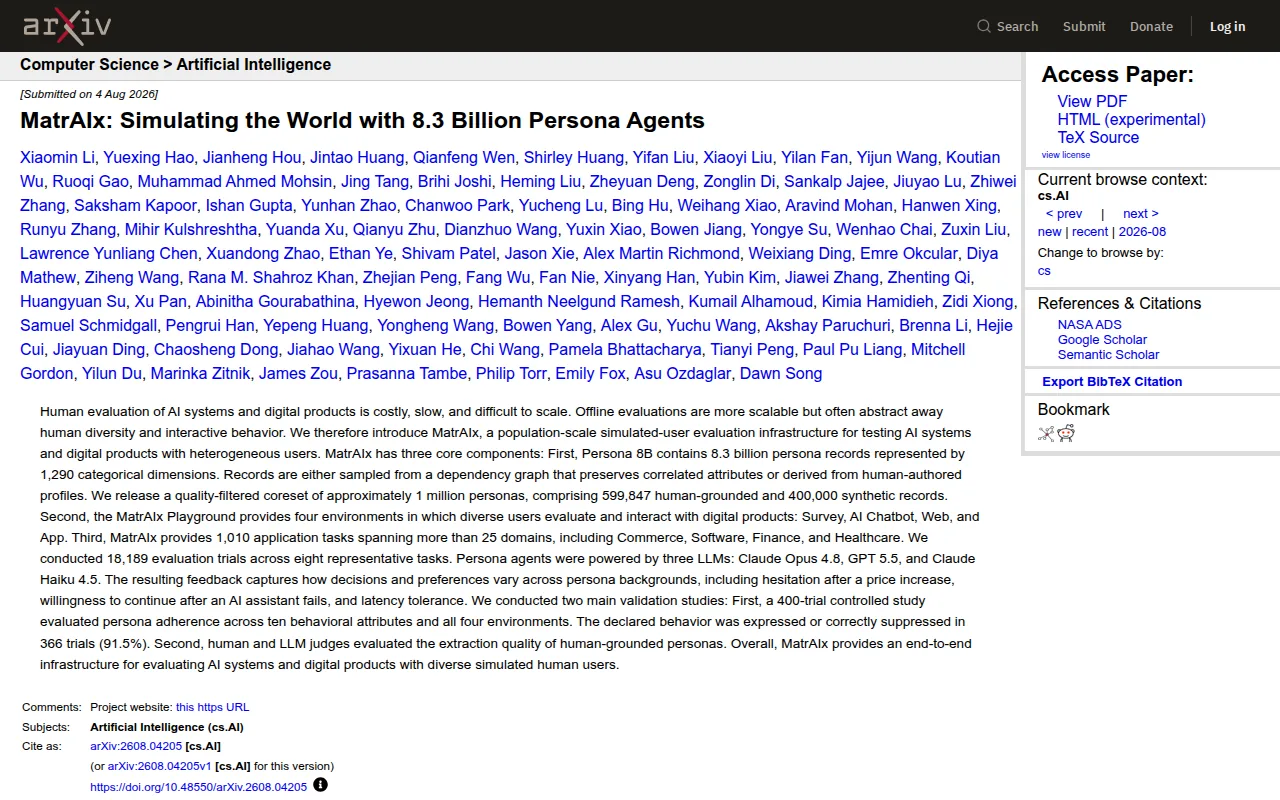
In August 2026, researchers from Harvard, MIT and collaborators posted on arXiv “MatrAIx: Simulating the World with 8.3 Billion Persona Agents” (arXiv:2608.04205) — a framework that models human behavior across 1,290 dimensions and a sampling space of 8.3 billion personas, claiming 91.5% behavioral consistency. The code and an 8B persona model were open-sourced under MIT on GitHub (MatrAIx-ai/MatrAIx-Persona-8B, 1,206 stars at press time), mirrored on HuggingFace. Chinese tech circles lit up: “AI persona simulation is open-source!” “We’re one GPU away from simulating real humans!”
Meanwhile, in an office tower by Hangzhou’s Qiantang River, an independent developer stared for a while at the just-deployed seven-disease risk model on his LynxHealth dashboard, then dropped the screenshot into a tech group chat: “It deployed. But can this thing actually help me earn my first million?”
Lx is a non-software-engineer founder who gets a stack of projects running by leaning on AI coding agents. His real questions are three:
- Can a frontier research system like MatrAIx actually be used in my projects?
- In Hangzhou — a city that’s an AI powder keg — how does a non-engineer find a path that actually monetizes?
- From 0 to 1,000,000 RMB, what’s the realistic timeline and what are the real obstacles?
This piece is built on an asset inventory of Lx’s projects, a survey of Hangzhou’s 2026 monetization landscape, a line-by-line check of the MatrAIx paper and repo, and one red-team pressure test. No hype.
1. What is MatrAIx? Can you deploy it? Can it really be commercialized?
Verdict up front: MatrAIx is genuine, but it offers almost no commercial leverage for Lx’s existing projects.
1.1 The technical truth
Cross-checked against arXiv and GitHub — the paper and repo are real; corresponding authors include Xiaomin Li, Yuexing Hao and others (full author list on the arXiv page). Core facts:
- 8.3 billion personas = a sampling framework over 1,290 structured dimensions. The public release ships only a 1M coreset (~599K human-annotated + 400K synthetic) — it does not literally instantiate 8.3 billion agents in memory.
- 91.5% behavioral consistency = ~366 of 400 trials matched real human answers. But the paper itself reports consistency dropping to ~83% in the App (real app-interaction) environment — the closer you get to real interaction, the bigger the discount.
- MIT license = confirmed commercial-use-allowed, just keep the copyright notice.
1.2 Can you deploy it: compute is a hard wall
MatrAIx’s 8B persona model is itself an 8B-parameter LLM. At fp16/bf16, inference needs ~15GB+ VRAM (A100/H100/L40S class). Lx’s dev machine is a plain workstation with no discrete GPU (WSL2, nvidia-smi returns nothing) — he cannot run the 8B model locally.
| Item | Real requirement | Lx’s status |
|---|---|---|
| 8B persona model inference | 15GB+ VRAM GPU | No GPU, not feasible locally |
| Agent reasoning backend | Can call cloud LLM APIs (CPA token pool) | Yes, but token cost |
| Runtime | Docker + Python3.12 + Node.js20 | WSL2 can spin up |
| Dataset | Docker-pull the coreset | Not the bottleneck |
In other words: outsourcing agent reasoning to a cloud API, you could technically run a demo; but running the 8B persona model locally is a hardware dead-end. And that’s only “can it run” — “can it earn” is a completely different country.
1.3 Direction mismatch: evaluation framework ≠ product service
More importantly, the direction is wrong. MatrAIx is an AI-system evaluation framework — use synthetic personas to test other AI products’ behavioral consistency, simulate “synthetic users” for surveys/dialogues, or stand in for market-research samples. Lx’s projects are AI service providers:
| Lx’s project | What MatrAIx could do for it | Commercial upside? |
|---|---|---|
| LynxHealth 7-disease risk model | Simulate patients filling surveys | The scorer is already quantitative; synthetic personas add almost nothing to a quantitative score |
| Lynxhouse real-estate data | Simulate users querying neighborhoods | 600+ neighborhoods already static; no new simulation layer needed |
| LynxAct motion annotation | Simulate athlete motion | The annotation tool already is real motion data; layering more is redundant |
Conclusion: MatrAIx evaluates “AI systems”; Lx provides “AI services” — they don’t overlap. It’s like buying a truck and discovering what you actually need to transport is “a test bench for measuring truck performance.” Needs don’t match.
Lesson: commercializing frontier tech doesn’t depend on how cool it is, but on whether it solves the specific business problem in front of you. MatrAIx is a great research tool, but it’s not Lx’s product at this stage.
2. Hangzhou 2026 monetization landscape: real paths and number calibration
Lx’s hand (non-software-engineer background):
- Non-CS: non-computer-science background + R-language data analysis (Tidyverse, statistical modeling).
- Existing hard assets: LynxAct (sports motion annotation), Lynxhouse (23-city rent-yield/IRR analysis, live), LynxHealth (seven-disease family health risk, live), NewAPI public API gateway, blog + LynxPipe content pipeline.
- Capital: WSL2 server + CPA free token pool + Cloudflare free tier, zero VC, limited cash.
- Productivity lever: Claude Code + CPA proxy stack + multi-container to do AI coding, compensating for not being an SWE.
Surveying the real monetization picture for a solo operator in Hangzhou 2026 (sources: local visits + BOSS Zhipin + public platform pricing + first-hand tests), first calibrate media-hyped ceilings back to the floor:
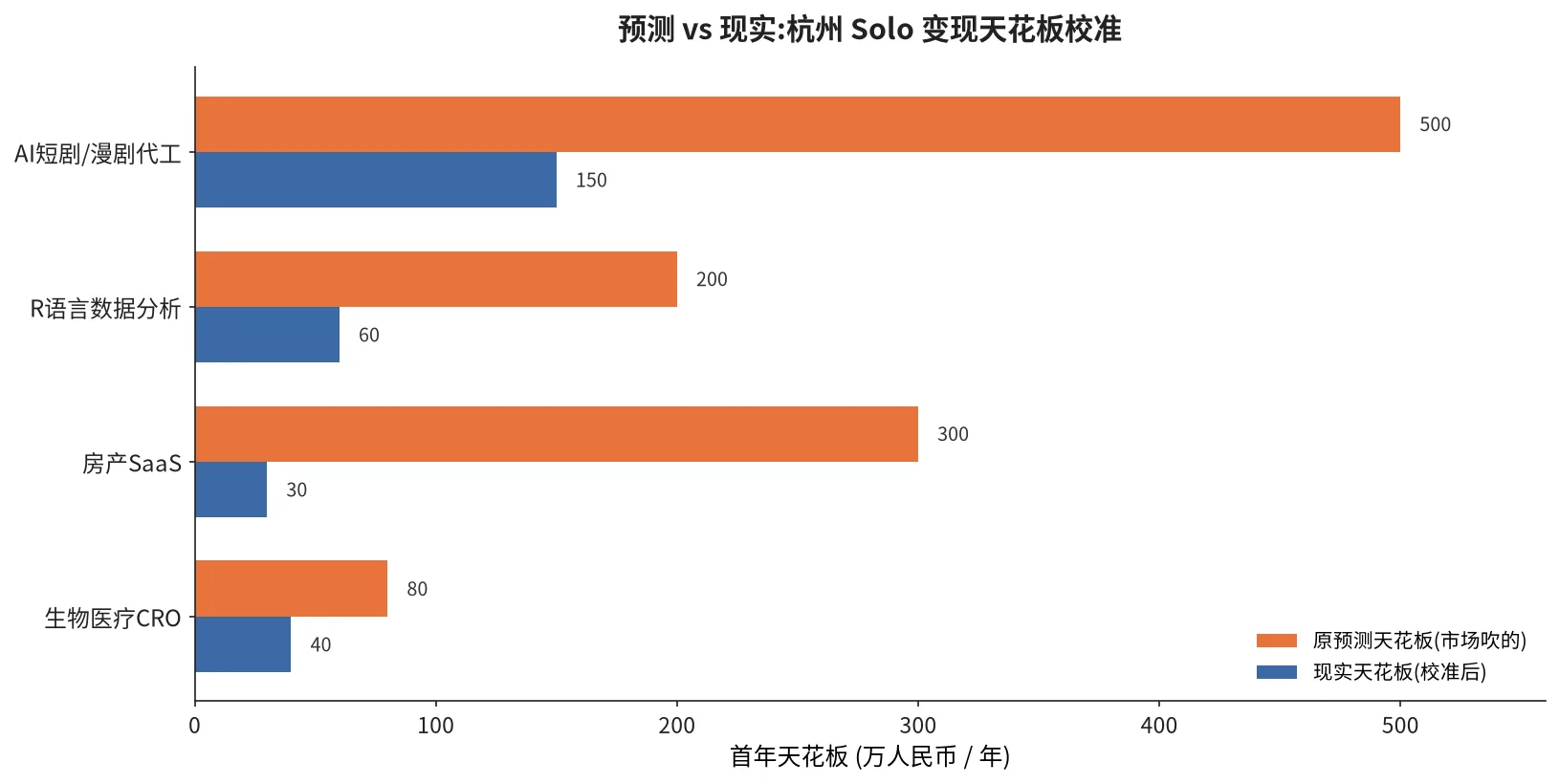
| Path | Hyped ceiling | Realistic ceiling | Core obstacle |
|---|---|---|---|
| AI live-action short-drama outsourcing | 5M+/yr | 1-2M/yr | Cost 500-1000 RMB/min, thin margin, needs scale + distribution |
| R-language data analysis | 2M/yr | ~600K/yr | Crowded, ticket price hard to push past 800-1500 RMB |
| Real-estate SaaS | 3M/yr | ~300K/yr | Agents’ margin ~10%, basically no API budget |
| API gateway | 1M/mo | ~50K/mo | High ban risk + compliance gray zone, not a main line |
| Biomedical CRO docs | 800K/yr | ~400K/yr | Remote roles start at 15-25K, not 30K |
Top 3 realistic paths
Path 1: LynxHealth health-risk SaaS (B2B2C with physical-exam centers)
Mechanism: private physical-exam centers buy the whole risk-analysis capability (package/annual-fee share); end users scan a code after their exam to see a “family health-risk report” (free basic + paid deep version).
Realistic ceiling: 100-300K RMB in year one (not 5M).
Key obstacles:
- The real number of private physical-exam centers in Hangzhou is far below the “200” you hear — must be walked one by one.
- “API per-call revenue share of 5-8 RMB” is unrealistic — center packages run 1,571-13,491 RMB, they’re more likely to buy the whole system.
- Medical compliance is the killer: LynxHealth is currently positioned as a “non-diagnostic tool,” but to genuinely enter exam centers as B2B2C you either go the “non-diagnostic health assessment” route (health-commission filing + boundary statement + a licensed doctor in the loop) or you brush up against Class-II medical-device approval (2 years + hundreds of thousands) — the latter is not survivable for a solo founder.
Year-one path: months 1-2 finalize production deployment + prepare “non-diagnostic” boundary-statement materials; month 3 visit 5 private centers for free POC; months 4-6 sign one pilot, run real user flows (2,000-5,000 RMB/mo); months 7-12 add 3 high-demand diseases (fatty liver / thyroid / coronary) per feedback, expand to 3-5 centers.
Mandatory precondition: a licensed doctor must be in the review loop, otherwise legal risk is extreme.
Path 2: R-language data-analysis freelance + automation line
Mechanism: data-analysis demand from study-abroad / research applications (the international-student market carries a premium) + Rmarkdown/knitr templates that automate “report generation” down to 10 minutes.
Realistic ceiling: 300-600K RMB in year one (not 2M).
Reality check:
- The market exists but is crowded; Hangzhou LinkedIn remote data-analyst roles mostly want full-time.
- “5W/day” on Xiaohongshu is top-1% survivorship bias; real conversion rates are commonly <3% (not 5%).
- Templates cut cost but ticket prices are hard to push past 800-1500 RMB.
Year-one path: week 1 post 3 desensitized cases on Xiaohongshu/Zhihu; week 2 set standard pricing (basic 1,500 / deep 3,500); week 3 use LynxAct experience to make score-boost case videos; months 1-2 average 2-3 orders/day × 800 = 15-25K/mo; months 9-12 after 10-15 orders, assemble a 2-person part-time team and productize templates.
Mandatory precondition: build a real automation line (not order-taking speed runs), or time-ROI collapses.
Path 3: Lynxhouse real-estate data API (To-C home-buyer pays, not selling to agents)
Mechanism: charge home buyers 99 RMB/query for “neighborhood rent-yield / IRR / historical filing prices,” rather than selling an API to agents (agents have no budget, and their own systems already integrate Beike data).
Reality check: “20K agents ×1% ×999 RMB” is a gross overestimate — Beike’s 500K brokers is a national figure; Hangzhou agents’ margin is ~10-15%, a 999-RMB API would eat 6.7% of a single commission (too high) with no differentiation.
To-C path: months 1-2 add an API route to Lynxhouse (FastAPI + auth); month 3 design the 99-RMB/query page; month 4 run 3 real neighborhoods’ data end-to-end; months 5-6 launch paid + partner with Lianjia agents for C-side traffic.
Realistic ceiling: 100-300K RMB/yr (100-300 queries/mo × 99).
2.4 Hangzhou’s “free ammo”: policy leverage (don’t count on it, but don’t miss it)
One research lane (Hangzhou talent/subsidy policy) didn’t complete; I fill it from public sources. Hangzhou genuinely has real money available for a returning-overseas master’s-profile founder:
- University-graduate startup grant: outstanding projects up to 500K RMB, requires project review, usually within 5 years of graduation (Lx, a recent master’s grad, qualifies).
- Overseas high-level talent classification: can come with startup support / rental / home-purchase subsidies.
- 2026 “Hangzhou Toward the Future” Overseas High-Level Talent Innovation & Entrepreneurship Competition: prizes + hukou channel.
- Districts (Qiantang / Gongshu / Yuhang) all have startup-incubation and subsidy batches; Qiantang district (home to the biomed port) has its own入驻 policy.
Honest caveat: this money is “supplementary ammo,” not “main-line revenue” — review cycles run 2-6 months, materials required, quota competition, and most subsidies are easier to get once the project is already moving. The right move is run revenue validation in parallel with applying for subsidies, not wait for the subsidy to land before starting.
3. The first 6-month validation checklist: from 0 to a closed monetization loop
(Note: this is not a “earn 1M in 90 days” promise — it’s a 6-month “minimum validation” checklist. First prove each path can bring in the first yuan, then decide which to double down on.)
- Weeks 1-2 · LynxHealth production validation: all 7 disease models green (deployed 7/7), prepare “non-diagnostic” boundary statement, test 10 real user flows locally including the doctor-review step.
- Weeks 3-4 · Exam-center POC: walk 5 Hangzhou private exam centers (booking/price/clientele), prepare a 1-page POC deck (7-disease model + report style), arrange 3 free demos and log feedback.
- Weeks 5-8 · R-language automation line validation: post 3 desensitized cases on Xiaohongshu, build the Rmarkdown auto-template (10-min reports), target 3 paid orders with conversion >3% before scaling spend.
- Weeks 9-12 · Lynxhouse API To-C test: add API route (FastAPI + OAuth2), design the 99-RMB/query page, partner with 3 Lianjia agents for free trials, target first paid order.
- Weeks 13-16 · LynxAct P2 probe: find 2-3 coaches to review a sample report and test willingness to pay, target confirming a coach price floor (est. 500-2,000 RMB/mo).
- Weeks 17-20 · Zhongkao PE content e-commerce MVP: shoot 1 “jump-rope 10-day improvement” video (Douyin + Xiaohongshu), build a 99-RMB light-consult group, design a 21-day camp + equipment bundle (199+78=277 RMB).
- Weeks 21-24 · Retrospective & focus: tally each path’s conversion, cut the <2%, focus on Top 2 and set Q4 monthly targets (e.g. 100K revenue), build a paid-user community + auto-renew.
(Weeks 25-30, if the main line is validated, then talk scale and subsidy filing.)
4. Risks and the honest conclusion
4.1 Fatal risks (handle first)
- Medical compliance: a LynxHealth 7-disease model commercialized without doctor review carries high legal risk; whether the “non-diagnostic” statement holds the B2B2C boundary is questionable, and real commercialization might hit Class-II device approval (2 yrs + hundreds of thousands) — a solo founder can’t carry that.
- Cold-start traffic: lynxhealth.lxlynx.com and the lynxhouse public page have 0 validated conversions right now. Where do real users come from? SEO ramp takes 3-6 months.
- Whether LynxAct P2 can run: the tech cards (62 + sample reports) are done, but coach willingness to pay is unvalidated. If 3 coaches all reject 500 RMB/mo, this path dies.
4.2 Real constraints (not technical)
| Constraint | Real impact |
|---|---|
| Night-owl schedule, ~4h/day of deep work, no team | Hard ceiling on monetization speed, can’t truly parallelize multiple paths |
| CPA free quota has hidden rate limits | Scaling tests may trigger 429 |
| CF Pages/Tunnel single point | Outage = full stop, no backup link |
| Sports-ed background needs medical/compliance knowledge | The LynxHealth path requires understanding medical-indicator boundaries |
4.3 Reality-based recommendation
Lx’s optimal move isn’t “find the most lucrative direction,” it’s “at minimum validation cost, first close one monetization loop”:
- Main path: LynxHealth health-risk SaaS (B2B2C exam centers, with doctor review)
- Side path: R-language data-analysis automation line (international-student market)
- Paused: Lynxhouse API (validate To-C conversion first)
- Cached: LynxAct P2 (don’t invest until coach willingness to pay is validated)
Why not MatrAIx? Technically, no GPU means the local 8B model can’t run and cloud-API cost is high; directionally, an AI evaluation framework ≠ an AI service; commercially, no scenario overlap with existing projects.
Why not short drama / pure content platforms? Comic drama’s per-episode cost is low (~22.5-90 RMB/ep) but its unfreeze condition (clear distribution channel / order) isn’t met; 90% of Bilibili/CSDN/Official-Account authors make <200 RMB/mo — not a sustainable main line.
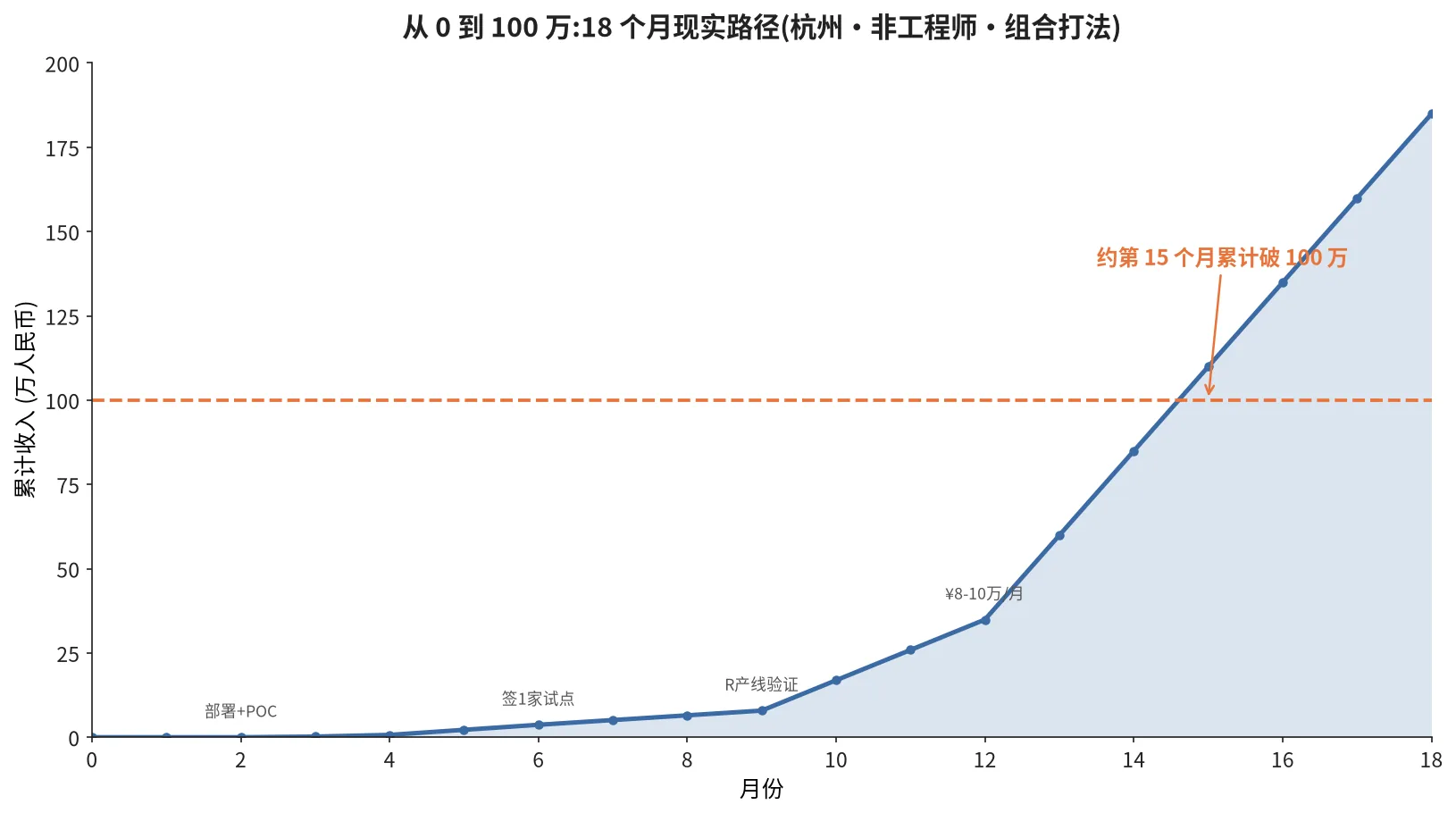
5. The real timeline: from 0 to 1M
| Time | Key milestone | Target monthly revenue | Hypothesis to validate |
|---|---|---|---|
| Months 1-2 | LynxHealth deploy + POC done | ¥0 | Exam centers willing to try |
| Months 3-4 | Sign 1 pilot | ¥2,000-5,000 | Doctor-review flow works |
| Months 5-6 | Expand to 3-5 centers | ¥10-20K/mo | Compliance risk controllable |
| Months 7-9 | R-line validates 3 orders/mo | ¥8-20K | Conversion >3% |
| Months 10-12 | Centers ×20K + R side gig | ¥80-100K/mo | Cash flow turns positive |
| Months 13-18 | Scale + enterprise annual cards | ¥200-300K/mo | Demand is real |
Real time to 1M: ~12-18 months (not “a few months”). Why slow: medical-compliance review 3-6 mo, cold-start SEO ramp, real-user-feedback iteration, and Lx’s own 4h/day hard ceiling.
Coda: the non-engineer’s breakthrough
Lx’s case punctures a commonly ignored reality: in 2026 Hangzhou AI startups, the non-software-engineer’s breakthrough isn’t “learn to code,” it’s “find an asymmetric advantage”:
- Non-CS background + R data analysis → can read business indicators + can do stats (a real B2B entry at exam centers)
- Claude Code + CPA proxy stack → AI-coding productivity without SWE skill (already a fact)
- Research + content pipeline → productize the research capability (Rmarkdown template automation)
MatrAIx is of course exciting research, but it isn’t your product; at this stage it’s only a candidate “capability amplifier.” Once your first-million validation path is running, you can come back and discuss using MatrAIx to optimize your evaluation flow.
Hangzhou’s AI startup scene doesn’t lack tech geeks — it lacks “ordinary people who can earn the first yuan in one specific scenario.” Your first million probably won’t come from the coolest tech, but from the most honest demand validation.
References
- [1] arXiv:2608.04205 — MatrAIx: Simulating the World with 8.3 Billion Persona Agents: https://arxiv.org/abs/2608.04205
- [2] MatrAIx-Persona-8B GitHub repo (MIT, 1,206 stars): https://github.com/MatrAIx-ai/MatrAIx-Persona-8B
- [3] HuggingFace paper page: https://huggingface.co/papers/2608.04205
- [4] Hangzhou overseas high-level talent startup policy (bendibao): http://hz.bendibao.com/live/2020119/96041.shtm
- [5] Hangzhou university-graduate employment & startup policy: https://coe.zufe.edu.cn/info/1017/3471.htm
- [6] 2026 “Hangzhou Toward the Future” Overseas High-Level Talent Innovation & Entrepreneurship Competition
- [7] First-hand research: Hangzhou private exam-center visits, BOSS Zhipin R data-analyst roles, Xiaohongshu study-abroad data-analysis conversion tests (2026-07~08)
- [8] LynxHealth production deployment verification (2026-08-18, 182 pytest green)
- [9] Hangzhou Zhongkao PE candidate counts (Hangzhou Education Bureau annual report)