
DeskcommCRM: An Open-Source CRM That Closes the Sales Loop with WhatsApp.AI
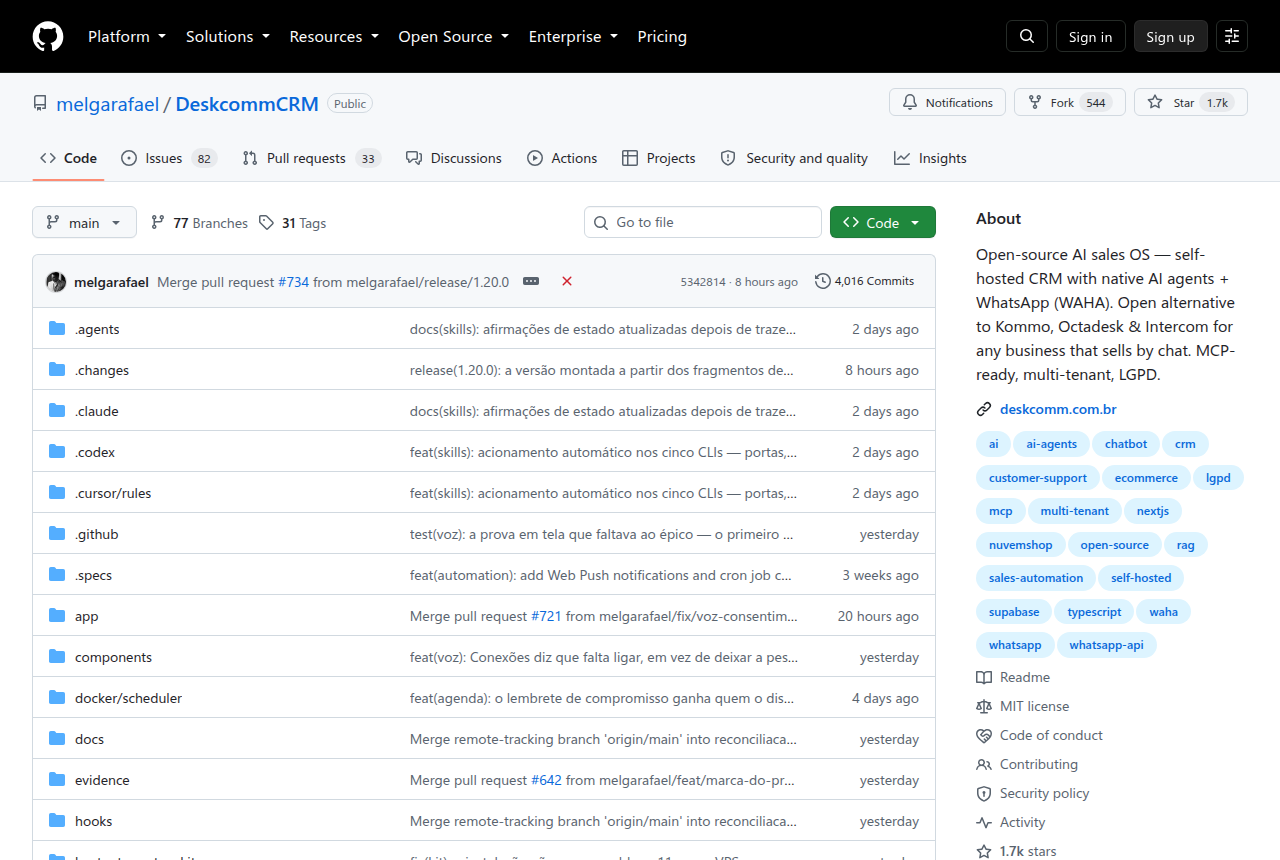
Today on GitHub Trending, Brazilian developer Rafael Melga’s DeskcommCRM racked up 505 stars in a single day. It isn’t just another customer management tool — it deploys an AI sales agent directly inside WhatsApp. No subscription fees, no black box, and your data stays entirely on your own servers.
This reflects a clear trend: enterprise AI is shifting from “LLM showboating” to “deployable sales engines.” While the Chinese market is still debating whether Agents are just a PPT concept, DeskcommCRM has already run the full pipeline — from lead acquisition → qualifying → closing — across Latin American markets.
1. Core Features: A Trio of CRM + WhatsApp + AI Agent
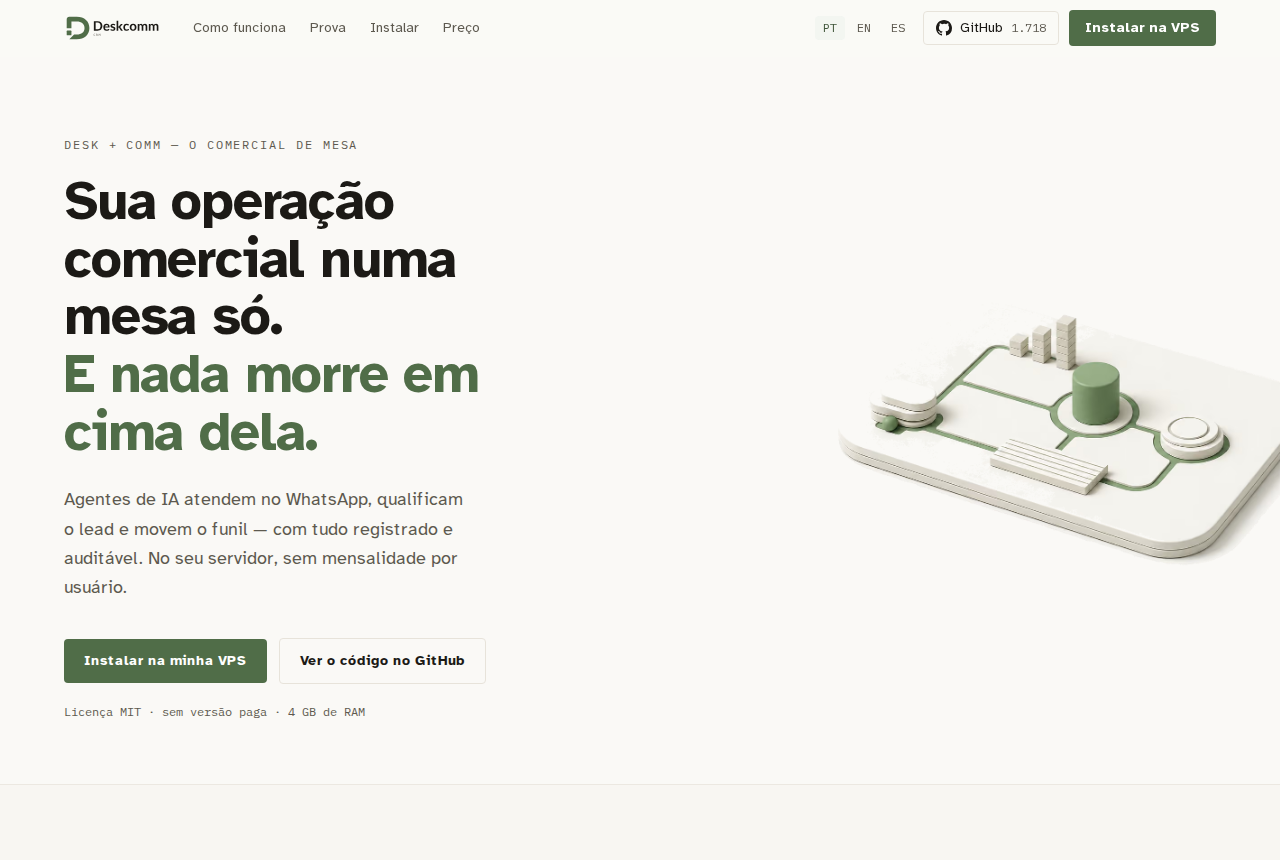
DeskcommCRM’s design is remarkably lightweight: it’s essentially a Next.js application that treats WhatsApp as the sole user touchpoint. You can think of it as a combination of:
- Supabase backend: All data — users, conversations, leads, and automation rules — lives in a transparent PostgreSQL schema
- WAHA WhatsApp integration: Two modes — Meta official API or QR Code — naturally suited to markets like Brazil and Mexico where WhatsApp penetration exceeds 95%
- AI Agent stack: Supports OpenRouter / Anthropic / OpenAI models, with local RAG retrieval over a product knowledge base and multi-tenant prompt isolation
Its biggest advantage is that it “doesn’t disrupt user habits”: all sales conversations happen inside WhatsApp. Customers don’t need to download a new app or register a new account — and that’s exactly why it outperforms traditional CRMs in WhatsApp-heavy markets.
2. Three-Step Setup: Simpler Than Docker Compose
The project’s hostgator-setup-kit compresses the installation process to the bare minimum:
| |
The entire setup requires zero knowledge of image versions, network modes, or pg_dump backup procedures. It even thoughtfully provides two deployment paths:
- Production: HostGator partnership plan (4GB RAM minimum), with pre-configured cron jobs for automatic updates and daily backups
- Local trial: Run
bash hostgator-setup-kit/comecar.shdirectly on MacOS / Linux / WSL — the script analyzes your current configuration and recommends a suitable plan
Updates don’t even require SSH access — just log into the admin panel and click “Update.” The system automatically: backs up the database → pulls new images → migrates the schema → runs health checks. If anything fails, it rolls back to the previous version.
3. Technical Trade-offs: The “Dumb” Approach Built for Localization
DeskcommCRM’s design philosophy is hidden in a seemingly “contrarian” decision: it deliberately refuses to provide a web-based customer chat interface.
Why? Because in Latin American markets, 80% of business owners and customers already live in WhatsApp. Adding a web channel only creates fragmentation and response latency. This “dumb” choice yields three real benefits:
- Minimal compliance cost: Brazil’s LGPD regulations require user data to be deletable. With all data in a self-managed Supabase instance, a single command clears everything for compliance
- Zero-friction multi-tenancy: Different brands share the same codebase but isolate model prompts and knowledge bases via plugin-style configuration (MCP-ready)
- Budget-friendly: Supabase free tier + self-hosted WAHA keeps monthly costs near zero — unlike commercial solutions that charge per seat
Technically, it makes several smart compromises:
- No Kubernetes: Single-VPS deployment is sufficient for small-to-medium teams; complex orchestration only increases the failure surface
- Unified chat entry point: A single WAHA channel rather than aggregating Telegram / Email, reducing model context confusion
- Idempotent schema tracking:
baseline.sqlsupports repeated runs with automatic historical data structure repair, making upgrade scripts incredibly simple
4. Who Should Pay Attention?
- Cross-border businesses with WhatsApp sales teams: Especially those targeting Mexico, Brazil, Indonesia, and similar markets — no need to educate users on a new app
- Business owners tired of monthly SaaS fees: After a one-time deployment, costs are limited to API calls and server expenses
- Technical teams wanting to customize agent scripts: Automatically build RAG vector stores from product materials, with fully proprietary data that never leaves your infrastructure
- Teams who want a complete business loop (leads → deals → reminders) — as opposed to those just tinkering with open-source or building agent bots for fun
The competitive landscape is clear:
- vs. Kommo / Octadesk: No feature gating, no per-seat fees — but you need to run your own server
- vs. Intercom: Focused on WhatsApp as a single channel rather than omnichannel, but with lower conversation latency and easier customer reach
- vs. self-built LangChain bots: Out-of-the-box with complete CRM functionality, with polished backlog / ticket workflows
Final Thoughts
DeskcommCRM’s emergence reminds us: when an open-source project seriously studies a market’s local entry point (like WhatsApp in Brazil), it may well be redefining the footprint and barrier to entry of “enterprise software.”
It may not fit every scenario — but if your customers already live in WhatsApp, this project deserves a spot on your tech radar.
The author has open-sourced the complete ARCHITECTURE.md and VISION.md — worth a read.