
Meta Launches Muse Spark 1.3: Aggressive Iteration Meets Cost-Driven Performance

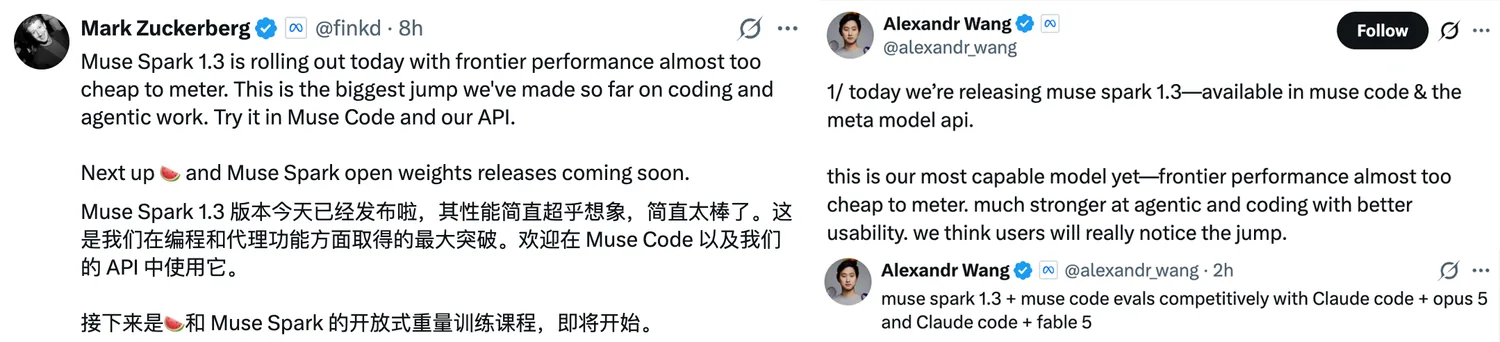
Meta released its latest flagship model, Muse Spark 1.3, on September 3, 2026. The model is now gradually rolling out in Muse Code and Meta Model API, with inference mode available immediately. The max-reasoning (extreme reasoning) mode will open after completing additional safety evaluations.
Key facts at a glance:
- Release date: September 3, 2026
- Version: Muse Spark 1.3 (4th iteration in 5 months: April launch, July 1.1, August 1.2, September 1.3)
- Pricing: Input $1.25/1M tokens (cache miss), $0.15/1M tokens (cache hit); output $4.25/1M tokens
- Open weights: Not yet released (Meta confirms it is planned for the future)
- Availability: Inference mode live; Muse Code integration rolling out
Benchmarks: Three Wins, Agent Capabilities Remain Fragile
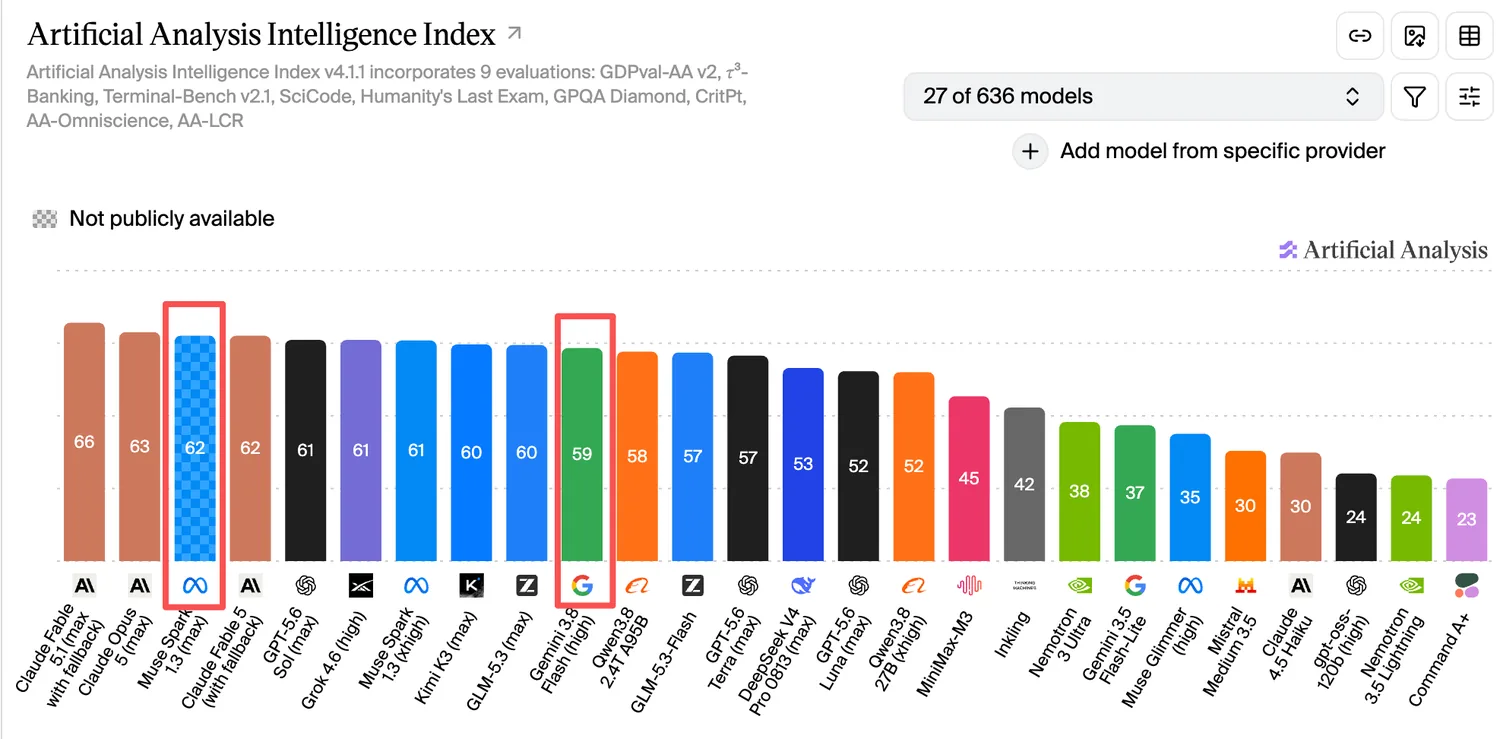
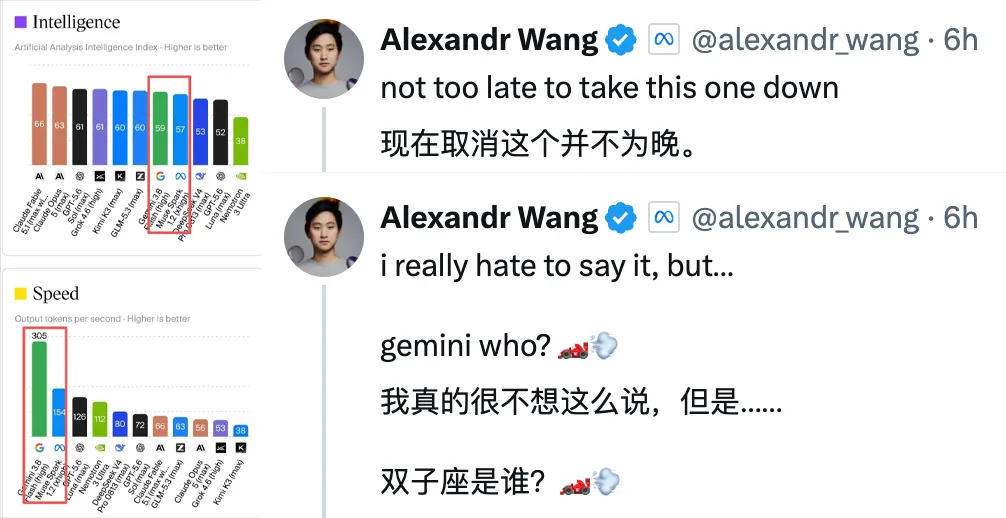
Per Artifical Analysis’s AI Index, Muse Spark 1.3 scores 62 points—just behind Claude Fable 5.1 (66) and Claude Opus 5 (63)—** surpassing Google’s newly released Gemini 3.8 Flash (59)**, which launched just four hours earlier. Meta’s model took five first-place finishes, outperforming GPT-5.6 Sol and Claude Opus 5 in code and out-of-context reasoning tests, while tying on Terminal-Bench agent command execution.
The model’s relative weakness lies in agent capabilities: it underperforms in web-search-augmented agents and the GDPVal-AA v2 general knowledge benchmark. Meta emphasizes Muse Spark 1.3 prioritizes long-duration task support and coding efficiency, maintaining context across multi-step workflows within a single session, recognizing its own boundaries, and autonomously refining plans without discarding key constraints.
Cost Efficiency vs. Output Quality: A Trade-Off Spectrum
Developers have documented striking cost savings. One built a Minecraft game for just $0.10; another ran 20 self-iteration cycles (60+ agent tasks in two hours) for under $1 using Ultra mode. Some observers noted the extended iterations could signal incomplete task resolution rather than raw capability.
MineBench, an open-source spatial reasoning benchmark, shows Gemini 3.8 Flash achieving $1.18 total cost, 111-second average latency, and 1888 Elo score; Muse Spark 1.3 costs $6.57, averages 336 seconds, and scores 1787. This reveals an unexpected trade-off: Muse Spark 1.3 offers faster startup and lower baseline usage, but per-call output quality lags behind Gemini 3.8 Flash.
▲ Major model pricing comparison (USD per million tokens)
| Model | Input (cache miss) | Input (cache hit) | Output |
|---|---|---|---|
| Muse Spark 1.3 | 1.25 | 0.15 | 4.25 |
| Gemini 3.8 Flash | Not disclosed | Not disclosed | Not disclosed |
| DeepSeek-V4-Pro (peak) | Not disclosed | Not disclosed | Higher than Muse Spark 1.3 |
Developer consensus: Muse Spark 1.3 matches Qwen 3.8 Max in cost and speed, though Qwen delivers higher output quality over a ~90-minute runtime versus Muse Spark’s ~2 minutes. GLM 5.3 leads in balanced performance across quality, cost, latency, and token efficiency.
Who Should Adopt Now—and Who Should Wait
Adopt immediately if your use case involves:
- Multi-step workflow orchestration or synchronous Agent chains
- High-frequency API calls where cost per token dwarfs quality sensitivity
- Rapid prototyping where iteration speed outweighs final-output polish
Consider waiting if you require:
- Production-grade single-call task completion with minimal rework
- Robust Agent functions reliant on real-time web search or deep domain knowledge
- SOTA generation fidelity where one-shot quality is non-negotiable
Final Thoughts
Meta’s four-model sprint in five months signals a strategic pivot from caution to velocity in large-model development. Its deliberate focus on “long-context + coding + task persistence” over brute-force universality presages an emerging industry norm: enterprises will increasingly route tasks across specialized models rather than relying on a single all-purpose system.