A Contest Framed Around Real Deployment
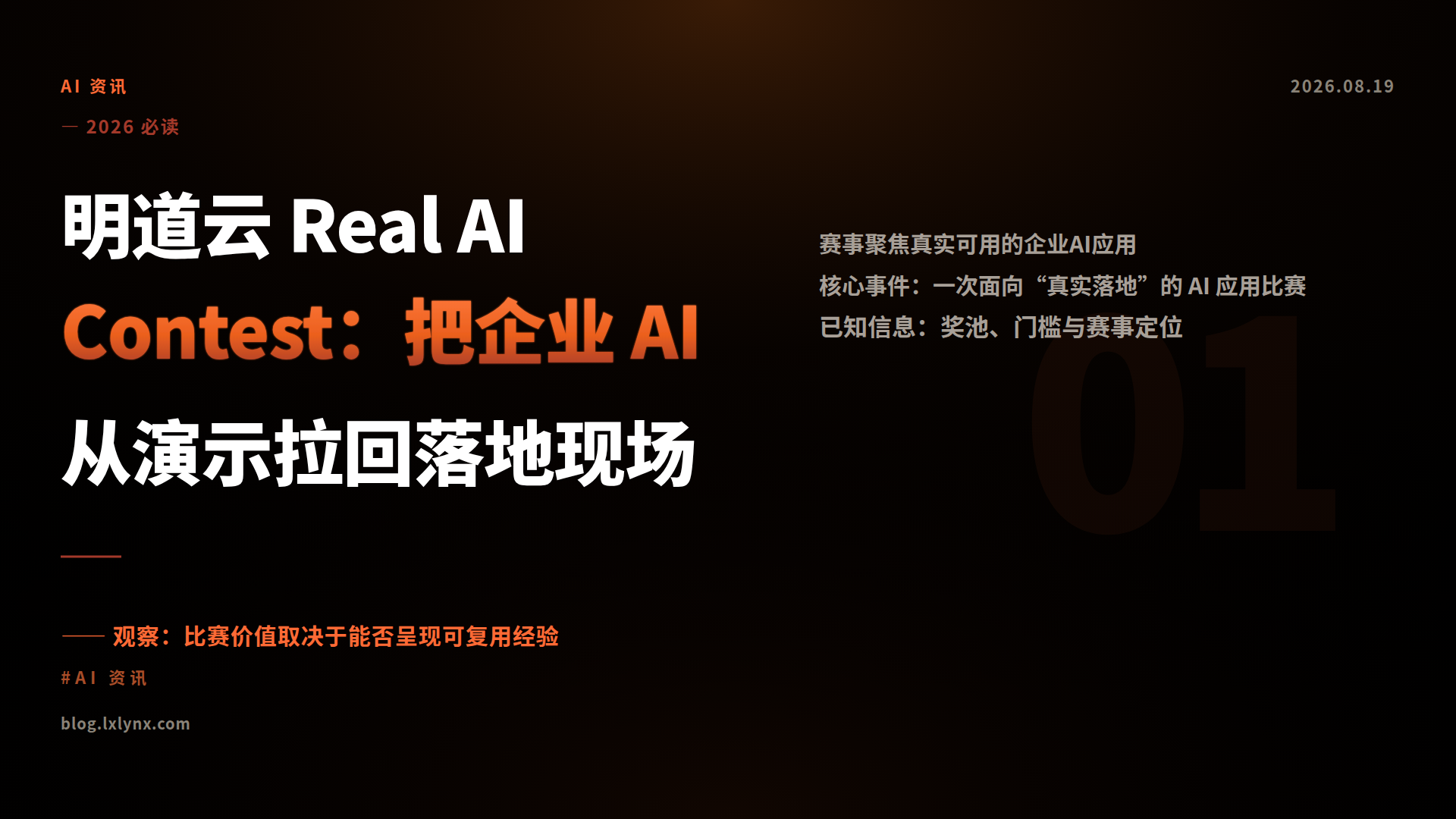
Mingdao Cloud has launched the first Real AI Contest, a competition focused on enterprise AI applications that have moved beyond concept demos and into practical use. According to the available summary, the contest offers a total cash prize pool of ¥80,000 and free registration.
The source article’s full text was not provided, so the confirmed facts are limited to the title and summary. What is clear is the positioning: the contest is not merely about showcasing AI ideas, but about comparing teams that have already completed some form of implementation under a shared evaluation framework.
In this context, “Real AI” points to real scenarios, real business problems, and real delivery rather than standalone technical demonstrations.
What Is Known So Far
The available information confirms several key points:
- Organizer: Mingdao Cloud;
- Event: the first Real AI Contest;
- Prize pool: ¥80,000 in cash;
- Registration: free;
- Focus: enterprise AI applications that have already gone through a real-world implementation process.
Enterprise AI applications usually refer to AI systems embedded in business workflows, knowledge management, internal operations, customer support, or decision-support processes. Unlike a general-purpose chatbot, enterprise AI typically needs to work with organizational data, permissions, business rules, and existing software processes.
The summary says the contest will place participating teams under the same set of standards. That matters because enterprise AI cases are often difficult to compare: one project may improve internal approvals, another may support customer service, while a third may help employees search company knowledge. A common framework can make those cases easier to evaluate. However, the original material does not disclose the specific judging criteria, so no further assumptions should be made about scoring or ranking.
Why “Real” Enterprise AI Matters
The enterprise AI market has moved past the question of whether AI can produce impressive demos. The harder question is whether it can be safely and repeatedly used inside actual business operations.
Generative AI, broadly speaking, refers to AI systems that can produce text, images, code, or other content. In companies, it is often used for document drafting, question answering, knowledge retrieval, and workflow assistance. But a working demo is only the beginning. A useful enterprise system must connect with data, respect permissions, fit existing workflows, and earn the trust of employees who use it daily.
This is why a contest focused on implementation could be more relevant than one centered only on technical novelty. For a business user, the most important questions are often simple: Does the application solve a real problem? Is it being used by real users? Can its impact be explained in business terms?
Industry Outlook
The value of the Real AI Contest will depend on how well it surfaces reusable lessons from actual projects. If the contest highlights cases that are already in use and can explain how AI changed a workflow, it may offer more practical insight than a conventional product showcase.
More details are still needed, including eligibility rules, submission requirements, judging methods, and how final cases will be presented. These factors will determine whether the contest can meaningfully distinguish between a polished demo and a deployable application.
The broader direction is clear: enterprise AI competition is shifting from “who has added AI features” to “who has embedded AI into business processes.” The strongest examples will be those that can show what problem they solved, who uses the system, and what changed after adoption. If Mingdao Cloud’s contest can make those questions visible, it may become a useful lens for observing the maturity of enterprise AI deployment.