
MiniCPM5-2B Open-Sourced: A New Benchmark for Edge-Side Agent Capabilities
- Release Date: September 8, 2026
- New Version: MiniCPM5-2B, 2B (2 billion) parameters
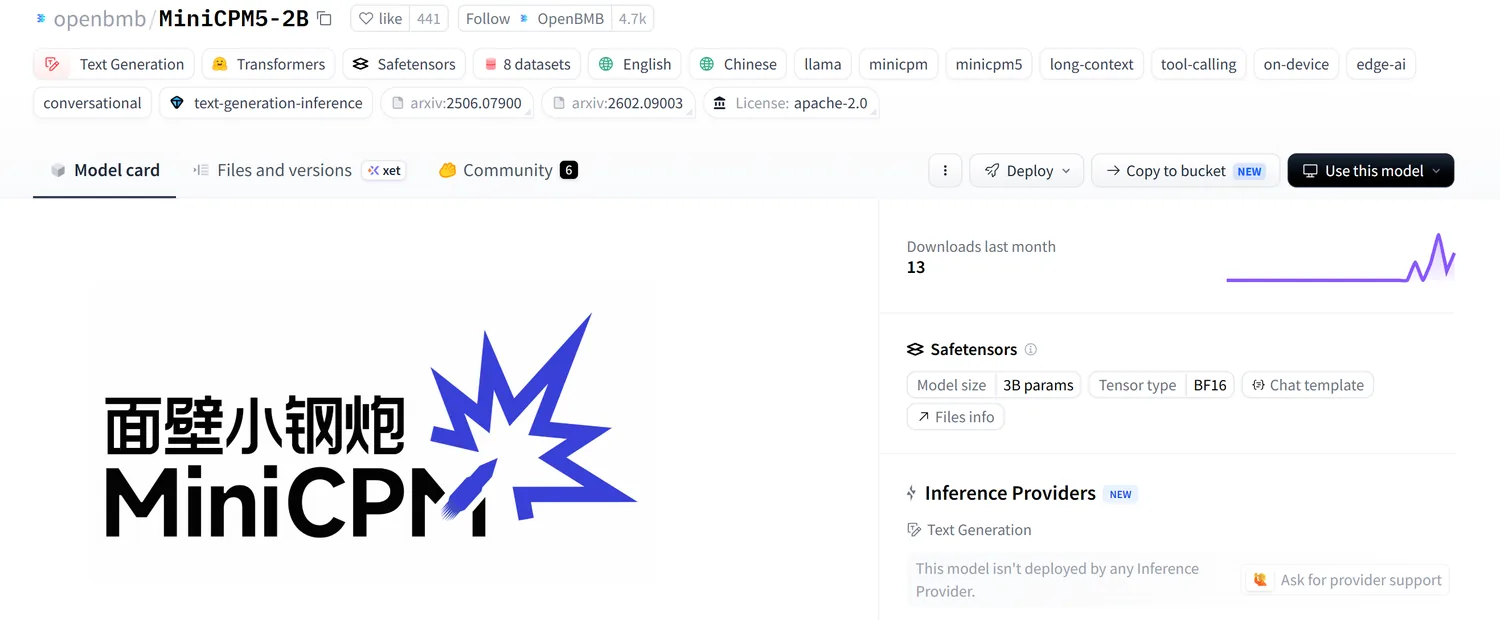
- Weights Available: Yes — model weights, training recipes, RL framework, and datasets are fully open-sourced
- Availability: Immediate — integrated into mainstream development toolchains
- Hardware Support: Day-0 native适配 for Intel, Rockchip (瑞芯微), and Arm platforms
Surprising Intelligence Density: A 2B Model Outperforms Much Larger Models
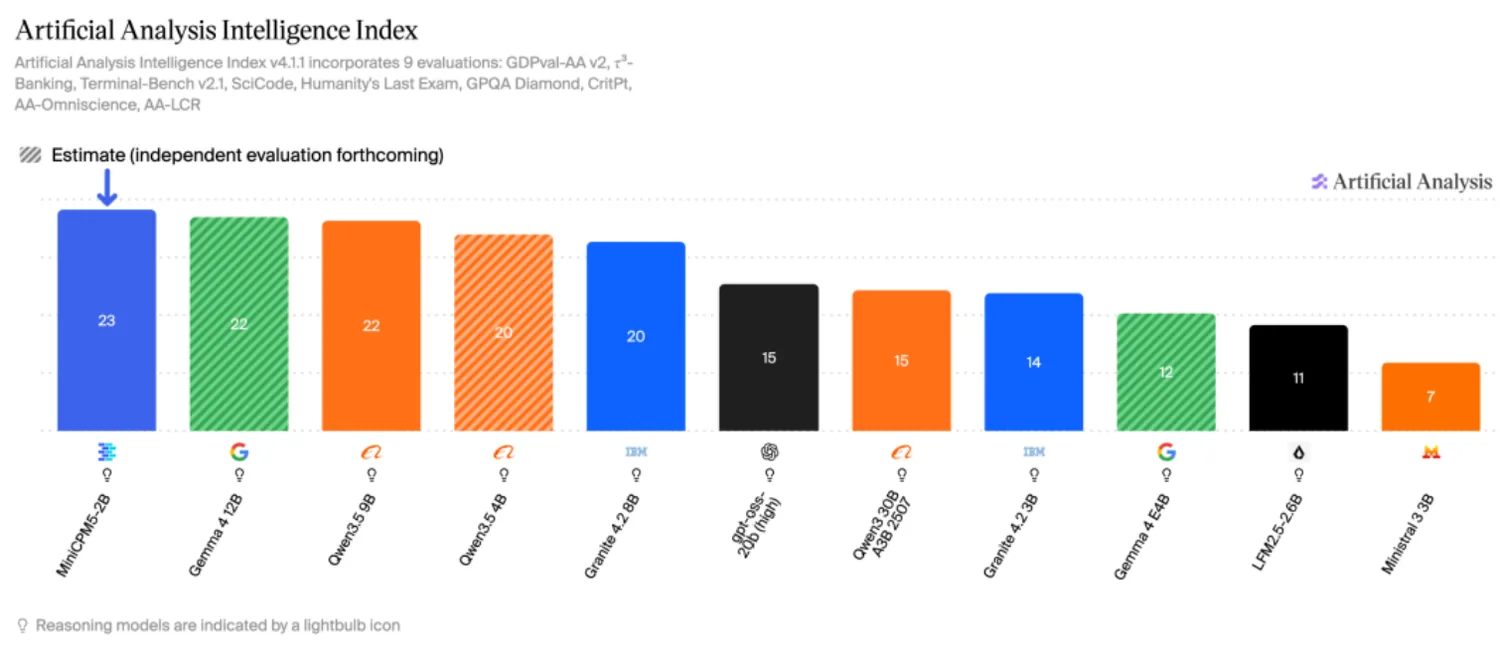
MiniCPM5-2B, jointly released by Beijing-based edge AI startup ModelScope (面壁智能) and the OpenBMB open-source community, achieves top ranking among 4B-parameter and smaller open-source models with a score of 23 on Artificial Analysis’ benchmark — surpassing Google’s 12B-parameter Gemma 4 (score: 14), despite using only one-sixth the parameters.
The unexpected metric lies in inference efficiency: MiniCPM5-2B consumes only 21k tokens (1.4k reasoning + 7k answer) to achieve 891 points on real-task evaluation, compared to Gemma 4 12B scoring just 647 with significantly higher compute. This indicates exceptional parameter utilization efficiency — MiniCPM5-2B delivers nearly double the intelligence per parameter.
Across 34 benchmark datasets covering code reasoning, math, instruction following, knowledge, long-context, tool use, and Agent tasks, MiniCPM5-2B averages 53.9 points, outperforming larger rivals like Qwen3.5-4B.
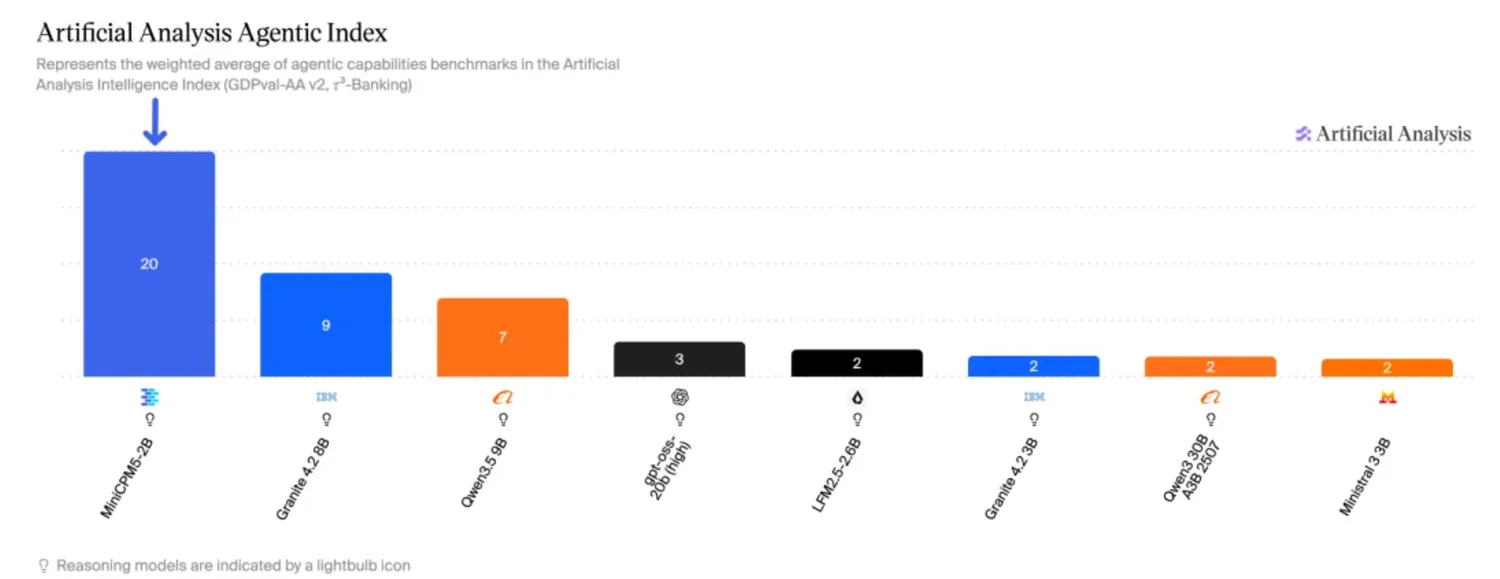
The Agentic Index, measuring autonomous task execution capability, stands at 20 points — double the next-closest competitors (all below 10), demonstrating emerging general Agent abilities.
| Model | Parameters | Artificial Analysis Score | Token Consumption | Real-Task Score | Key Features |
|---|---|---|---|---|---|
| MiniCPM5-2B | 2B | 23 | 21k (1.4k+7k) | 891 | Tool use, deep search, code generation |
| Gemma 4 12B | 12B | 14 | ~126k (estimated) | 647 | Larger size, low efficiency |
| Granite 4.2 3B | 3B | Not specified | 19k (12k+7k) | 14 | Long chain but low性价比 |
| LFM2.5-2.6B | 2.6B | Not specified | 21k (14k+7k) | 11 | Same-tier low efficiency |
Reinforcement Learning Frameworks and Training Recipes Openly Shared
Beyond the model, three core components are open-sourced:
- Meshy Framework: Self-developed RL training system that removes the centralized controller and Ray dependency, supporting synchronous, asynchronous, and fully-async modes for flexible scaling
- JustRL II: Improves GRPO with a token-level Critic for credit assignment, addressing data quality and reward分配 challenges in long-chain reasoning, delivering significant post-training gains
- Complete Training Recipe: Full training配方, data (UltraData series), and code to ensure reproducibility
MiniCPM5-2B integrates with LlamaFactory and ms-swift (fine-tuning) and SGLang, vLLM, llama.cpp, Ollama, Hugging Face Transformers (inference), plus ModelScope’s Arclight CPU inference engine.
Day-0 Native Support Across Major Hardware Platforms
Bạn đồng hành with hardware partners enables rapid deployment:
- Intel: Optimized for Core Ultra series CPU/GPU/NPU and OpenVINO, targeting AI PC local deployment
- Rockchip: Runs on RK3588 and RK1828 dual-chip platforms via RKNN3; supports full task chain including tool calls
- Arm: Native support for Armv9 devices with SME2 technology, achieving 1.7× faster prefill and 1.2× faster decoding
Who Should Try It Now
Adopt now if you are:
- Edge/embedded developers needing optimized deployment on Rockchip/Arm hardware
- Researchers exploring tool-use and reasoning chains on limited hardware (high Agentic Index helps)
- Academic/teaching labs requiring reproducible RL experiments (complete Meshy + JustRL II open-source)
Consider waiting if you:
- Require ultra-low latency in production — exact latency data not disclosed; initial stress testing recommended
- Rely on specific Chinese AI chips (Huawei昇腾, Cambricon) — no mention of support yet
Final Thoughts
MiniCPM5-2B signals a shift from parameter bloat to intelligence efficiency in edge AI. When a 2B model beats a 12B model on raw capability, the value of compression and training innovation becomes undeniable — computational efficiency is emerging as the defining metric for next-generation local AI.