
A Key Engineering Figure Leaves MiniMax

MiniMax has lost a senior engineering figure who had been closely associated with its model, agent and developer-facing work. Skyler Miao, known in Chinese developer circles as Adao and listed publicly as Head of Engineering, is shown as having left the company on Feishu, according to QbitAI. His next role has not been disclosed.
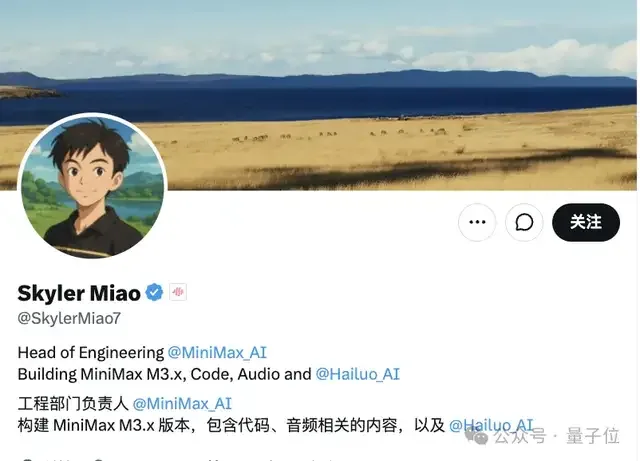
Miao’s X profile had not been updated at the time of the report. It still identified him as Head of Engineering and listed work related to MiniMax M3.x, Code, Audio and Hailuo AI. Those areas span several of the company’s most important technical and product lines: language models, coding tools, agents, speech and consumer-facing multimodal applications.
It is not yet known who will take over his responsibilities or where he will go next, and Miao himself has not responded publicly.
From Internet Infrastructure to Large Models
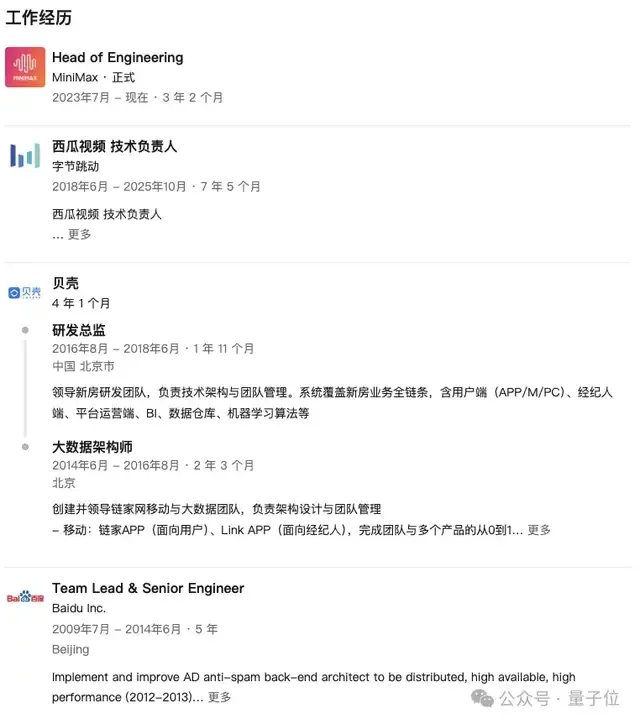
Miao’s career reflects a common path among senior Chinese technology engineers: large-scale systems first, AI infrastructure later. He graduated from Beijing University of Posts and Telecommunications, joined Baidu in 2009 as a Team Lead and Senior Engineer working on backend architecture for ad anti-fraud, moved to Beike in 2014 as a big-data architect and later R&D director, and joined ByteDance in 2018 as technical lead for Xigua Video.
He joined MiniMax in July 2023, during the first major wave of large-model startups after ChatGPT. At a large model company, a Head of Engineering role typically goes beyond software delivery. The job is to turn model capabilities into systems that can be trained, deployed, evaluated, iterated and eventually shipped inside real products.
Public information links Miao to MiniMax M3.x, Agent, Audio and Hailuo AI. In practical terms, he sat at the intersection of foundation models, agent infrastructure, voice technology and multimodal applications.
Why the Timing Matters
MiniMax has been pushing a strategy built around multimodal foundation models, agents and AI-native products. Its model work covers text, audio, image, video and music, while its product lines include MiniMax Code, MiniMax Hub, MiniMax Audio and Talkie.
Miao’s role became more visibly tied to agent engineering from the M2 series onward. MiniMax M2 was designed around Agentic Coding and Agentic Cowork: using AI systems to write code or cooperate with humans on complex tasks. The company also built Forge, an agent-native reinforcement learning system for long-horizon agent trajectory training, scheduling and inference optimization.
For general readers, an “agent” is an AI system that can plan steps, use tools and continue working toward a goal; a “harness” is the surrounding engineering layer that connects a model to tools, workflows, memory and evaluation.
Recent MiniMax milestones include:
- In late May, MiniMax upgraded Agent Team to split complex tasks across multiple agents for parallel collaboration;
- In early June, it released flagship model M3, emphasizing coding, agents and a 1-million-token long context, alongside the closely integrated MiniMax Code;
- In late July, it released MiniMax H3, its first general video model.
Miao’s departure therefore comes as MiniMax is binding its models more tightly to coding products, long-context use cases and multi-agent workflows.
A Public Voice for Engineering Strategy
Unlike many engineering executives who remain mostly internal, Miao had become a recognizable public technical voice for MiniMax. He appeared in offline technical events, developer roundtables and community discussions, where he discussed model engineering, harness design, agent infrastructure and long-context systems.
At a QbitAI roundtable in April, he argued that competition in the agent era was beginning to shift from the model itself to the harness. He compared a model to an F1 car: the same car can perform very differently depending on who drives it and how it is driven. In agent systems, the same model paired with different harnesses can consume several times more or fewer tokens to complete the same task. Tokens are the basic units large models process; higher token use usually means higher cost and latency.
In a conversation with the Hermes Agent team, Miao also discussed the shifting boundary between application-layer capabilities and model capabilities. Skills, workflows and harness features that today look like product moats may eventually be absorbed into more powerful foundation models. That observation points to a structural challenge for general agent startups: they need strong product experiences, while also facing the possibility that future models will internalize parts of what their software layer currently provides.
His outreach extended to social platforms as well. In May last year, he posted an AMA-style note on Xiaohongshu that turned into a technical Q&A thread, drawing nearly 400 comments and more than 1,000 likes.
Industry Takeaway
Miao’s departure does not by itself indicate a change in MiniMax’s roadmap. But it highlights a broader truth about the AI industry: large-model competition is no longer just about benchmark scores or single-model capability. The harder work is engineering integration—training, inference, tool use, evaluation, product feedback and developer ecosystems must operate as one loop.
MiniMax’s recent releases around M3, MiniMax Code, Agent Team and H3 show that it is still accelerating model-to-product integration. The open question is who will now carry forward the cross-functional engineering and developer-communication role Miao occupied. Across the industry, people who understand models, systems, products and communities at the same time remain scarce. Agent development will likely continue to swing between two forces: stronger models absorbing more functions, and external engineering frameworks making current models more useful.