
A systems-level debut in Beijing
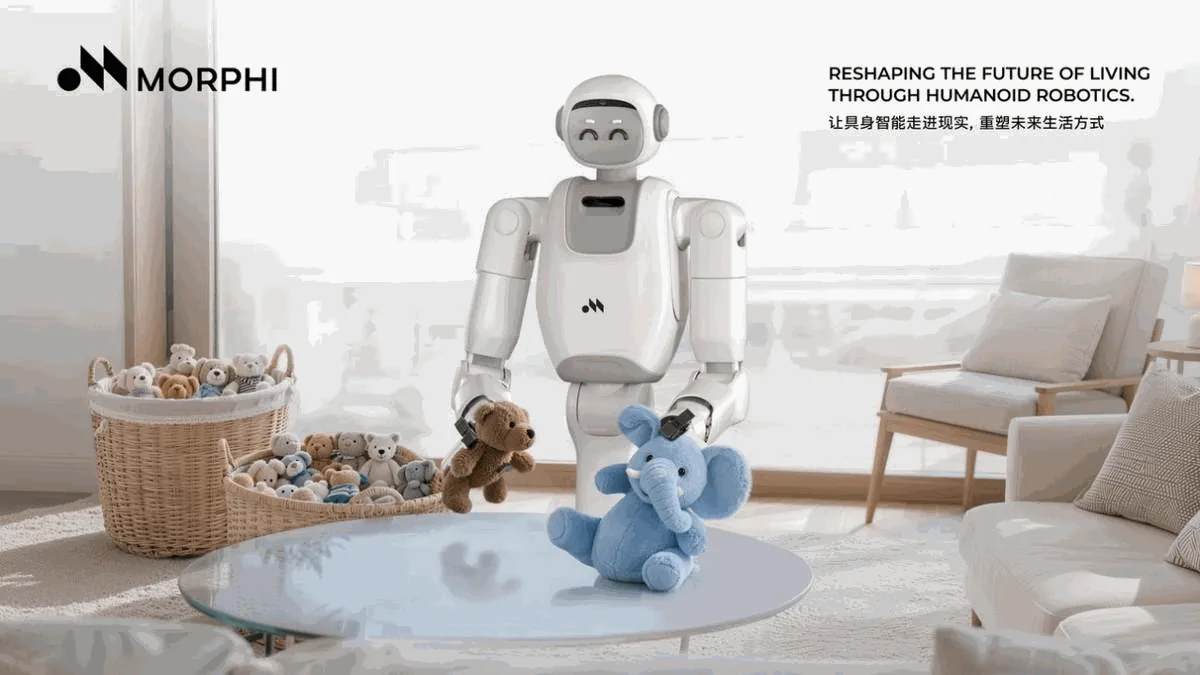
MORPHI used WRC 2026 in Beijing to present its embodied AI architecture, MoRA, and to introduce MORPHI KINO, a wheeled robot designed for long-horizon household tasks. The World Robot Conference ran from August 19 to 23 at the Beijing Etrong International Exhibition & Convention Center, giving the six-month-old company its first systematic domestic showcase.
Embodied AI refers to AI systems that perceive and act through a physical body, rather than only producing digital outputs. MORPHI’s central message was that useful home robots must move beyond isolated manipulation demos and handle continuous task execution in real spaces.
KINO demonstrates a 15-minute household workflow
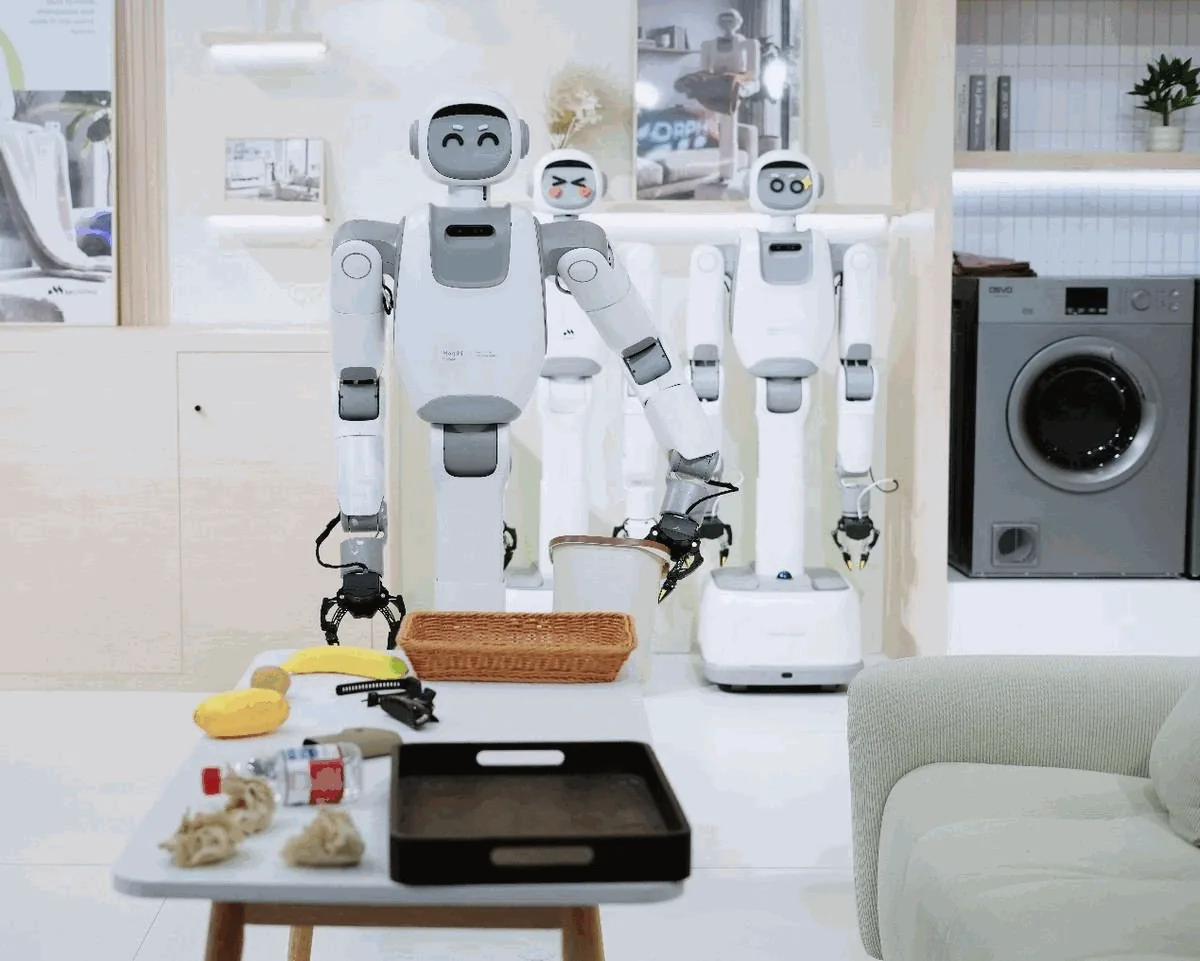
The main on-site demonstration was a roughly 15-minute, multi-step home scenario. MORPHI KINO moved across a simulated apartment setting to clean a living room, organize tabletop items, check and refill refrigerator drinks, transfer laundry between appliances, and fold dry clothes.
The robot identified objects such as paper tissues and water bottles on a coffee table, grasped and discarded trash, and placed scattered items onto a tray. It then checked beverage inventory in a refrigerator, fetched bottled water when supplies were insufficient, restocked the fridge, and closed the door. Such actions require perception of handle positions, door angles and applied force, as well as continuous adjustment of body and hand posture.
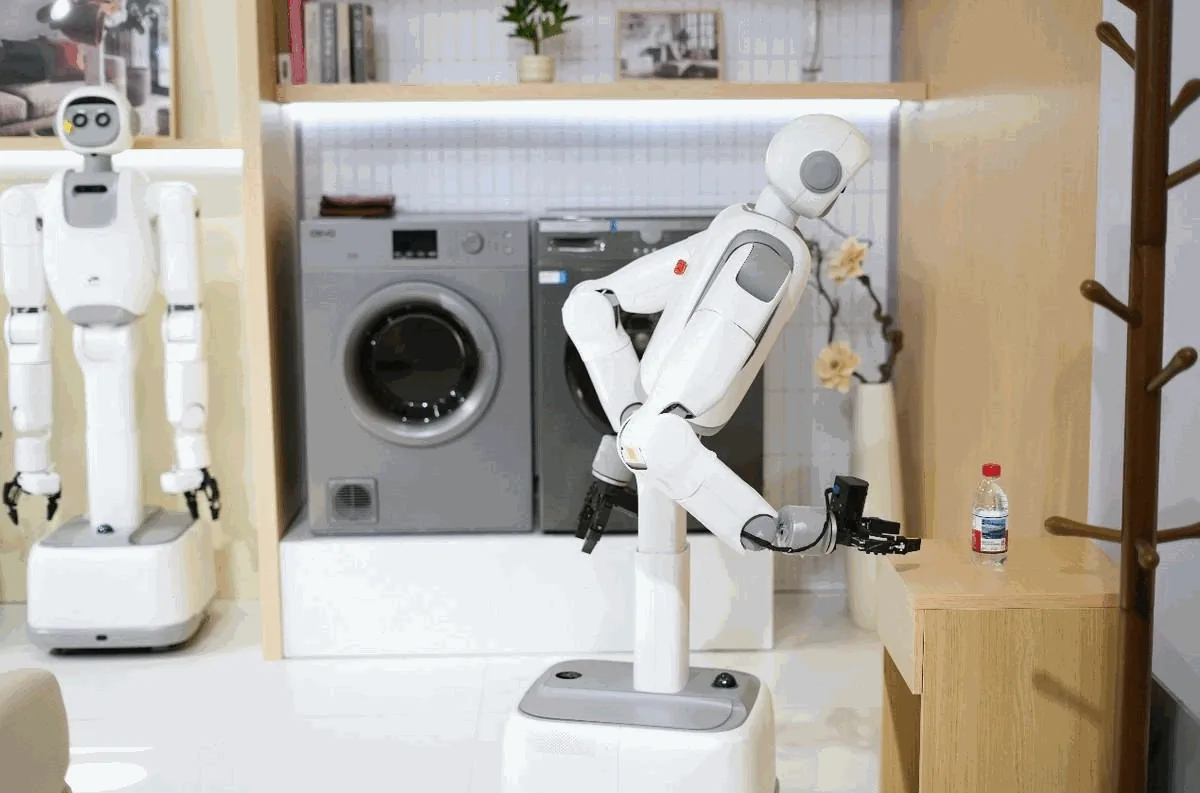
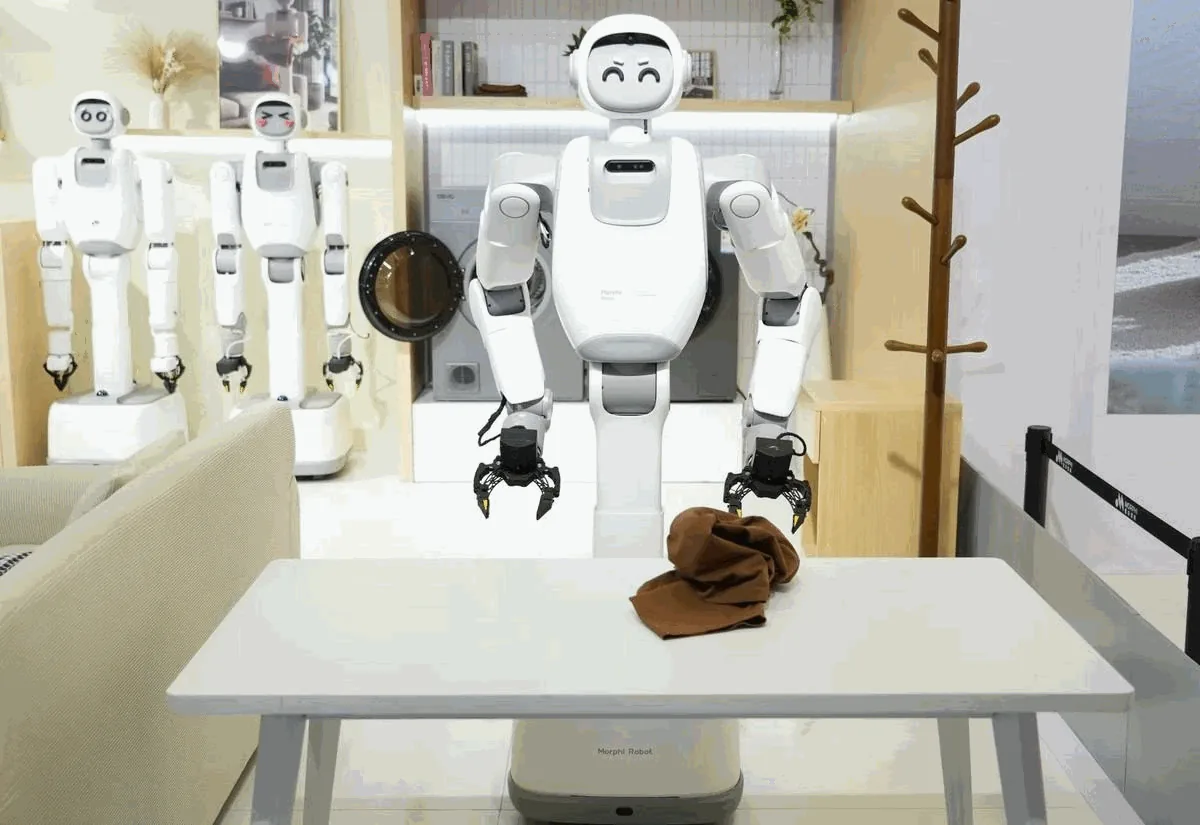
The laundry workflow added another layer of difficulty: the robot opened a dryer and a washing machine, moved dry and wet clothes, closed appliance doors, pressed the power and start buttons, and then folded clothes on a table. The notable point was not a single gripper trick, but coordination among the mobile base, torso, dual arms, vision and force-sensing modules.
MoRA shifts more autonomy into the action model
MoRA, short for MORPHI Reasoning and Autonomy, is MORPHI’s proposed embodied model architecture. Many robotics systems use a two-layer setup: System 2 handles high-level cognition and planning, while System 1 executes low-level robot policies. MORPHI argues that if goal tracking, memory, progress monitoring and recovery remain almost entirely in System 2, the execution layer can become too short-horizon and reactive.
Its Agentic-Native approach gives System 1 more responsibility for sustained execution. The company highlights three capabilities:
- Goal-Conditioned Execution: acting continuously toward a text or image-defined goal;
- Multi-Granularity Memory: maintaining short-, medium- and long-term execution memory;
- Progress-Aware Closed Loop: outputting not only actions, but also task state, progress and predictions.
In this division of labor, System 2 interprets intent, decomposes tasks and intervenes when needed. System 1 receives structured goals, generates full-body actions, tracks execution progress and asks for help when it reaches a boundary.
Real-world data as the training foundation
MORPHI also emphasized data infrastructure. Co-founder and CTO Huang Qingqiu said embodied model progress depends not only on architecture, but also on high-quality real-world data. In his view, current industry data still lacks sufficient quality and unified standards, even as companies discuss tens of millions or hundreds of millions of hours.
The company’s approach combines self-developed collection hardware with real scenarios. MORPHI Sense Kit is described as a real-world data acquisition system capable of millimeter-level trajectory reconstruction in difficult conditions such as low-texture and highly reflective scenes. The company is also deploying collection equipment in hotels and serviced apartments, where frontline workers generate real operational data. MORPHI says it has accumulated 30,000 hours of real-scene data and plans to reach 150,000 to 200,000 hours this year.
Why it matters
The WRC demonstration shows how embodied AI competition is shifting from standalone algorithms or impressive single actions to integrated systems: model architecture, robot hardware, data flywheels and scene adaptation. Exhibition demos are not the same as large-scale home deployment, and the harder tests will involve robustness, cost and maintenance in less controlled environments.
Still, MoRA points to an important direction: putting goal awareness, memory and progress tracking closer to the robot policy itself. For general-purpose robots, the next benchmark may not be whether they can perform one action, but whether they can reliably finish an entire job in the physical world.