
Core Event Overview

The National Supercomputing Internet Platform has achieved a major milestone, with user scale officially surpassing 1 million. The platform, coordinated and deployed by the Ministry of Science and Technology, was officially launched in April 2023, with the establishment of the National Supercomputing Internet Union, where the National Engineering Research Center for High Performance Computer serves as the chair unit.
- User Scale: Officially surpassed 1 million
- Computing Resources Connected: Covers 14 provinces and cities, with over 30 national-level supercomputing and intelligent computing centers integrated
- Total Computing Power: Formed China’s largest heterogeneous computing resource pool with 150,000+ accelerator cards and 2 million CPU cores
- Agent Matrix: Built 6 major intelligent agent matrices including materials computing and industrial simulation
- Number of Agents: Over 500 agents launched cumulatively, providing 10,000+ skills
- Developer Community: AI community attracts over 32,000 developers
Platform Core Capabilities and Resource Integration
The National Supercomputing Internet has formed China’s largest heterogeneous computing resource pool, integrating 150,000+ accelerator cards and 2 million CPU cores, delivering nearly 70 specifications of computing power to users. The scale of this integrated computing resource pool represents the widest coverage and highest integration level of supercomputing resources in China to date.
Covering 170 core computing scenarios, the platform enables users without programming expertise to build dedicated scientific computing agents like assembling Lego bricks, using over 16,000 content components and conversational building tools. This design significantly lowers the usage barrier for high-performance computing, allowing non-specialists to rapidly create professional-grade computational applications.
Large Model Ecosystem and Developer Community
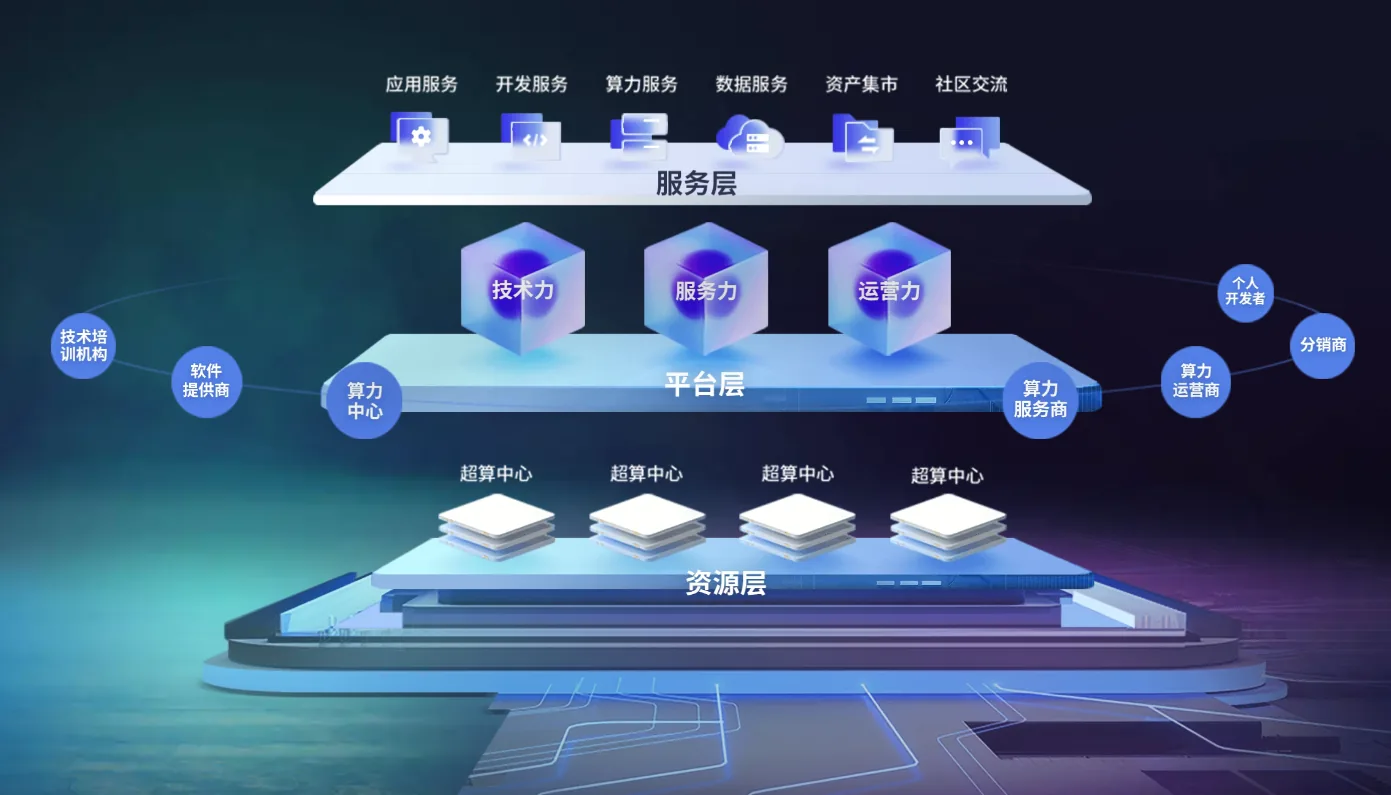
The Supercomputing Internet AI Community has become a vital open-source AI ecosystem in China. Major large model providers including Baidu’s PaddlePaddle ERNIE Bot, SenseTime, MiniMax, and Wen Xiaobai have joined the platform. Thousands of open-source large models, along with agents, knowledge bases, MCP (Model Content Platform) components, and datasets, are available for users to freely explore and rapidly build upon.
Notable Reversal: Against the traditional backdrop of supercomputing systems requiring high programming expertise, the platform’s conversational building tools and modular component approach have achieved an unprecedented democratization of computational application development—far exceeding industry expectations.
Practical Application Recommendations
- Ideal for: Academic research teams, R&D departments of small and medium-sized enterprises, and government public service units requiring high-performance computing support but lacking professional programming expertise.
- Consider waiting: Users with highly customized computational demands or specific proprietary software compatibility requirements may wish to wait for further collaborations between the platform and commercial software vendors.
Written at the end: The large-scale implementation of the National Supercomputing Internet marks China’s shift from isolated breakthroughs to nationwide collaborative coordination in computing infrastructure construction. The ability to integrate 150,000+ accelerator cards provides a solid foundation for digital transformation across scientific computing, engineering simulation, and other fields.