Core Event: Show-o Series Unified Architecture Unveiled at ECCV 2026
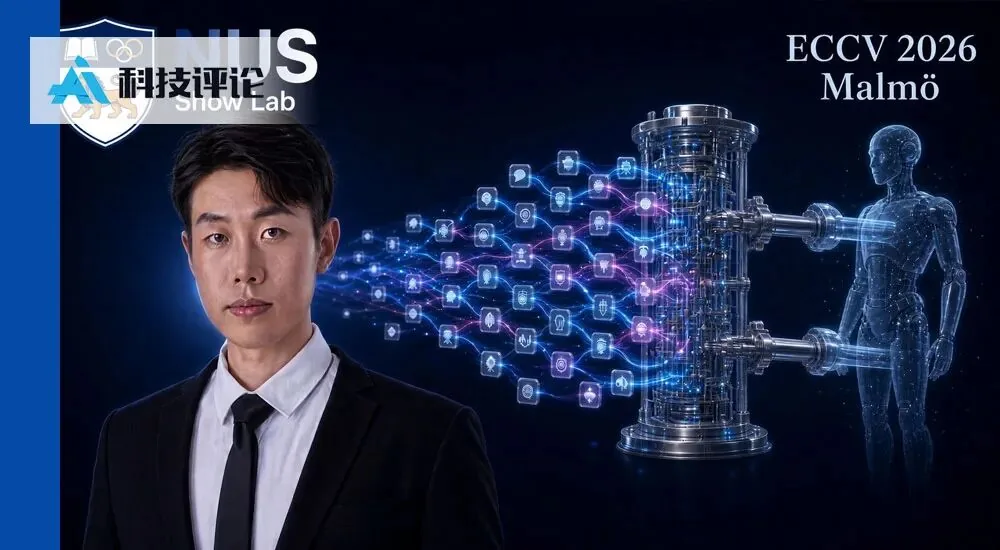
NUS Show Lab presented its Show-o series unified multimodal foundation model at ECCV 2026, marking a pivotal transition from “experimental Toy” to embodied AI “brain.” Key facts:
- Release timing: Disclosed on-stage at ECCV 2026 (led by Prof. Shou Zheng)
- Models: Show-o (initial) and Show-2 (video extension)
- Architectural breakthrough: First to integrate autoregressive (AR) prediction and discrete masked diffusion within a single Transformer
- Weight status: Not specified in source material; no commercial availability timeline mentioned
- Application focus: Unified multimodal understanding/generation + embodied robotics
Architectural Innovation: Breaking the “Understanding-Generation” Duality

Existing approaches rely on model stitching—e.g., NEXt-GPT couples LLMs with standalone diffusion modules for Any-to-Any inputs/outputs, yet remains fundamentally分立. Show-o’s counterintuitive finding: a single Transformer can native support both understanding and generation.
Three core restructurings:
- Architecture stitching: Resolves the “deadlock” between text discreteness and visual continuity. AR mode handles text/image-text interleaved data; diffusion mode (Mask-and-Predict) processes images/videos, recovering full visual tokens in ~10 strokes
- Tokenizer upgrade: Show-2 introduces a 3D Tokenizer for unified image/video encoding/decoding; attention combines causality for text with full spatiotemporal connectivity for vision
- Path design: Experiments show full encoder sharing degrades understanding slightly; Show-2 adopts “shared 3D encoder + internal split paths” with a semantic distillation layer in the understanding branch to preserve both accuracy and generation quality
The field long faced a trade-off: AR models suffer from slow sequential token generation; continuous diffusion is fast but inapplicable to discrete-token LLMs. Show-o fixes this via discrete diffusion + unified Transformer, balancing generation quality, inference efficiency, and logical modeling.
Data & Training: Closed-Loop Self-Supervision Solves Annotation Scarcity
Embodied AI struggles with high-quality labeled data, especially in niche cultures or low-resource domains. Show Lab introduces cycle consistency supervision:
- Observe: Input unlabeled image
- Describe: Generate caption via understanding module
- Resynthesize: Reconstruct image using caption as diffusion prompt
- Self-supervise: Minimize reconstruction error
This enables learning from unlabeled YouTube videos to extract physical commonsense, dramatically extending Scaling Law’s data frontier. The key insight: generation doesn’t just benefit from understanding—it actively sharpens understanding through closed-loop feedback.
Deployment Strategy: Cloud-Edge Collaboration

Latency determines embodied intelligence. The deployment split:
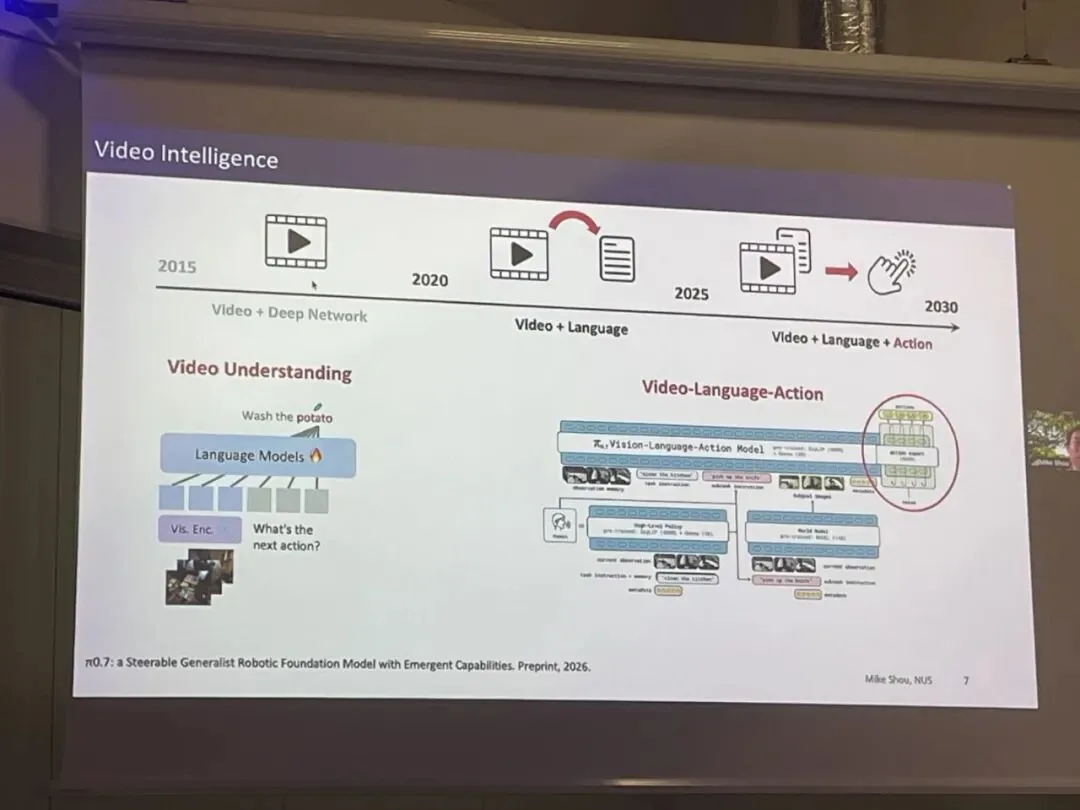
- Model evolution: VLM → VLA (Vision-Language-Action) → World Model → World Action Model (WAM)
- Hybrid deployment:
- Cloud: Frontier large model (strong planning; 8–20 seconds per decision)
- Edge: Fine-tuned open-base model (low-latency, real-time response)
- Hardware: Desktop dual-arm (gripper/five-finger hand) + mobile base with active arm; teleoperation captures state-action trajectories
Target Audiences & Practical Guidance
- ** Adopt now**: Multimodal researchers, embodied AI teams, engineers seeking unified inference pipelines
- Wait longer: If you need out-of-box checkpoints or commercial APIs—this remains research-grade; if self-supervision efficiency and edge latency optimization matter, its cycle consistency design warrants deep analysis
Final Thought
This work demonstrates that unified architectures are more than technical compromises—they use architectural redesign to unlock bidirectional understanding-generation synergy. When models no longer sacrifice depth for speed, embodied agents begin to truly coordinate deliberate thought with instinctive action.