
AGI Is Not the Finish Line — It’s the Starting Line
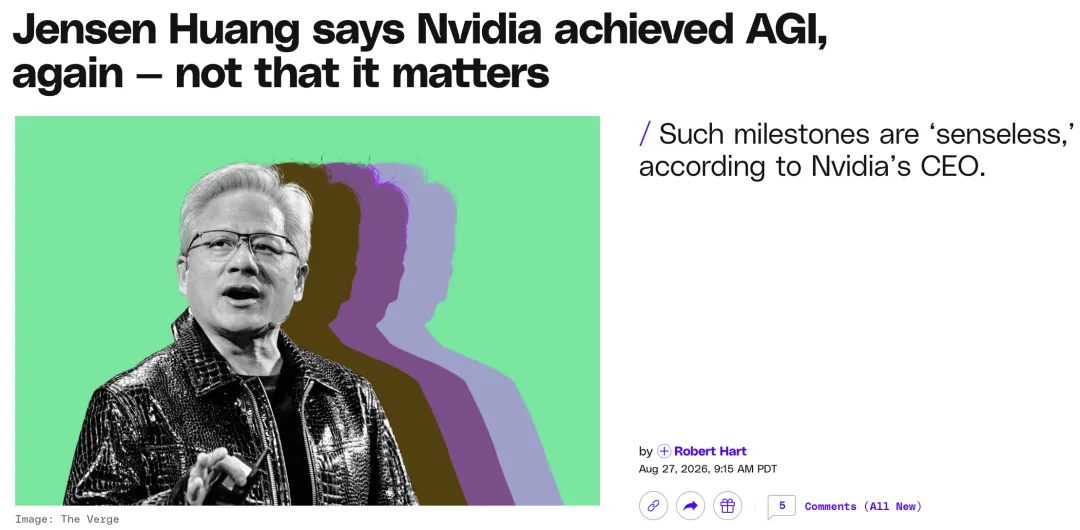
On the latest earnings call, Jensen Huang calmly dropped a bombshell: for many tasks, we have already achieved AGI.
He didn’t bother racing OpenAI over who crosses the line first — he flipped the table instead. Obsessing over “how exactly to define AGI” is now meaningless. The entire tech industry doesn’t even have a consensus standard for “intelligence” itself, so arguing about what the finish line looks like is a pure waste of time.
What really excites Huang isn’t the terminology — it’s the fundamental qualitative leap in AI capability.
What a Perfect ARC-AGI-3 Score Means
NVIDIA’s Avo architecture scored a perfect 100% on ARC-AGI-3. The benchmark, designed by Keras creator François Chollet, specifically targets large models’ weakness of “memorizing the test”: it requires AI to face logic puzzles it has never seen, with no historical data to draw on, demonstrating abstract reasoning from only a handful of examples.
In the past, even the strongest models from OpenAI and Google struggled to break 50% accuracy here. NVIDIA, under zero-shot prompting, autonomously reasoned its way through all 183 levels across 25 public environments — no explicit rules given, figuring everything out on its own.
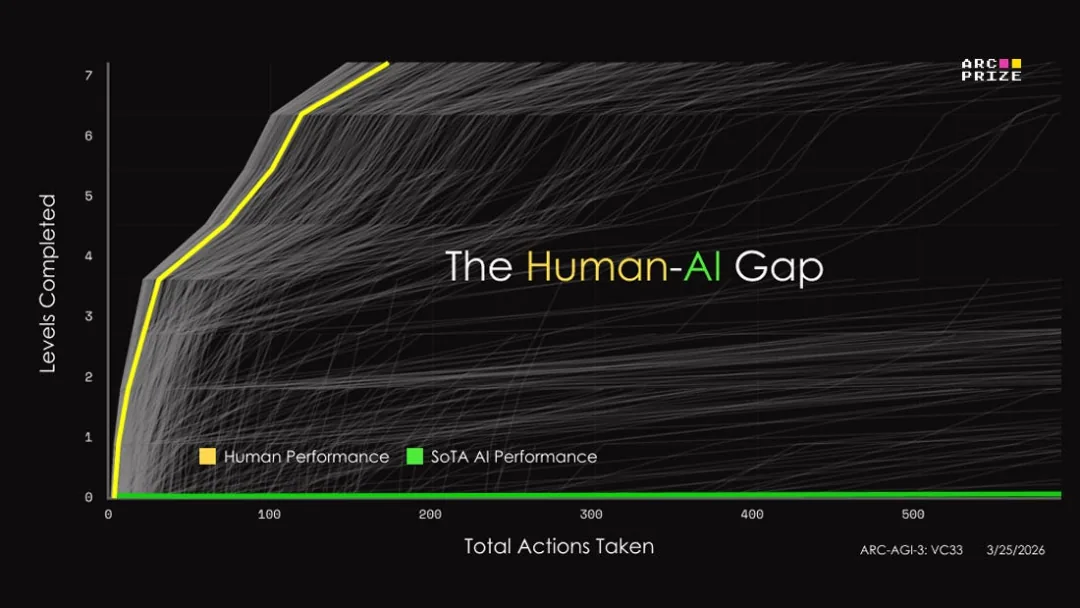
This means AI has crossed out of the dead end of “pattern matching” and gained general cognitive ability to handle unknown, complex problems. It’s no longer “you ask, it answers” — it receives a task, breaks it into steps by itself, executes on its own, and afterwards reflects and learns new skills.
Chips Verified by AI Itself — the Loop Is Closed
Benchmarks are only evidence on paper. NVIDIA’s productionized “AGI builds chips” effort is ChipStack AI Super Agent — jointly released with Cadence, at autonomy Level-5. It orchestrates workflows with Codex and Nemotron, calling Cadence Xcelium for RTL simulation and Jasper for formal verification, all running inside the NVIDIA OpenShell sandbox.
The result: a typical verification loop shrank from about five weeks to less than a day, and the RTL verification cycle sped up by more than 40x. NVIDIA’s internal verification system — thousands of engineers, billions of compute hours per year, millions of tests — is now carried by this agent system.
This is the closed loop of “compute feeding back into R&D”: AI helps you design the next-generation GPU, and the next-generation GPU makes AI even stronger — a self-bootstrapping dimensional strike.
$1.06 Billion per Day
FY2027 Q2 earnings numbers:
- Revenue of $96.2 billion (expected $92.2 billion, up 106% year over year)
- Data center revenue of $89 billion (up 117% YoY), with hyperscale customers at $48.7B + enterprise AI at $40.3B
- Net income of $59.7 billion, a 62% net margin
- Gross margin of 75%, gross profit of $72.1 billion
Spread over 91 days, that’s roughly $1.06 billion in revenue per day, every day, weekends included. Q3 guidance is $108 billion — the first single quarter above $100 billion, pushing the daily average close to $1.2 billion.
CFO Colette Kress gave a full-year 2028 outlook a year ahead of schedule: revenue growth of about 70%. Wall Street consensus was only 44%. Based on the roughly $400 billion consensus for the current fiscal year, total 2028 revenue would approach $673 billion — overtaking Apple and Microsoft to become America’s second-largest tech company by revenue (behind only Amazon).
Huang twisted the knife: 70% is merely a supply-constrained number limited by the supply chain; unconstrained by capacity, real demand growth is close to 100%.
Tokens Are the Money Printer
Huang laid bare the underlying logic of AI commercialization: more compute = more tokens produced = inevitably more profit.
Tokens are no longer just data in a lab. When AI generates bug-free backend code, the efficiency gain is profit in token form; when AI produces investment strategies in seconds and executes the trades, the earnings are real hard cash. Roughly $10–15 million in base compute cost per megawatt can be turned into $50 million or even over $100 million of downstream revenue.
The key metrics for winning the AI war have changed — “tokens per dollar” and “tokens per watt”. Whoever controls the compute controls the new era’s money printer. The Vera Rubin architecture lifts the revenue opportunity per GW of data center from Hopper’s $18 billion to $40 billion.
40,000 Humans Directing 4 Million AIs
Huang’s prediction: NVIDIA may only need to maintain 40,000 human employees while simultaneously having 400,000 or even 4 million digital employees (AI agents). A human-to-machine ratio of 1:10, or even 1:100.
SemiAnalysis founder Dylan Patel’s projection is even grander: a ten-trillion-scale compute expansion will trigger more than $5 trillion of credit demand across the entire ecosystem. Within the next two to three years, the real-world economy — interest rates, valuations of traditional value stocks — will become a direct downstream consequence of AI compute monopoly and expansion.
Compute Is Power, Tokens Are Wealth
This earnings call will go down in history — not just for the numbers, but for revealing the truest bottom card of AI commercialization.
Panic is futile. There is only one survival rule for the future: either become the person who controls AI, or become the person replaced by it.
LynxHot · Tracking AI tools, models, and industry shifts