
NVIDIA Open-Sources IMO Gold-Level Reasoning System

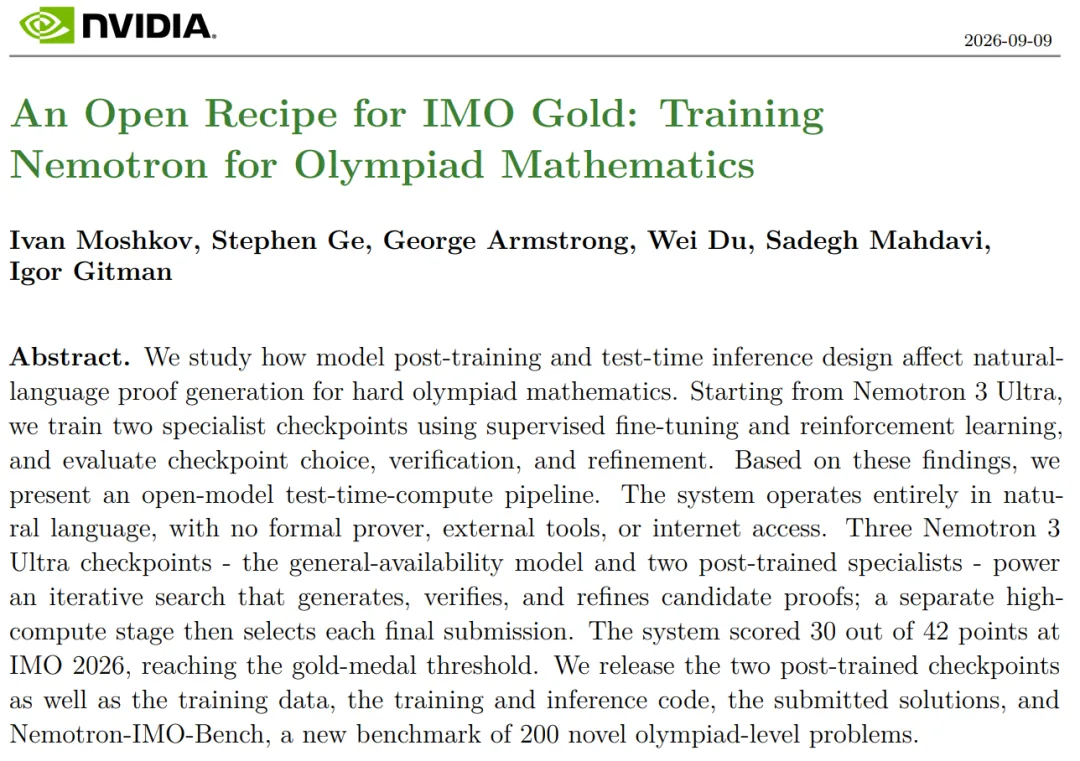
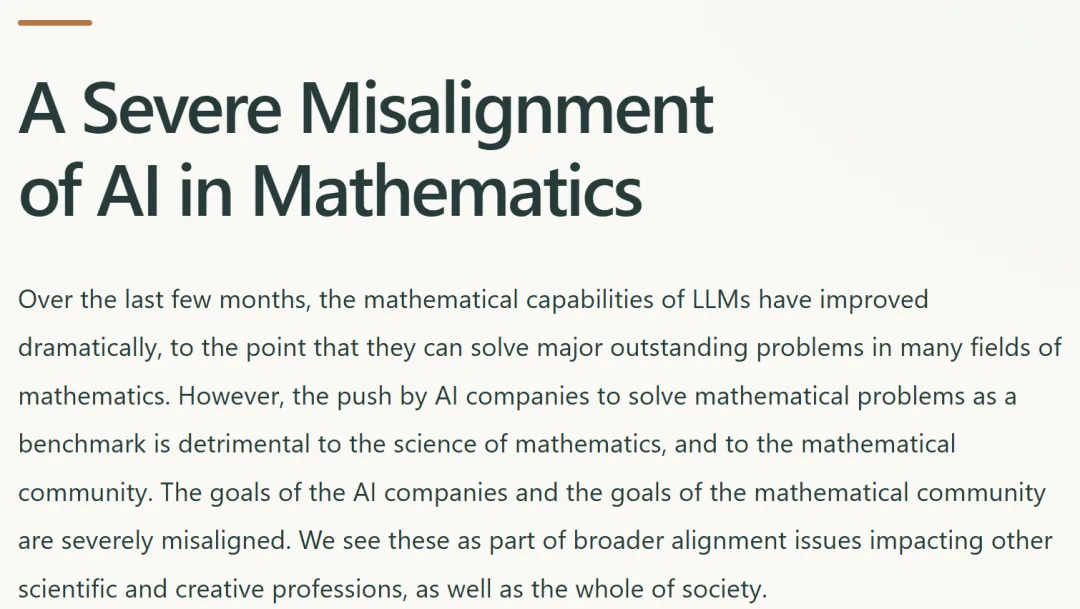
On September 9, 2026, NVIDIA unveiled its complete math reasoning stack for the 2026 International Mathematical Olympiad, where the system scored 30/42 points, exceeding the gold medal threshold of 29 points. Two days later, 25 Fields Medalists—including Terence Tao, Peter Scholze, and Maryna Viazovska—jointly criticized the rapid pace of AI math publications relative to verification timelines.
Key facts of this release:
- Release date: September 9, 2026
- New models: Nemotron 3 Ultra (base) + two domain experts (SFT and RL checkpoints)
- Weight openness: Full release including SFT/RL training data, inference code, training recipes, verifier components, and 200 new test problems (Nemotron-IMO-Bench)
- Incomplete openness: Some intermediate teacher and MOPD checkpoints remain unreleased; full training chain is not step-by-step reproducible
- Hardware barrier: Running the 550B-parameter model requires 1.5TB GPU memory, corresponding to 384 initial generations plus multi-round refinement
Technical Architecture: Three-Chain Coordination and Proof Pool
Rather than relying on repeated sampling from a single model, NVIDIA’s system implements three协同 mechanisms:
- Base checkpoint: Nemotron 3 Ultra provides general mathematical reasoning capacity
- SFT expert checkpoint: Trained for proof modification and validation—skilled at fixing errors in partially completed proofs
- RL expert checkpoint: Trained via reinforcement learning to adjust sampling probabilities toward high-value proof paths
This triple-checkpoint strategy addresses the effective sampling coverage challenge: under fixed compute budgets, diverse post-training paths produce less-correlated candidates than repeating samples from one model, enabling broader proof-space exploration.
The proof pool mechanism adds another dimension:
- 384 candidate proofs generated in initial round
- Verifier feedback preserves incomplete but promising proofs for refinement cycles instead of discarding them
- Revised proofs rejoin the pool to compete for continued resources
This design balances search breadth (many initial candidates) and search depth (focused refinement), contrasting sharply with brute-force sampling where each attempt starts fresh.
Hard Reality: 1.5TB Memory Barrier vs. “Code Equality” Promise
NVIDIA’s open-access posture conflicts with literal hardware access:
- Full recipe and training data are published, enabling theoretical reproducibility
- Yet the 550B model requires 1.5TB VRAM, equivalent to 8 B200 GPUs × 1,464 hours of inference time
- Such barrier excludes 99% of university labs globally
A deeper issue is verifier error correlation: despite multi-checkpoint cross-validation, the system released a demonstrably flawed proof where all three checkpoints shared the same blind spot due to common base model architecture.
High acceptance thresholds reduced false positives but increased false negatives—correct proofs were rejected when minor issues triggered failure, illustrating the trade-off between safety and inclusivity.
Implications for Verification Scalability
The open release enables extensible experimentation:
| Component | Open-Sourced | Notes |
|---|---|---|
| Nemotron 3 Ultra weights | Yes | Base model |
| SFT checkpoint | Yes | Supervised fine-tuned expert |
| RL checkpoint | Yes | Reinforcement learning expert |
| Training data (SFT/RL) | Yes | Full proof traces |
| Inference code | Yes | Proof pool & refinement logic |
| Nemotron-IMO-Bench | Yes | 200 new test items |
| Teacher checkpoints | No | Not fully released |
| MOPD checkpoints | No | Not released |
Researchers can now tune variables: checkpoint combinations, sampling budget, verifier threshold, and refinement depth.
Audience Recommendations

- For whom now: Teams with multiple GPU nodes (A100/H100/B200) can iterate on verifier modules or adapt to new problem domains
- For whom to wait: Labs with fewer than 100 GPU cards should monitor for compressed versions or cloud-based time-sharing services
Final Note
NVIDIA’s open-source act is a starting gun, not a finish line. As generation capability becomes democratized, competitive advantage will shift toward verifier diversity and blind-spot coverage. Computational equality without verification diversity risks replicating the same errors across increasingly expensive hardware farms.