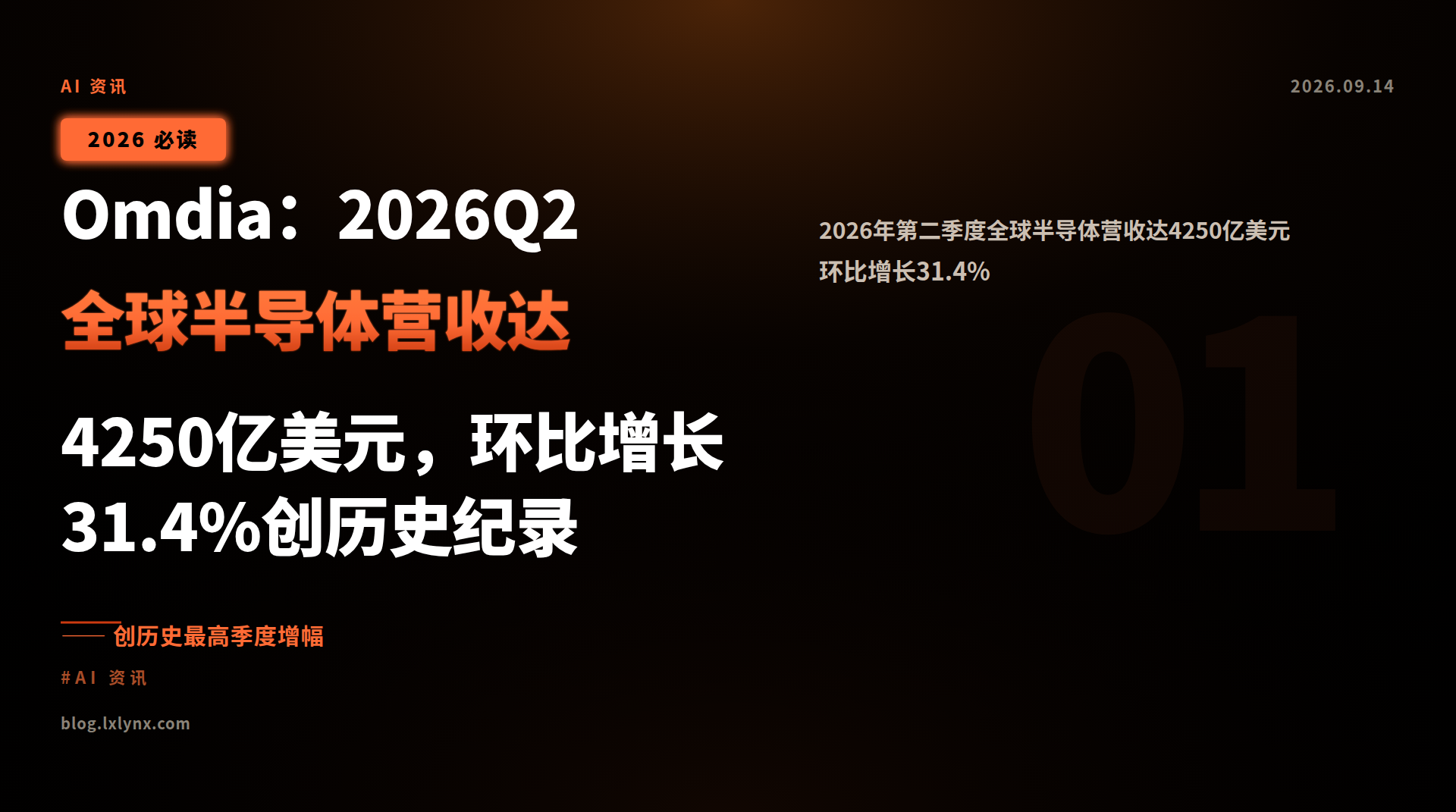
Global Semiconductors Revenue Sets Record in Q2 2026
On September 14, 2026, UK-based market research firm Omdia reported that global semiconductor industry revenue reached $42.5 billion in Q2 2026, representing a month-on-month (MoM) growth of 31.4%. This marks a new record high for quarterly growth since Omdia began tracking the sector and surpasses the previous record of 29.2% set in Q1 2026.
Key facts:
- Reporting period: Q2 2026 (April-June)
- Total revenue: $42.5 billion USD
- MoM growth: 31.4%, the highest on record for second quarter
- Previous quarter: 29.2% MoM growth in Q1 2026
- RMB equivalent: approximately RMB 285 billion (at 2026 Q2/Q3 exchange rates)
Memory Markets Lead with Record-Breaking Growth
AI demand has become the primary catalyst reshaping suppliers’ production priorities across the semiconductor ecosystem. Omdia confirmed that DRAM, NAND, and NOR memory segments all recorded their strongest Q2 MoM growth since Omdia began compiling such statistics. The memory segment, historically cyclical and volatile, now demonstrates structural growth drivers from AI infrastructure scaling.
The expansion is notably broad-based. Other semiconductor categories—including logic chips, analog devices, and discrete components—also exceeded traditional seasonal patterns. All non-memory segments posted MoM growth exceeding 10%, significantly above the long-term average of approximately 3% for the same period. This synchronized acceleration across product types suggests a self-reinforcing cycle of capacity utilization, inventory replenishment, and new project approvals.
H1 Performance and Full-Year Outlook
The cumulative revenue for H1 2026, combining Q1 and Q2 figures, indicates an industry trajectory well above prior annual estimates. Based on the reported growth rates and industry expectations, full-year 2026 revenue could approach or exceed $85 billion if current momentum persists.
From the demand side, expandable markets include data center infrastructure, high-performance computing (HPC), automotive electronics, and industrial automation. The rising computational loads for AI training and inference have directly pressured memory suppliers to reallocate wafer capacity toward higher-bandwidth, higher-value products, particularly in the Herbert-bound memory (HBM) segment—though Omdia did not specify product-level breakdowns in this report.
Practical Implications for Stakeholders
Industry participants should note these interpretive cues from the data:
Memory manufacturers with advanced节点 technology: Those producing high-bandwidth DRAM (HBM3/HBM3E) or advanced NAND stacks benefit disproportionately from structural memory demand shifts.
Fabless and IDMs with AI-focused portfolios: Companies with各类 chips optimized for inference workloads or edge deployment see enhanced adoption trajectories.
Equipment and materials suppliers: Capacity expansion announcements from major Foundries (e.g., TSMC, Samsung, Intel) in 2026 Q2-Q3 typically precede capitalquipment orders with 6-9 month lead times.
** Recommendations **: Investors tracking semiconductors may consider increasing exposure to memory-focused segment leaders or AI accelerator designers at current valuations; those waiting for broad-based consumer recovery leading to full-system inventory build-up should monitor September-October seasonal reorder activity for confirmation of a second wave.
A Final Perspective
A 31.4% quarterly growth rate is more than an arithmetic milestone—it signals the semiconductor industry’s entry into a new growth regime after three years of inventory correction and demand consolidation. The synchronized expansion of both memory and logic/IDM segments confirms that AI infrastructure investment has transcended pilot phases and entered mass deployment. Should this pace continue, 2026 may well be remembered as the year semiconductors returned to double-digit annual growth after the 2022-2025 correction period.