Quick Summary
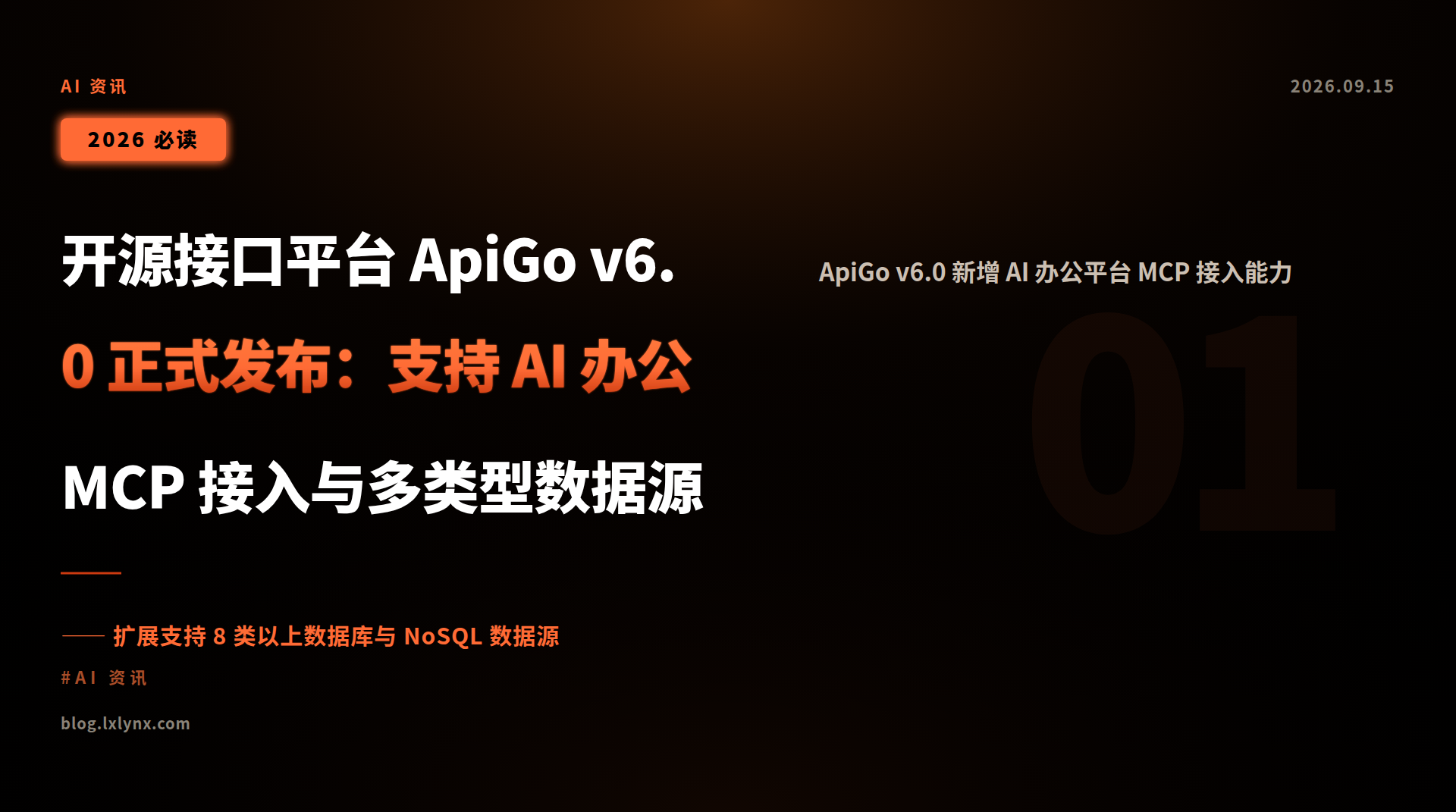
The open-source API development and management platform ApiGo has released version 6.0, with a focus on enhanced AI office integration and database compatibility. Key highlights include:
- Release timing: Officially launched v6.0 recently
- New capability: Supports MCP protocol integration with major AI workspaces including WorkBuddy, Qwen Office, Trellix Work, and Doubao
- Data source expansion: Added support for DuckDB, TiDB, Hive, and DolphinDB among others
- Licensing: Continues as free open-source software
Feature Enhancements in Detail
ApiGo is an enterprise-oriented online platform for API development, management, SQL auto-generation, and data preview. Building upon existing features like dynamic data sources and dynamic SQL with tag support, v6.0 extends integration with AI office ecosystems.
A notable contrast: While most database visualization tools prioritize traditional relational databases (e.g., MySQL, Oracle, Dameng), ApiGo simultaneously supports newer analytical and distributed databases including DuckDB, Hive, and DolphinDB. Notably, DuckDB—a single-file, embedded columnar database typically used for local analysis rather than server deployment—demonstrates the platform’s balance of lightweight office scenarios.
MCP (Message Collaboration Protocol) here refers to a common communication standard for plugins and extensions among AI office platforms. By integrating MCP, ApiGo enables users to invoke generated API services directly within these AI workspaces, enabling “conversation-driven data queries.”
Data Source Support Comparison
| Category | Supported Sources | Notes |
|---|---|---|
| Relational | MySQL, Oracle, Dameng | Traditional enterprise standards |
| Cloud-native / Distributed | TiDB, Hive | suited for big data and OLAP |
| Analytical | DuckDB, DolphinDB | Embedded and time-series analysis |
| Others | - | No specific count of additions mentioned |
Practical Adoption Recommendations
Users ready to try now:
- Internal low-code teams seeking to integrate AI assistants with existing SQL systems
- Analytical teams using newer databases like DuckDB/TiDB who want to expose queries as offline services
- Integrators working with Chinese AI office tools (Qwen, Doubao, etc.)
Users advised to wait:
- Teams with单一 MySQL needs and no MCP requirements—v5.x likely suffices
- Large organizations requiring enterprise-grade SLAs or paid support—await official commercial edition details
Final Thoughts
Open-source tools are evolving from “interface generation” to “human-AI collaboration.” ApiGo’s MCP integration signals that future low-code platforms may become modular data nodes within AI workflows rather than static data pipes—accelerating the shift from “button-click interfaces” toward natural-language-driven interactions.