
OpenAI Claims Navier-Stokes Breakthrough, Sparking Academic Controversy
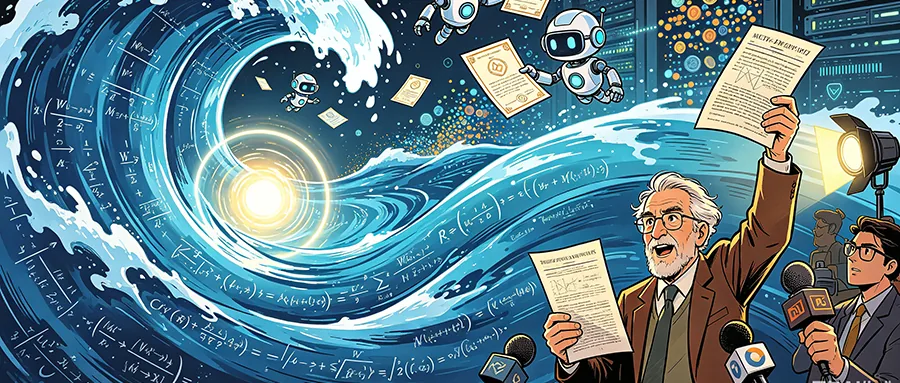
On September 9, 2026, OpenAI announced its internal multi-agent system successfully solved the 90-year-old “Millennium Prize Problem”—the existence and smoothness problem for the Navier-Stokes equations. The core proof was completed by local time September 5, followed by 17 hours of Lean formal verification by GPT-6 Astra. The entire project took approximately 88 hours, involving about 10,000 concurrent agents and 4.9 million exchanged messages, consuming roughly 30 billion output tokens. Scientist Noam Brown stated the project cost several million dollars.
A notable detail: the core Navier-Stokes proof alone consumed 2.7 million messages and 13 billion tokens, significantly less than the overall project budget. Prior to this, OpenAI’s system cracked the easier Euler equation regularity problem (without external forces), requiring only about 100 agents working for 50 hours. The approach began with simpler problems as training, then leveraged Euler equation results as prompt inputs for the more complex Navier-Stokes攻关 (攻关 means “攻关” attackers, used metaphorically here for tackling). This progressive strategy proved effective.
NYU Professor Questions Pathway Similarity
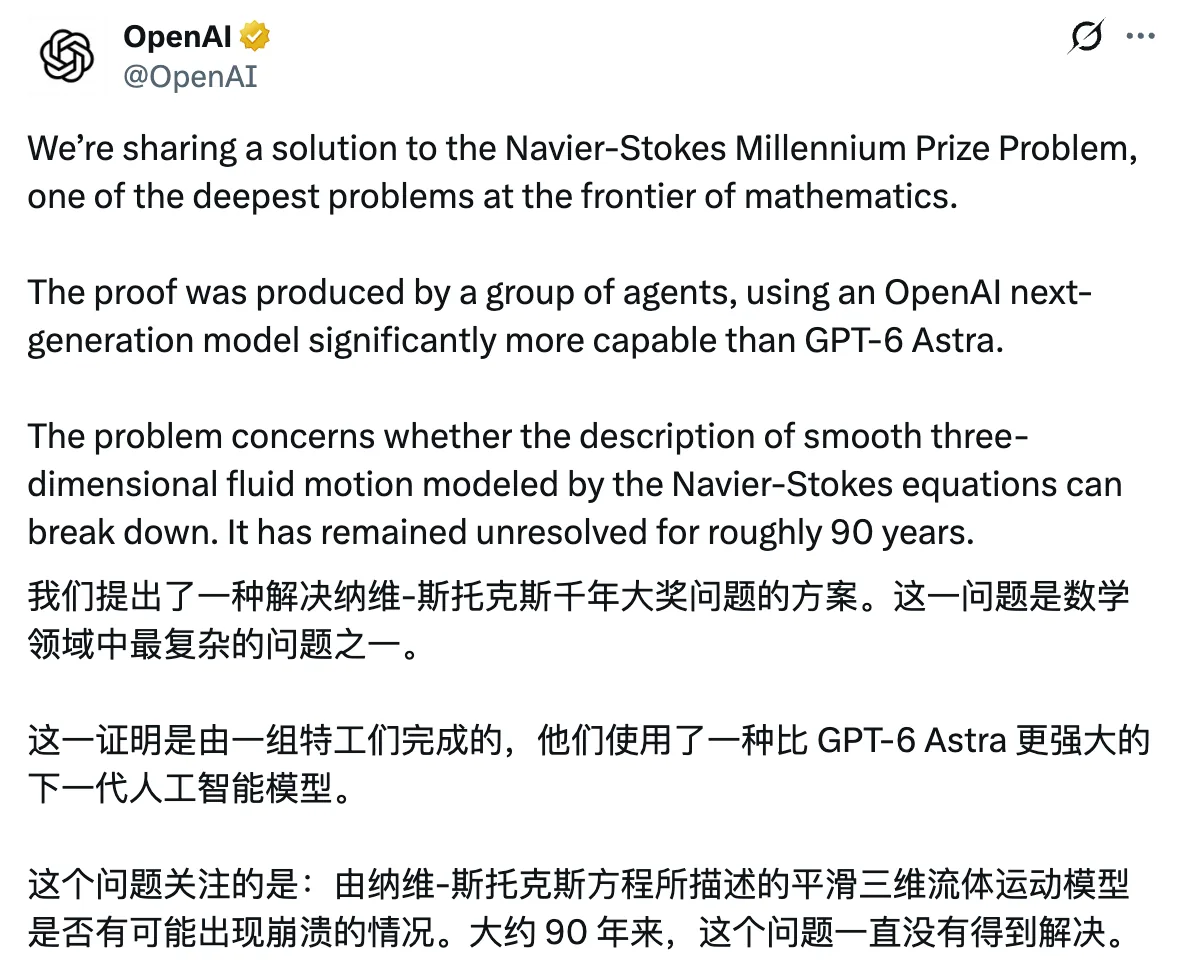
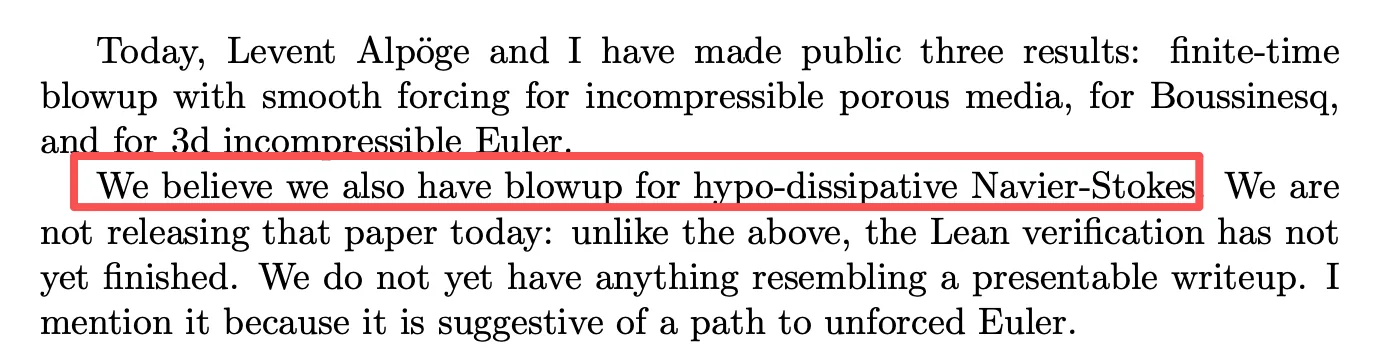
The controversy centers on the unusual overlap in research methodology. OpenAI’s blog acknowledged that rumors of breakthroughs by Tristan Buckmaster (NYU math professor) and Levent Alpöge (Anthropic researcher) on August 31 triggered the focused Initiative. On September 6—after completing all work—OpenAI contacted Buckmaster’s team proposing joint release and承认优先权 (acknowledgment of priority). OpenAI then discovered the NYU group had addressed a different variant: the Euler equation with external forces, while OpenAI targeted the no-external-force Navier-Stokes case.
Buckmaster expressed skepticism: his team’s breakthrough traces to August 15, 2025, with Lean verification completed by August 22, followed by intensive work. OpenAI started model training on August 28 and published results by September 5. He stressed the particular strategy—building on Diego Córdoba and Luis Martínez-Zoroa’s obscure ideas—is rarely pursued globally, making it unlikely that merely feeding a problem description to a model could discover this approach in just days.
OpenAI showed Buckmaster the prompt and claimed “minimal human intervention,” yet Buckmaster Countered during calls that OpenAI operated a full team, the prompt was Iteratively refined via Codex, the team began with no-external-force formulations, and massive compute resources were deployed.
When asked whether models use Codex user data, OpenAI stated it does not access conversation records but conceded it cannot rule out that de-identified user-generated content may have indirectly influenced model optimization.
The Millennium Problem and Proof Core
The Navier-Stokes equations describe fluid motion and rank among the seven 2000 Clay Mathematics Institute Millennium Problems, each carrying a US$1 million prize. The core question: can smooth initial flow conditions develop singularities—points where velocity becomes infinite—in finite time, causing the equation to fail?
OpenAI’s proof constructs a vortex structure: inward spiraling, elongating like spaghetti, shrinking center while velocity rises—yet total energy remains finite throughout. Crucially, the solution ruptures via fluid self-motion alone, avoiding artificial infinite external forces, satisfying propositions C and D, thus solving the prize problem. It confirms that even with viscosity, smooth initial data may still evolve singularities.
Model Strategy Comparison
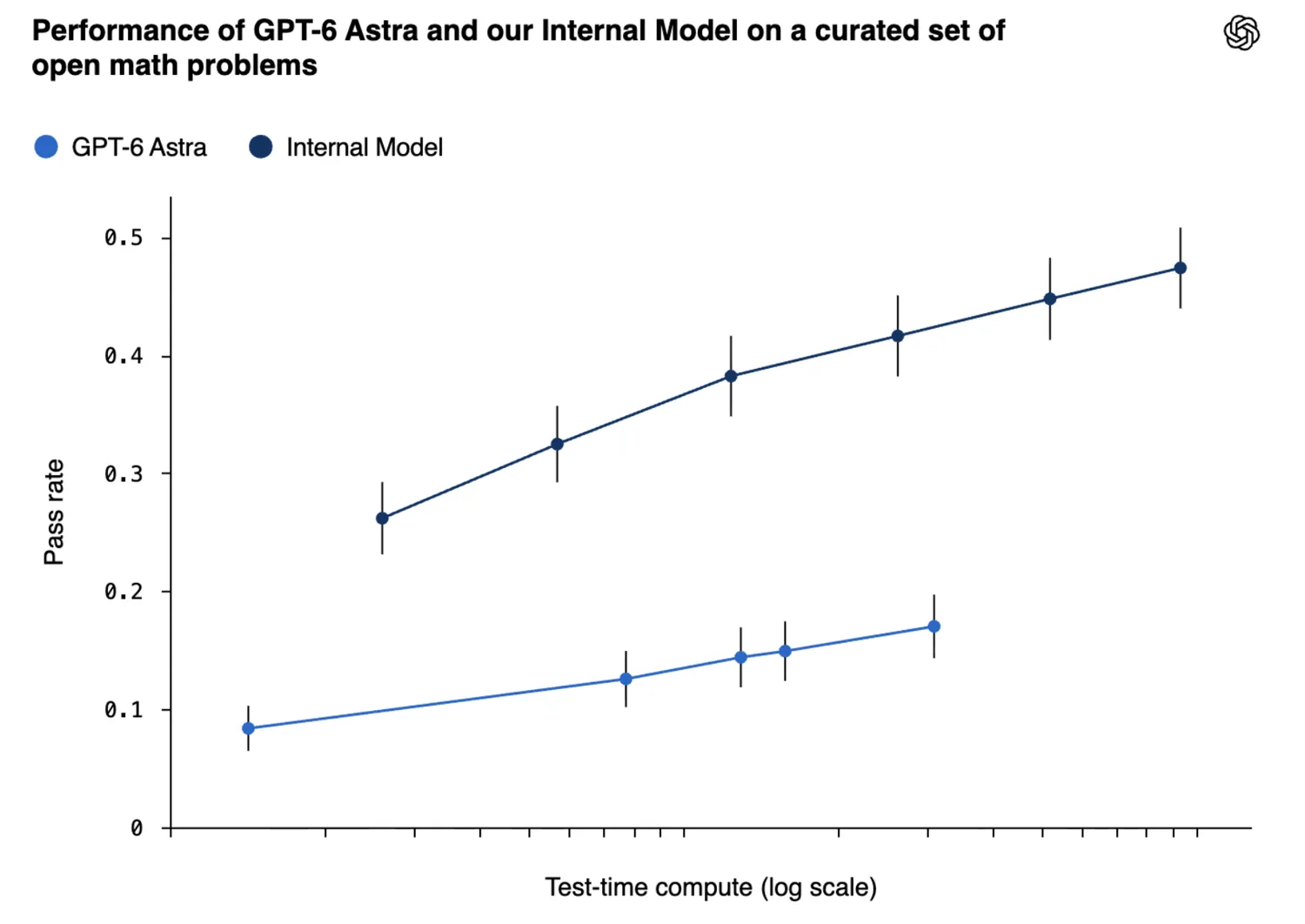
| Parameter | Euler Equation (no external force) | Navier-Stokes Equation (no external force) |
|---|---|---|
| Agents | ~100 | ~10,000 (peak) |
| Duration | ~50 hours | Core proof: 88-hour total pipeline (includes parallel runs) |
| Tokens | Lower than Navier-Stokes | ~13 billion (2.7M of 4.9M messages) |
| Key Condition | Viscosity neglected (limit case) | Viscosity retained (stronger dependency) |
| Pathway | Solved first as training exercise | Deployed more resources after Euler success |
Practical Recommendations
Researchers tracking AI for Science should watch OpenAI’s multi-agent coordination framework closely—its multi-million-dollar compute scale may become the new benchmark for large-scale科研 projects (scientific research projects). However, given the proof’s lack of peer review, current findings are best treated as technical exploration references. Academic teams should assess their算力 (computational resources) and path feasibility carefully to avoid being trapped in a reactive “catch-up” position.
Final Thoughts
This episode exposes institutional gaps in priority attribution when AI compresses six months of research into three days—traditional academic “slow verification” and AI-driven “fast breakthroughs” urgently require new coordination mechanisms.