Core Event Overview
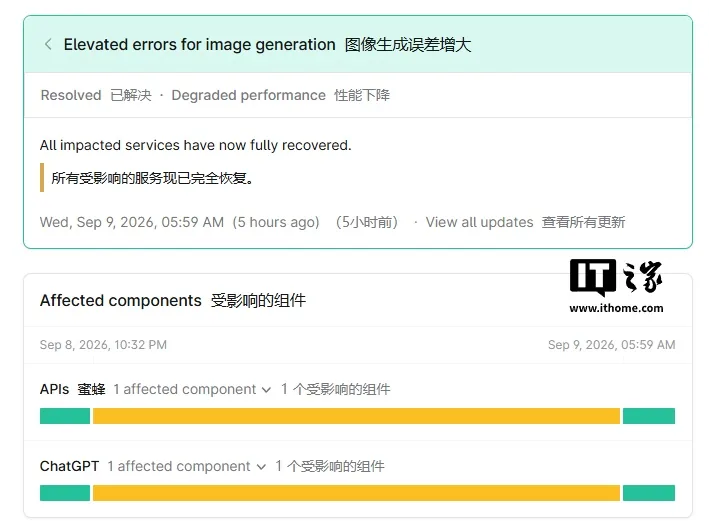
OpenAI experienced a service disruption on the evening of September 8 to the morning of September 9, fully disabling its image generation capabilities. According to the official status page, the outage began at 22:32 Beijing time on September 8 and ended at 05:59 on September 9, lasting approximately 7 hours and 27 minutes.
- Affected Services: ChatGPT image generation function, OpenAI Images API (for developers)
- Fault Type: High-frequency error responses, file upload processing anomalies
- Recovery Time: 05:59 marks when service status was restored, not necessarily when active repairs concluded
- Technical Cause: OpenAI has not disclosed the specific root cause
Fault Details and Impact Scope
During the outage, user experience deteriorated significantly:
- Users submitting image generation prompts frequently received error responses instead of generated images
- File upload functionality was simultaneously affected: some files showed “completed upload” status but remained stuck in processing, rendering them inaccessible
- Other upload requests failed outright without clear error messages
Key anomalous data point: While core image generation was disrupted, ChatGPT’s basic conversational capabilities and Tools functionality remained operational—the outage exhibited high modularity, reflecting OpenAI’s ongoing system decoupling efforts in recent years. The Images API failure did not trigger a cascading outage of the conversational model.
Both end users and developers were impacted. End users could not use the DALL·E-powered image generation features in ChatGPT; developers building image generation workflows via Images API encountered service unavailability, potentially disrupting automated content production pipelines.
Technical Profile of File Upload Anomalies
Two typical failure patterns emerged during file upload disruptions:
- False Completion State: Upload requests returned success responses, but downstream processing queues stalled, preventing file download or use in subsequent generation tasks
- Direct Failure: Upload requests returned HTTP error codes outright, with no complete error explanation
This differentiation suggests the fault likely originated in the async processing环节 after initial file review passed (upload metadata was accepted), rather than in the API entry layer’s authentication or bandwidth. Given the errors concentrated in the image generation workflow’s “bursty processing” phase, speculation centers on video/frame extraction services or middleware between prompts and model scheduling—though OpenAI has not confirmed this.
Business Impact and Practical Advice
Scenarios where immediate alternative solutions make sense:
- Designers producing high-consistency commercial illustrations: Consider locally deploying Stable Diffusion or using paid APIs (e.g., Leonardo AI) as backup pathways
- Educators and content creators: If generation speed is not urgent, waiting for service restoration and off-peak usage remains the most cost-effective approach
Scenarios worth waiting for:
- SaaS applications relying on real-time Images API generation: No evidence indicates本次 outage affected data persistence; if original files uploaded by users were successfully saved, temporarily storing pending requests for batch reprocessing after restoration can avoid re-triggering the same error path.
In Conclusion
A several-hour modular outage inadvertently validates the resilience value of cloud-native architecture—single-point failure did not cascade into a full system collapse, demonstrating that decoupling design has yielded measurable returns. Looking ahead, the more pertinent question may be how OpenAI can bring its “service availability” metrics closer to competitor parity in stability.