
Overview of Key Announcements
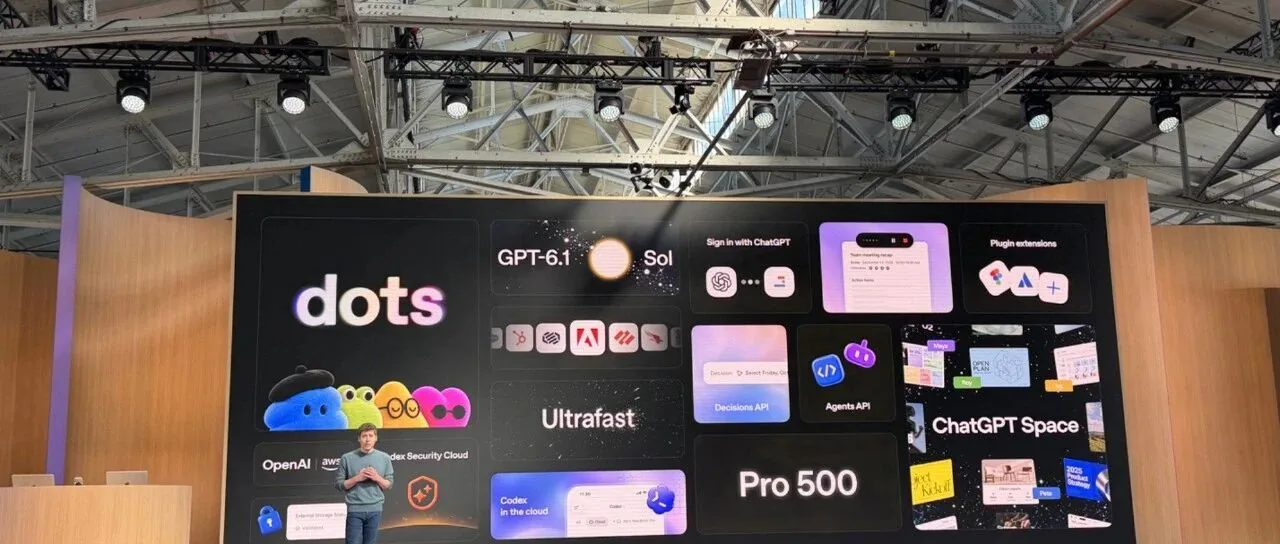
On September 30 at midnight Beijing Time, OpenAI hosted its largest-ever Developer Conference, unveiling 25 updates. Core hard facts include:
- New model: GPT-6.1 Sol launched, with intelligence approaching Astra and API pricing at one-fifth of Astra’s; GPT-6 Sol and Luna are now priced at half their original rates
- New feature: dots—AI agents powered by GPT-6 Astra—are available to Pro-tier users and above; the first dot is complimentary and interactions with it do not consume quota
- New pricing tiers: Pro 500 introduced ($500/month); old Pro 200 reopened but new subscriptions receive reduced quota; grandfathered quotas for existing subscribers expire on October 29
- Key change: Usage quotas are redefined by tier; Pro 500 offers 25x Plus quota; Astra Ultrafast—exclusive to Pro 500 and enterprise—consumes quota at 8x standard speed
- Availability: All updates live now; GPT-6.1 Sol rolling out gradually to Plus, currently only in ChatGPT Work and Codex
- Access policy: dots, Spaces, Dynamic Pages, and Ultrafast require Pro or higher; free and Plus users mainly get Codex developer tools
Pricing Recalibrated: From Chat Volume to Work Output
The most striking contradiction at this event: models getting cheaper while Pro usage quotas shrink significantly. OpenAI’s pricing is shifting from a chat-consumption model to a worker-compensation logic—charging based on how much work is delivered and how fast, rather than token volume or chat turns.
Take Pro tiers as an example:
| Tier | Monthly Price | Quota vs. Plus | Price vs. Plus | Astra Ultrafast |
|---|---|---|---|---|
| Plus | $20 | 1x | 1x | Not available |
| Pro 100 | $100 | 5x | 5x | Not available |
| Pro 200 (new) | $200 | 10x | 10x | Not available |
| Pro 500 | $500 | 25x | 25x | Available (8x quota consumption) |
| Old Pro 200 | $200 | 20x | 10x | — |
Note: New Pro 200 represents roughly half the API-equivalent cost of the old version. Yet Pro 500’s $500 monthly fee exceeds the Silicon Valley median AI spend of $300 cited in the conference context.
Speed itself is now monetized separately. Astra Ultrafast charges 6x in API pricing and burns quota 8x faster in ChatGPT—akin to paying extra for express shipping.
Dots: Cloud-based Agents as Incubator for Startup Ecosystems
Dots represent the conference’s centerpiece, described by OpenAI as agents that “continuously carry responsibilities.” Powered by GPT-6 Astra, each dot runs on a dedicated cloud computer with browser access and can integrate with 4,000+ apps to operate around the clock across ChatGPT, Slack, and Teams.
- Access control: Restricted to Pro ($100/month+) and Business Premium
- Billing rules: First dot is free; chatting with dots doesn’t consume quota; but if dots execute tasks in ChatGPT Work or Codex, quota is deducted normally
- Capabilities limitation: Product head Tibo (Thibault Sottiaux) demonstrated its capabilities firsthand; however, attendee feedback at the live screening highlighted that tools requiring commercial licenses (e.g., specialized math solvers) may not migrate seamlessly to the cloud; rewriting alternatives remain immature
Accompanying dots is the “Log in with ChatGPT” service: users authenticate to partner apps (Notion, Vercel, 16 others) with their ChatGPT account; Plus/Pro users can spend their own quota in partner apps (limited preview).
##Who Should Act Now vs. Wait
Recommended for immediate adoption:
- Enterprise teams (Business Premium+): Unified dot management, Slack/Teams integration; OpenAI Software Marketplace allows committing quota to purchase 32 vendor solutions (Adobe, Figma, Salesforce)
- Developers: Codex adds voice commands, enhanced code review & security scanning; Responses API traffic is up 100x year-over-year
- Pro 100/200 users on standard usage: transparent quotas suit budgeting if they accept reduced allocations
Recommended to delay:
- Budget-constrained creators/students: Plus users face notable feature restrictions; GPT-6.1 Sol is not yet available in standard Chat; math/algorithm researchers remain skeptical of cloud migration feasibility
- Users relying on local environments with proprietary tools: cloud compatibility of dots remains unconfirmed; may lack flexibility of local Codex
##In Conclusion
OpenAI is blurring its own product boundaries: selling both model APIs and bundled services; building not just assistants but an ecosystem of “virtual employees.” This transition makes developers the first customers billed by task output—a shift more fundamental than any new model. The silence after Sam Altman’s presentation echoed that more than features, the change in pricing unit is defining the next competitive paradigm.
(Word count: ~1,440)