
PaXini AI Accelerates Strategy: Full-Stack Deployment Enters Industrial Phase
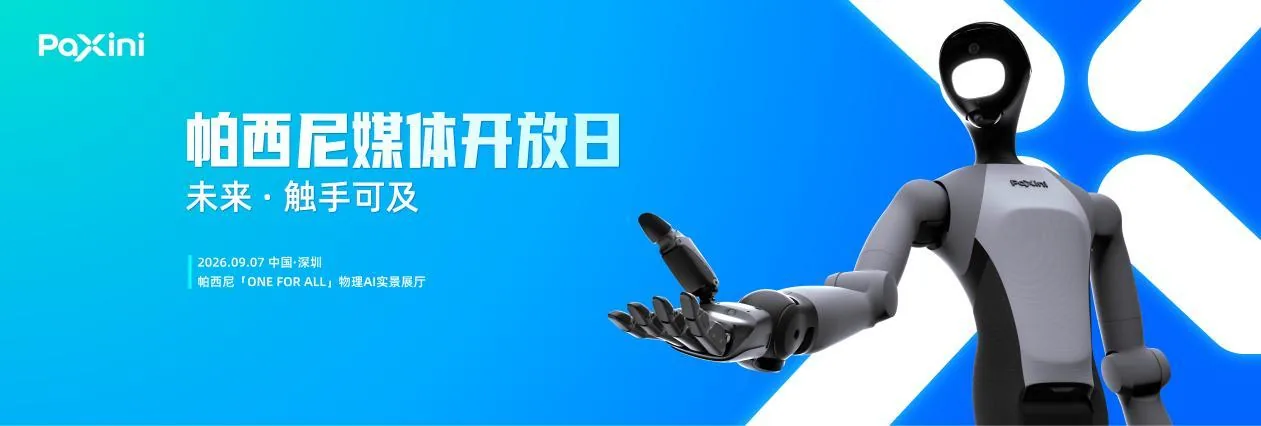
Over the past month, PaXini AI has synchronized acceleration across technology capital, and organizational dimensions: On September 7, the company held a media open day in Shenzhen, unveil ing its complete physical AI实景 (real-world) demonstration展厅 for the first time; Beijing headquarters simultaneously launched, establishing dual-city synergy withShenzhen manufacturing; completed its joint-stock reform and secured a new RMB 1 billion funding round; and launched the PX6AX GEN4 product matrix featuring the GEN4 FUSE native 6D tactile perception chip.
Though seemingly separate initiatives, these moves collectively signal PaXini’s transition from technology accumulation to scalable industrial deployment.
PIE: The Foundational Logic Chain for Embodied Intelligence Commercialization
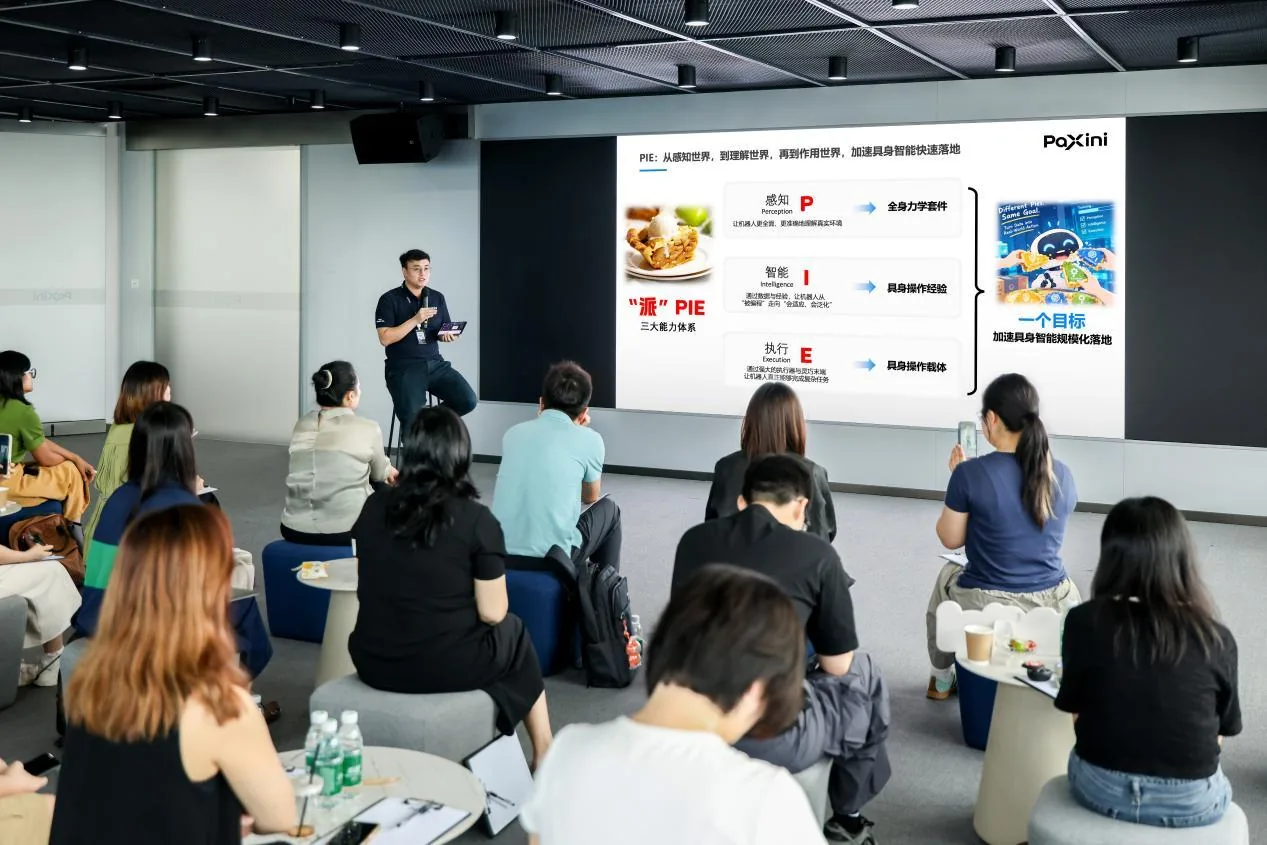
CEO Dr. Xu Jincheng introduced the «PIE» framework for embodied intelligence commercialization:
- P (Perception): Enable robots to acquire real physical feedback through true 6D tactile chips—contact, force, slip, and deformation;
- I (Intelligence): Transform physical interactions into reusable and transferable capabilities;
- E (Execution): Execute real-world tasks via dexterous hands and robots.
The breakthrough here is critical: GEN4 FUSE is the world’s first—and currently only量产 (mass-produced)—native true 6D tactile perception array chip. PaXini integrates semiconductor wafer fabrication into tactile chip production, reducing costs by orders of magnitude and transforming touch sensing from a «premium option» to an «essential configuration» for embodied AI.
Full-Stack Validation: From Chip to Humanoid Robot
The 3,000-square-meter «ONE FOR ALL» physical AI展厅 constructs an intact robot capability evolution path:
- Perception Layer: GEN4 FUSE chip + full-body mechanical sensing suite (covering fingertips to feet);
- Data Layer: OmniSharing DB multimodal collaborative self-calibration system enabling automated data cleaning calibration, and annotation;
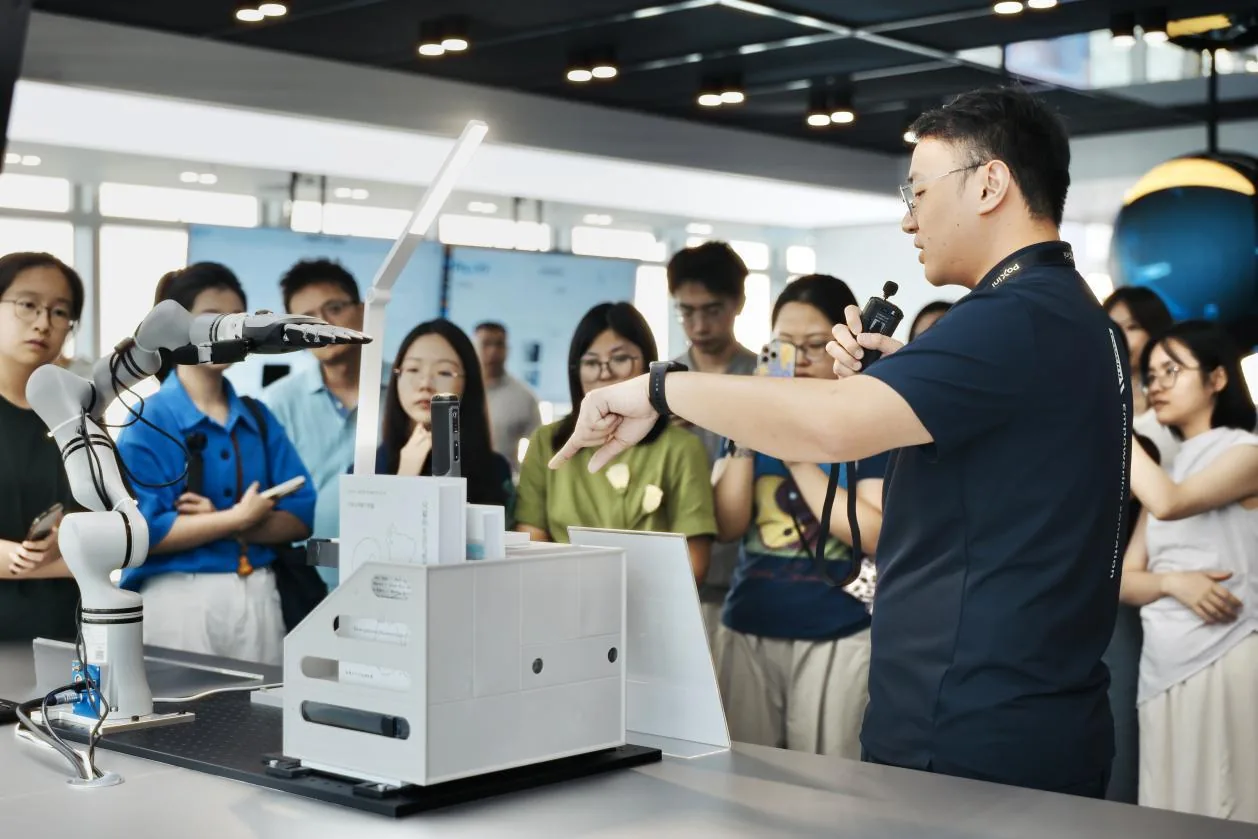
- Execution Layer: PXCap Pro capture glove (integrated multi-array tactile sensors, in-house high-precision rotary encoder, and wide-angle wrist camera), multi-gen tactile dexterous hands, and TORA series humanoid robots.
A Counterintuitive Metric: Traditional data labeling heavily relies on manual labor, whereas OmniSharing DB’s automation significantly reduces human effort, computational resources, and token consumption—indicating a qualitative leap rather than incremental improvement in data efficiency.
Three Financial Calculations: Industry Barriers to Commercialization

In media interviews, Dr. Xu outlined three essential门槛 (thresholds) for commercial deployment:
- Perception Cost Accounting: Wafer-level mass production enables affordability, transforming touch sensing from «premium option» to «base configuration»;
- Data Efficiency Accounting: OmniSharing DB enables continuous collect-train-feedback loops, avoiding the trap where more data equals higher costs;
- Production Value Accounting: Collaboration with BYD captures real manufacturing工艺 (process) experience—contact, force, rhythm, anomaly correction—transforming production standards into learnable data.
These calculations form a unified logic: P reduces cost of acquiring physical reality, I reduces cost of learning, E validates and amplifies capability in real production.
Who Should Deploy Now? Who Should Wait?
- Ready Adopters: Enterprises with industrial site deployment capability requiring high-precision force control (e.g., precision assembly, complex sorting); system integrators with in-house or collaborative R&D capacity who can integrate with OmniSharing DB’s data ecosystem;
- Worth Waiting For: AGV/mobile robot vendors with vision-only solutions lacking multimodal interaction capability; technical teams without physical scenario闭环 (closed-loop) validation relying solely on simulation training.
Final Thoughts
While the industry continues discussing sensors data, models, and bodies in isolation, PaXini has chosen to redefine the path to embodied AI commercialization through a single causal chain—its true objective is not a technology portfolio, but a shorter evolution loop: faster real-data capture, faster task capability formation, faster real-world validation.
This may signal that embodied intelligence has shifted from lab-scale race toward industrial value validation phase.