
Introduction: Two Blackouts as a Systemic Warning
On July 22, 2026, a transmission line fault in Ashburn, Virginia—a region hosting the world’s largest data center cluster—stripped over 3 gigawatts (GW) from the grid within seconds. This was not an isolated incident: in 2024, a single failed surge arrester triggered the simultaneous disconnection of roughly 1,500 megawatts (MW). Both events stemmed not from insufficient generation but from a systemic failure of grid architecture, exposing the growing incompatibility between AI-powered data centers and-century-old infrastructure.
- 2024 incident: A single faulty arrester caused ~1,500 MW of coordinated load rejection
- 2026 incident: Transmission line failure shed >3 GW in milliseconds
- Ashburn serves as the epicenter of global AI infrastructure capacity
Why the Traditional Stack Falters
Standard data center power architecture has remained largely unchanged for decades: medium-voltage power enters the facility, is stepped down by transformers, conditioned by low-voltage uninterruptible power supply (UPS) systems, then delivered to server racks. When scaled to AI workloads, three vulnerabilities emerge starkly:
First, UPS batteries shrink to a “spare tire”. Legacy UPS designs accommodate minute-long outages—not the millisecond-scale, 70% load swings now occurring throughout the day. During model training, compute clusters can rapidly ramp power demand—or cut it—far exceeding batteryresponse capacity.
Second, eco-mode becomes standard, but weakens both sides. To offset conversion losses, operators engages “eco-mode”: a static switch bypasses filtering by delivering power directly from the grid. Grid-side transients—sub-millisecond voltage dips—pass unimpeded into equipment, while rapid power swings from computation propagation back to the grid exacerbate grid instability.
Third, protection logic lags behind today reality. Designed when 50 MW constituted “large load,” existing schemes lack system-level visibility. When upstream faults cause voltage sags, protection relays trip as programmed—e.g., “disconnect on the third voltage dip”—precisely when grid stability demands steady loading, worsening disruption in a feedback loop.
The designs were sound for their era. The load itself has evolved beyond their intended operating envelope.
A Three-Step Architecture Refactor
The emerging solution: medium-voltage inline UPS systems, achieved via three integrated upgrades:
- Move it up—Supply at 13.8 kV or higher medium-voltage, matching grid backbonel levels rather than 480 V low-voltage;
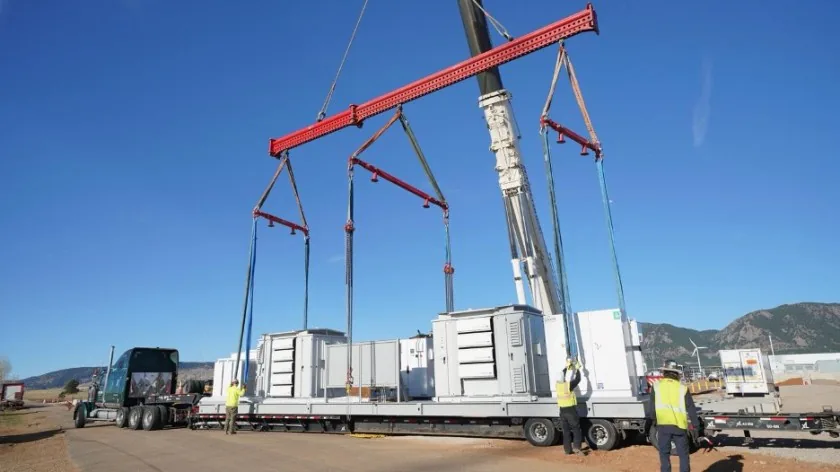
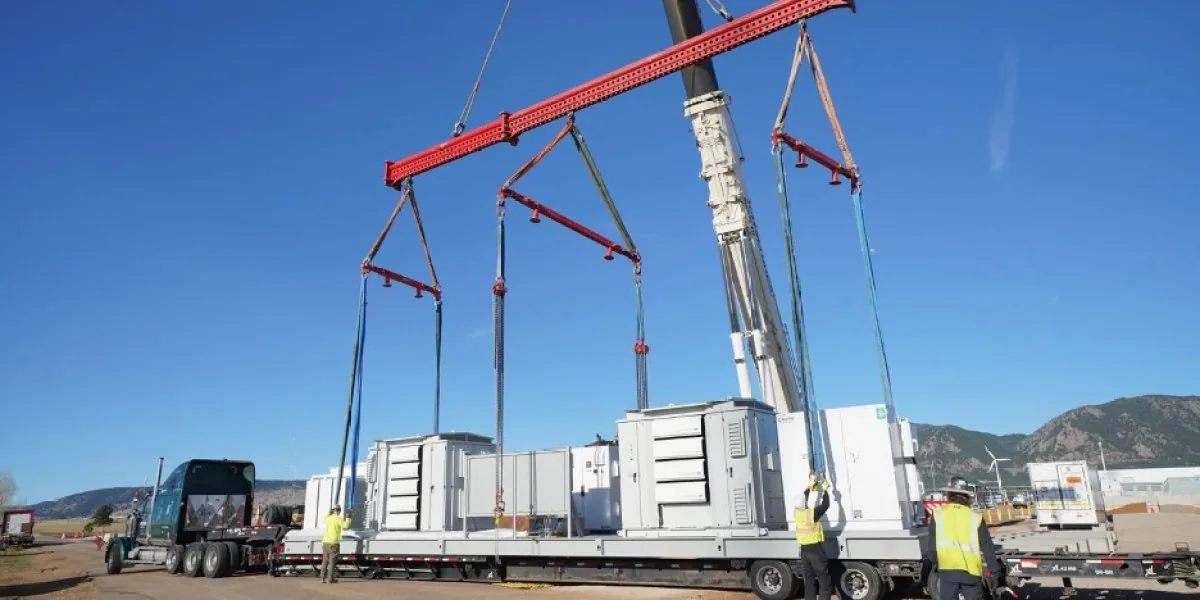
- Move it out—Relocate critical infrastructure (UPS, storage, conversion) to modular outdoor enclosures near substations, leaving only compute and essential cooling indoors;
- Move it into the path—Operate the system continuously in series, not in parallel bypass. Every electron passes through regulation, eliminating detection and switching delays—no tripping, no fallback.
Full-scale validation at the U.S. Department of Energy’s National Laboratory of the Rockies in early 2026 confirmed performance: the system simultaneously sustained real AI load profiles at full medium voltage while enduring grid faults—including a complete zero-voltage event. Compute-side operations remained stable; grid-side behavior was unaffected. It cleared ERCOT’s stringent large-load voltage ride-through requirements with margin, setting a new benchmark for grid-integrated AI facilities.
Practical Value and Economic Rebalancing
The architectural shift delivers tangible benefits beyond reliability:
- Compliance acceleration—Utilities certify a single medium-voltage enclosure instead of auditing every downstream component (transformers, UPS, chillers, pumps, switchgear); permitting timelines shrink accordingly;
- Space optimization— Freed UPS rooms convert into compute or cooling capacity; construction dollars yield higher density;
- Backup power monetizes—Medium-voltage, outdoor, self-contained systems qualify for participation in grid services (peak shaving, demand response), transforming backup from pure cost to revenue-generating asset;
- Incentive eligibility—Becomes eligible for tax credits and renewable/grid-support incentivize programs previously unavailable to legacy rack-level UPS.
Adoption Recommendations
- Who should act now—Plans or builders of facilities ≥100 MW scale; operators prioritizing uptime resilience and grid partnership; projects targeting total cost of ownership reduction and revenue Abbey from grid participation;
- Who can wait—Small facilities (<10 MW) face limited urgency; short-term or temporary deployments with limited lifecycle planning; projects以 strict capital constraints disqualifying incremental upgrade investment.
Final Word
The Virginia blackouts are both a warning and a pivot point. As AI loads become grid-dominant, redesigning the customer-side architecture proves more urgent—and more efficient—than unrelated generation expansion. This shift from passive consumer to active grid supporter heralds a meaningful transition from industrial-era to digital-era power systems.
(Word count: ~1380)