A counterintuitive ledger
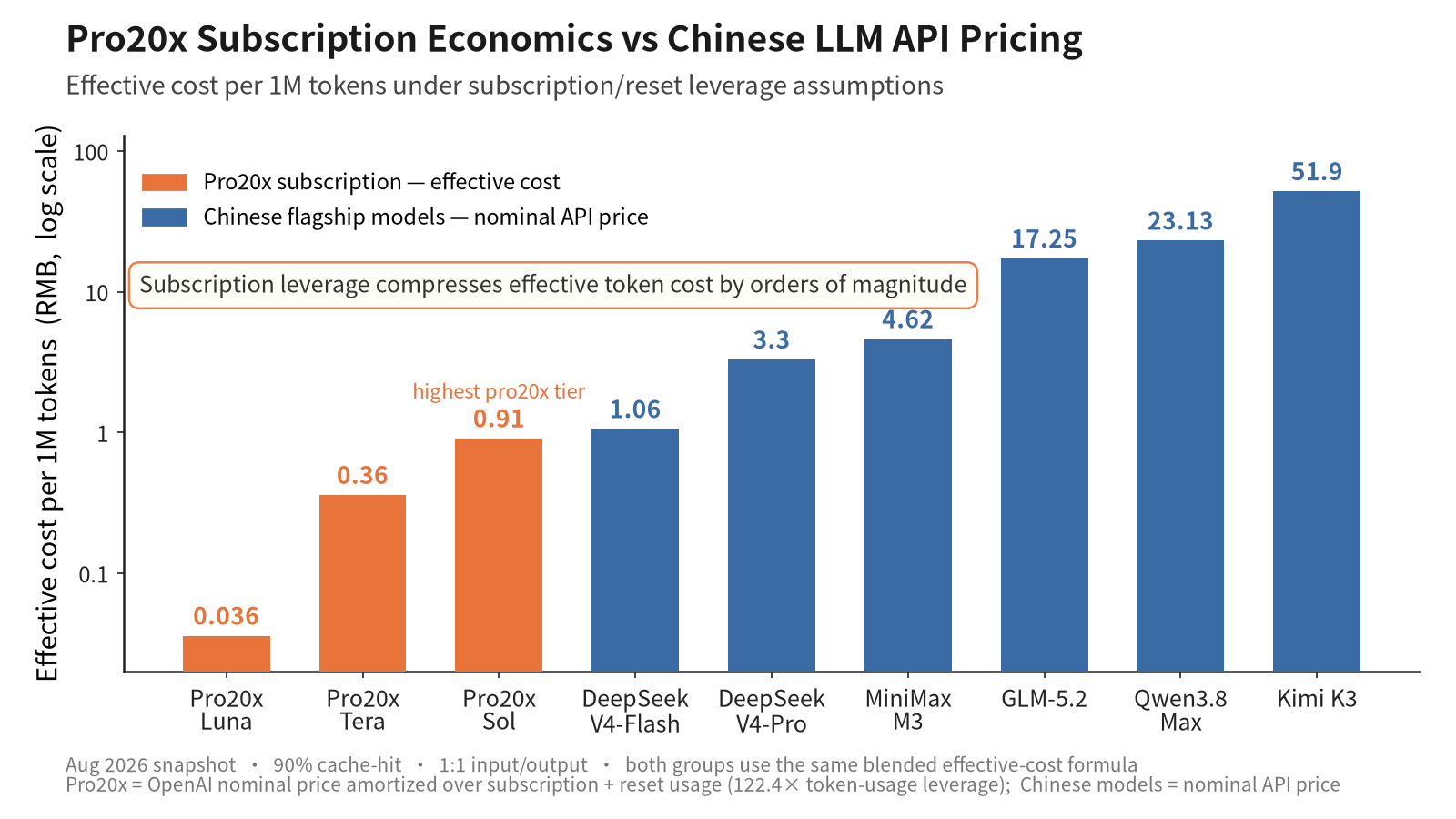
Suppose you pay 1000 RMB to activate a ChatGPT “pro 20x” subscription, equivalent to roughly $1700 of API value per week, and stack OpenAI’s ~10 monthly “Goodwill Resets” (announced by tibo — each one refreshes a brand-new fully-loaded 7-day cycle). Under that assumption, your effective cost per million tokens lands at 0.036 ~ 0.91 RMB — while China’s cheapest DeepSeek-V4-Flash costs 1.06 RMB, ~1.2x higher; against the priciest Kimi K3 (52 RMB) it’s ~57x cheaper.
Let’s break it down.
Methodology (assumptions up front)
- Subscription assumptions: pro 20x activation 1000 RMB (~$139); weekly API-equivalent value $1700; ~10 resets/month → effective budget ≈ $1700 × 10 = $17,000 of API value. At 7.2 RMB/USD, $17,000 = 122,400 RMB, so leverage = 122,400 ÷ 1000 = 122.4x (you pay 1/122.4 of the API price).
- OpenAI three tiers (litellm 2026-08 snapshot, OpenAI direct prices, per 1M tokens): GPT-5.6 Sol input $5 / cached-read $0.5 / output $30; Tera $2 / $0.2 / $12; Luna $0.2 / $0.02 / $1.2. All three cache reads are 0.1x of input. In RMB (×7.2): Sol input 36 / cache 3.6 / output 216. Counterintuitive: Sol is the flagship (priciest), Luna is the cheapest (the one OpenAI gives free users unlimited chat on).
- China side all updated to 2026-08 latest flagships: DeepSeek-V4 (Flash/Pro), Qwen3.8-Max, GLM-5.2, Kimi K3, MiniMax-M3; prices converted to RMB/M. DeepSeek/Qwen/GLM/MiniMax rows come from litellm’s direct provider price keys (USD×7.2); Kimi K3 from Moonshot’s official pricing page (platform.kimi.com, 2026-08 newly released flagship: cache-hit 2 / cache-miss 20 / output 100 RMB per 1M tokens). Doubao/ERNIE/Hunyuan are excluded — their official pages need JS rendering, lack litellm direct keys, or omit cache prices, so they can’t be programmatically verified.
- Combined per-million-token cost: 90% cache hit on input (
0.9×cache-read + 0.1×input), output at full price; input:output assumed 1:1, so per 1M total token =(effective_input + output) / 2. A fair “total token” metric; under Codex-heavy reasoning all models scale up proportionally, but the ratios between models stay essentially constant.
pro 20x paid vs China’s top APIs
| Model | Vendor | Input¥/M | Cache¥/M | Output¥/M | Combined¥/M | vs pro20x Sol | Source |
|---|---|---|---|---|---|---|---|
| pro20x · Luna | OpenAI* | 1.44 | 0.144 | 8.64 | 0.036 | 0.04x | paid (122.4x leverage) |
| pro20x · Tera | OpenAI* | 14.4 | 1.44 | 86.4 | 0.36 | 0.40x | paid (122.4x leverage) |
| pro20x · Sol | OpenAI* | 36.0 | 3.6 | 216 | 0.91 | 1x | paid (122.4x leverage) |
| DeepSeek-V4-Flash | DeepSeek | 1.0 | 0.02 | 2.0 | 1.06 | 1.2x | litellm (direct provider) |
| DeepSeek-V4-Pro | DeepSeek | 3.13 | 0.026 | 6.26 | 3.30 | 3.6x | litellm (direct provider) |
| MiniMax-M3 | MiniMax | 2.16 | 0.432 | 8.64 | 4.62 | 5.1x | litellm (direct provider) |
| GLM-5.2 | Zhipu | 10.08 | 2.016 | 31.68 | 17.25 | 19.0x | litellm (direct provider) |
| Qwen3.8-Max | Alibaba | 14.4 | 1.8 | 43.2 | 23.13 | 25.4x | litellm (direct provider) + Bailian official |
| Kimi K3 | Moonshot | 20.0 | 2.0 | 100.0 | 51.90 | 57.0x | Moonshot official pricing page |
* The input/cache/output figures for pro20x rows are OpenAI gpt-5.6 nominal API prices converted at 7.2 RMB/USD; “combined paid” is then divided by the 122.4x leverage to get your effective cost. China rows are nominal API prices (no discounts); the combined column is that model’s per-million-token cost under the same metric.
What the table says
- pro20x Luna at 0.036 RMB/M is ~29x cheaper than China’s cheapest DeepSeek-V4-Flash (1.06 RMB). Luna is OpenAI’s low-end tier (the one given away unlimited); stacked with reset leverage it’s effectively free.
- DeepSeek-V4 dragged China’s floor down hard: the previous V3 output price was 7.92 RMB/M; V4-Flash compresses it to 2.0 (input also down to 1.0), landing at a combined 1.06 RMB — the cheapest on the China side, only ~1.2x pricier than pro20x Sol (0.91 RMB), a much smaller gap than the V3 era (~2.6x).
- Even pro20x’s priciest Sol tier (0.91 RMB) beats every listed Chinese API — the closest, DeepSeek-V4-Flash, is still ~1.2x; Kimi K3 is 57.0x.
- Most expensive Chinese flagship is Kimi K3 (51.90 RMB) — Moonshot priced K3 (2.8T params, 1M-context flagship) as a super-premium tier, output 100 RMB/M, over 2x Qwen3.8-Max’s output price; Qwen3.8-Max (23.13 RMB, a full order of magnitude above the previous Qwen3-32B’s 2.7 RMB) and GLM-5.2 (17.25 RMB) follow, the three forming China’s price ceiling.
Why this happens
It’s a pricing-model gap: Chinese APIs bill per token, while pro 20x is subscription + periodic full-cycle resets — OpenAI does Goodwill Resets after outages and user milestones (crossing N-million active users), refreshing every paid user’s 7-day cycle and full quota. In July 2026 this happened 12 times; in the first 13 days of August, 8 more. Treating each reset as a fresh full cycle, the subscription’s “API-equivalent throughput” gets multiplied by about 122.4x.
In other words: you pay a subscription fee (1000 RMB) but receive a token volume worth 122.4x the nominal API price. That’s where every number in the table comes from.
A 1000 RMB entry fee, in the low-price zone
Flip the question to “is it expensive?”: pro 20x’s activation fee is only about 1000 RMB (~$139), which sits in the low-price zone of the subscription market — yet that buys roughly $1700 of API-equivalent value per week, a ~12x payback in a single week (1700 ÷ 139), before the 10 monthly resets stack it up to 122.4x leverage. In other words, a low-price-zone entry fee unlocks throughput that per-token billing can never reach — which is exactly why every Chinese API loses in this table.
Caveats that matter
- This is a hypothetical calculation, not steady state: pro 20x activation fee, weekly quota, and reset count are estimates; reset cadence is wildly unstable (April 2026 had 2, July had 12). “10/month” is a fine average, not a promise.
- Leverage comes from resets, which may tighten: Goodwill Resets are OpenAI’s ad-hoc compensation, not contractually guaranteed. Fewer outages/milestones → fewer resets → leverage shrinks.
- Sources & freshness: DeepSeek-V4/Qwen3.8-Max/GLM-5.2/MiniMax-M3 rows come from litellm 2026-08 snapshot direct provider price keys (×7.2), Kimi K3 from Moonshot’s official pricing page (platform.kimi.com, 2026-08 newly released flagship: cache-hit 2 / cache-miss 20 / output 100 RMB per 1M tokens). Doubao/ERNIE/Hunyuan are excluded — their pages need JS rendering, lack litellm direct keys, or omit cache prices, so they can’t be programmatically verified — always defer to each vendor’s official page.
- The combined metric carries assumptions: 1:1 input:output is a rough estimate. Read-heavy workloads widen pro20x’s advantage; Codex-heavy reasoning scales all models up proportionally while keeping ratios stable.
- Not a “freebie guide”: this is a data observation of token economics. Reset info comes from a public tracker (LynxCodex reset compass); subscription terms are per OpenAI’s official policy.
Bottom line
Under the “1000 RMB subscription + 10 resets/month” assumption, pro 20x’s per-million-token paid cost (0.036~0.91 RMB) is systematically lower than every top Chinese LLM’s latest flagship API (about 1.06 ~ 52 RMB), by 1.2 to 57x on the Sol axis and 29 to 1442x on the Luna axis. Notably, DeepSeek-V4 cut China’s floor from the V3-era 2.35 RMB down to 1.06 RMB, narrowing the gap with pro20x Sol to just ~1.2x — but the Luna tier is still ~29x cheaper; at the other end, Moonshot’s new flagship Kimi K3 pushed China’s ceiling up to 51.90 RMB/M (output 100 RMB), widening the gap with pro20x instead. The gap isn’t because the model itself is cheaper — it’s that the subscription-plus-reset billing leverage flattens the per-token price to a place per-token API billing can’t reach. How long this leverage lasts depends on whether OpenAI keeps resetting this generously.