Particle Launches Radar: Turning 130K+ Podcasts into a Searchable AI-Ready Engine
Release date: August 26, 2026
Product: Radar — podcast search and intelligence platform
Core capabilities: Automated transcription, entity recognition, smart alerts, clip extraction
Pricing: $29/month per seat; $399/month business plan (20 seats); API custom pricing
Availability: Live now — web interface and API simultaneously accessible
Particle, an AI newsreader startup founded by former Twitter engineers, has pivoted from news curation to podcast intelligence. Its new Radar platform indexes over 130,000 podcasts, claiming the title of world’s largest transcribed podcast service. The index grows by 20,000 episodes daily and covers all Apple Podcasts Top 200 across 135 verticals.
Beyond transcription: semantic understanding of spoken content
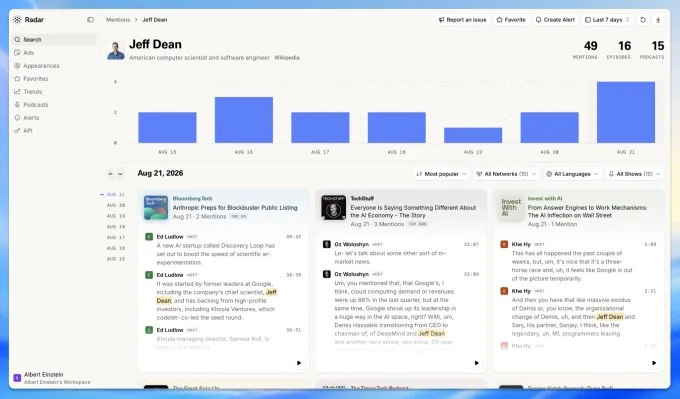
Radar’s value stems from converting unstructured speech into machine-readable data. Beyond basic speech-to-text, it delivers:
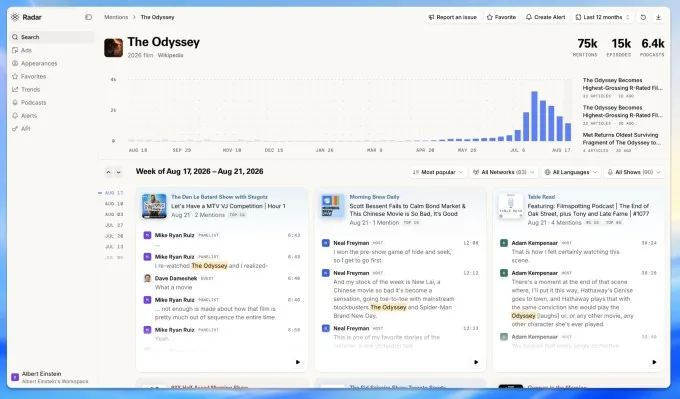
• Entity recognition & tracking: Identifies people, companies, brands, products, topics; traces mentions across podcasts
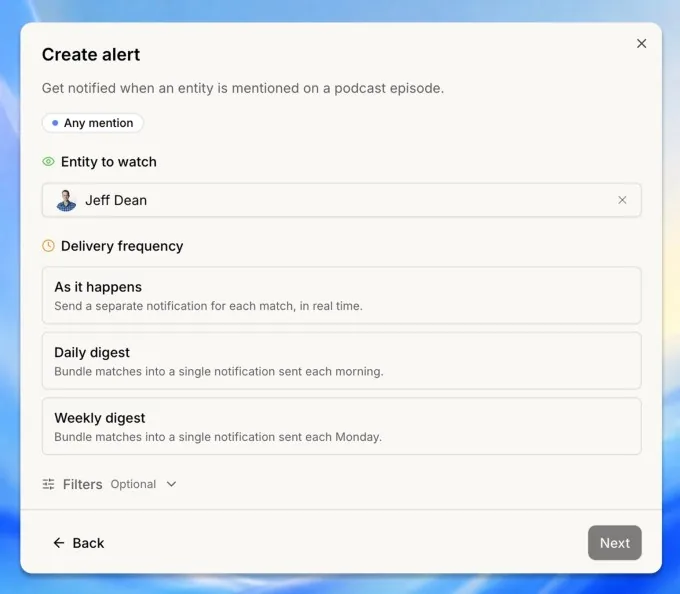
• Custom alerts: Filter by guest, topic, or podcast; delivered via email, Slack, or webhook as real-time or daily/weekly digests
• Snippet extraction: Pre-chosen highlights with timestamps, playable and readable
• Ad tracking: Specialized search to find all episodes featuring a brand’s advertisements and monitor trends
The most surprising commercial traction to date: hedge funds serve as the highest-volume API customers. CEO Sara Beykpour confirmed to TechCrunch that asset managers use Radar to uncover audio insights invisible to conventional AI agents — data points missed in text-only crawling.
From tool to data product
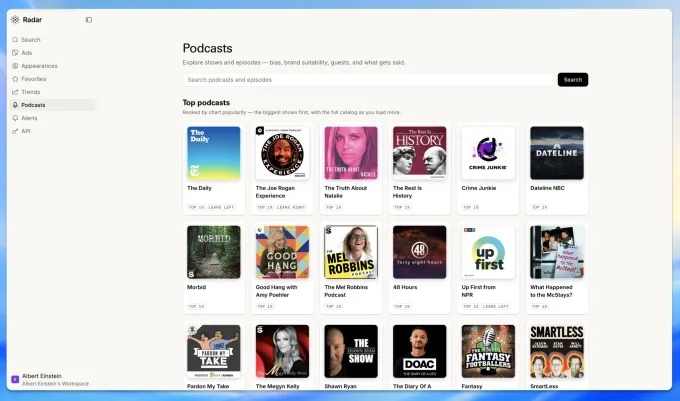
Radar generates commercial value through three customer segments:
- AI search platforms (like Exa) integrate the API to enhance model audio comprehension
- Financial institutions build alternative data signals from topic sentiment
- Media & brand analysts use bias assessments, audience estimates, and sponsorship data for content strategy
A key market gap: Current AI agents rely on web crawling and suffer from an/audio occlusion — they understand text, not speech. “Agents are generally blind to audio,” Beykpour notes. “Unless something or someone transcribes it first.”
Pricing tiers and expansion roadmap
Radar offers three access modes:
| Tier | Price | Seats | Enterprise features | API access |
|---|---|---|---|---|
| Personal | $29/month | 1 | Basic filters, search | None |
| Business | $399/month (20 seats) | 20 | Advanced filters, team management | None |
| API | Custom pricing | — | Full data fields, SLA | Yes |
The platform currently focuses exclusively on podcasts but plans to extend support to YouTube videos and news clips.
Who should use it now?
- AI developers needing agents to comprehend interview dialogue, reviews, or industry discussions
- Content analysts in media or PR using brand mention tracking and competitor ad monitoring
- Quant researchers building alternative data models from topic sentiment shifts
If you only require basic podcast discovery or non-real-time analysis, existing free platforms suffice. Radar’s premium buys automation of audio-to-structured-data pipelines — precisely the kind of raw input AI systems lack today.
Final thought
Industrial-scale audio processing is becoming the new infrastructure for AI-era intelligence. As text search saturates, companies that decode sound are redefining the data value chain — Radar’s 130K-podcast database may well seed tomorrow’s content intelligence standard.