
1. The Maxim Blends Four Different Concepts
A maxim circulates in online dating discourse: “If you want a long-term relationship, display short-term traits; if you want a short-term relationship, display long-term traits.” Part of its appeal is that it captures an asymmetry people keep running into: some who only want something brief come across as devoted and eager to commit, while others who genuinely want something lasting seem bland early on and are never taken seriously. These observations get compressed into a rule that looks actionable, and so it spreads.
There is a real psychological phenomenon underneath it. Sexual Strategies Theory (SST) in evolutionary psychology models short-term mating (a strategy characterized by brief, low-investment pairings) and long-term mating (a strategy characterized by stability, high investment, and joint maintenance) as two distinct psychological mechanisms from the theoretical outset (Buss & Schmitt 1993). But the original text is framed hypothetically; this is theoretical interpretation, not a laboratory verdict. On the empirical side, “context really does evoke different standards” does have direct experimental support: when male college students rated prospective marriage partners versus prospective brief sexual encounters, their age preferences did differ (Young et al. 2005). Context-dependent shifts in height preference also showed up in a cross-cultural sample, but only among men, and the effect was marginally significant (Pisanski et al. 2022). Beyond that, the sex difference in the direction of preferences was replicated again in a large 45-nation sample in 2020: men weighted youth and physical attractiveness more heavily, women weighted somewhat greater age and a partner’s financial prospects more heavily (Walter et al. 2020). These results support the claim that short-term standards are not identical to long-term standards, but the effects are all small, and they are sex-specific and trait-specific (reasonably strong research support, though mostly from single or small samples, and measuring stated preferences rather than actual choices). In other words: the brain does process short-term and long-term mating separately, but there is no single, strong “context switch.”
The problem is that getting from “two sets of standards” to that maxim requires a severe oversimplification. It conflates at least four distinct concepts: displaying short-term attractiveness (appearing appealing), expressing short-term relationship intent (stating outright that you only want something brief), displaying long-term partner value (appearing reliable, someone you could build a life with), and falsely promising a long-term relationship (verbally pledging marriage and a future you do not actually want). The maxim fuses these four into a single pair of “traits,” as if they were two sides of one coin. In reality, a person can be enormously attractive in the short term and never deceive anyone, or be entirely unappealing while sincerely wanting something lasting. The maxim collapses “how you appear” and “what relationship you want” into one variable — and that compression has no research support whatsoever.
2. Why It Sounds Right: Five Mechanisms, Five Boundaries
The maxim spreads because the psychological mechanisms beneath it are partly real; it fails because each mechanism gets stretched far past its range of application. Let us take them one at a time.
Scarcity and psychological reactance. The intuition that we want what we cannot have is ancient; the corresponding concept in psychology is reactance (the motivation to restore freedom when freedom of choice is threatened) (theoretical interpretation). It can explain why moderate reserve might draw more notice than constant availability; it cannot tell us which facet of reserve is doing the work, and it certainly cannot support a durable strategy.
The classic test of “hard to get.” Walster et al. (1973) ran five experiments testing whether a woman who is hard to get for everyone is more desirable. All five failed. Only the sixth experiment found what actually worked: the woman men rated most highly was the “selectively available” one (available to the pursuer himself, unavailable to everyone else). Men kept her availability as a virtue, read the exclusivity as something precious, and simultaneously avoided all the downsides of the uniformly-hard-to-get type (reasonably strong research support — this is the strongest link in the whole evidence chain; its limitation is a 1973 sample of male undergraduates). What it explains: the engine of attraction is exclusivity, the sense that “you are special to me,” not “you reject me.” What it does not explain: rejection itself has no magic, and being uniformly cold to everyone does not increase attraction.
Uncertainty amplifies attraction. Whitchurch et al. (2011) had 47 female college students browse fictional male profiles. The group told that “his interest in you is uncertain” gave the highest attractiveness ratings, higher even than the group told he clearly liked them; the authors hypothesized that the mechanism is cognitive preoccupation — the more you think about someone, the more drawn you become (reasonably strong research support, but a single small-sample experiment, measuring one-shot initial attraction only, with no long-term outcomes at all). This explains the flutter felt while still guessing at someone’s feelings; it stops there, and anything long-term lies outside its range.
The backfire of being too hard to get. A scoping review synthesizing 18 studies concluded that “playing hard to get” can only work when uncertainty sits at a moderate level; excessive unavailability prompts the other person to withdraw their own interest, so both parties wait each other out and mutual inhibition sets in (Houle et al. 2023) (reasonably strong research support, scoping review). This is precisely where the maxim fails: push “unavailable” to the extreme and the effect reverses.
Intermittent reinforcement. Online discourse often explains hot-and-cold behavior as intermittent reinforcement (rewards delivered unpredictably sustain behavior more durably). The concept comes from operant conditioning, but among the studies verified here, no direct experiment links intermittent reinforcement to romantic attraction. It belongs to online folk wisdom and theoretical extrapolation, and cannot serve as a research endorsement. At most, it reminds us that uncertainty affects attention — but attention is not liking, and it is certainly not willingness to build a relationship.
Lined up side by side, these mechanisms point to a fairly consistent conclusion: they operate only at the initial attraction stage, under relatively demanding conditions, and not one of them supports faking intent. The maxim sounds right because it borrows the names of these real mechanisms; it fails because it compresses these named, condition-bound effects into an unconditional directive.
3. The Biggest Misunderstanding: Attraction Is Not Short-Term Intent
Most people who act on that maxim founder on the same misunderstanding: treating “possesses initial attractiveness” and “wants only a short-term relationship” as the same thing, so that the traits which make someone appealing early on get wholesale stigmatized as “short-term traits.”
Unpacked, the things that may raise initial attractiveness are quite ordinary: appearance and self-presentation, confidence, independence, social skill, humor, personality, a sense of boundaries, not over-accommodating, having a life of one’s own, romantic attraction (the appeal that sparks romantic interest), and not projecting excessive neediness. A caveat: this list is a synthesis at the level of folk observation and theoretical interpretation; the verified research has not tested its items one by one. But none of them has any logical connection to short-term relationship intent. Someone seriously looking for a long-term partner can perfectly well possess every trait above.
Conversely, equating “expressing long-term intent” with “seeming boring” is the other face of the same misunderstanding. Long-term partner value is often invisible early on — not because it is strategically concealed, but because it needs time and circumstance to surface: emotional stability (not being knocked off balance by small things, being able to self-regulate under stress), consistency, integrity, and responsibility cannot be fully observed across two or three meetings.
So: short-term attractiveness is not a declaration that you only want a short-term relationship; a person can be looking for a long-term partner while possessing strong personal appeal in the early stage. The idea that binds the two together has no research source; it comes from speculative generalization about “the love lives of attractive people.” What genuinely needs distinguishing has always been attraction versus intent, not so-called “short-term traits” versus “long-term traits.”
4. Relationships Already Have a Natural Order
There is indeed a rough order of disclosure in relationships: attraction first, long-term judgment later. But this is an order of judgment tasks, not an order of impersonation tasks.
At the start of a relationship, the first question a person asks is “am I interested in getting to know this person further,” not “should I marry this person.” That is not strategy but cognitive necessity: most components of long-term partner value — values, emotional stability, ways of resolving conflict — can only be observed through time spent together and cannot possibly be presented in full on day one. Therefore, long-term value is usually not the most important information at first contact; what matters more early on is Attraction, Chemistry (the immediate sense of pull and fit between two people), and Curiosity. As the relationship deepens, the weight gradually shifts toward Trust, emotional stability, consistency, values, responsibility, career and life direction, and Compatibility (whether both parties’ habits and goals can sustain living together long-term).
Two mutually irreplaceable judgments have to hold at the same time: long-term partner value cannot fully substitute for initial attraction; initial attraction cannot substitute for trust and compatibility in a long-term relationship. The first explains why someone with excellent credentials may still produce no spark; the second explains why the spark is only a beginning.
Organized into a six-stage model, each step corresponds to a core question:
- Attraction — “Do I want to keep getting to know this person?”
- Curiosity — “What else about this person is worth learning?”
- Connection — “How do I feel when I spend time with them?”
- Trust — “Is this person reliable?”
- Long-term Compatibility — “Are we suited to entering each other’s lives?”
- Commitment — “Are we both willing to build a long-term relationship together?”
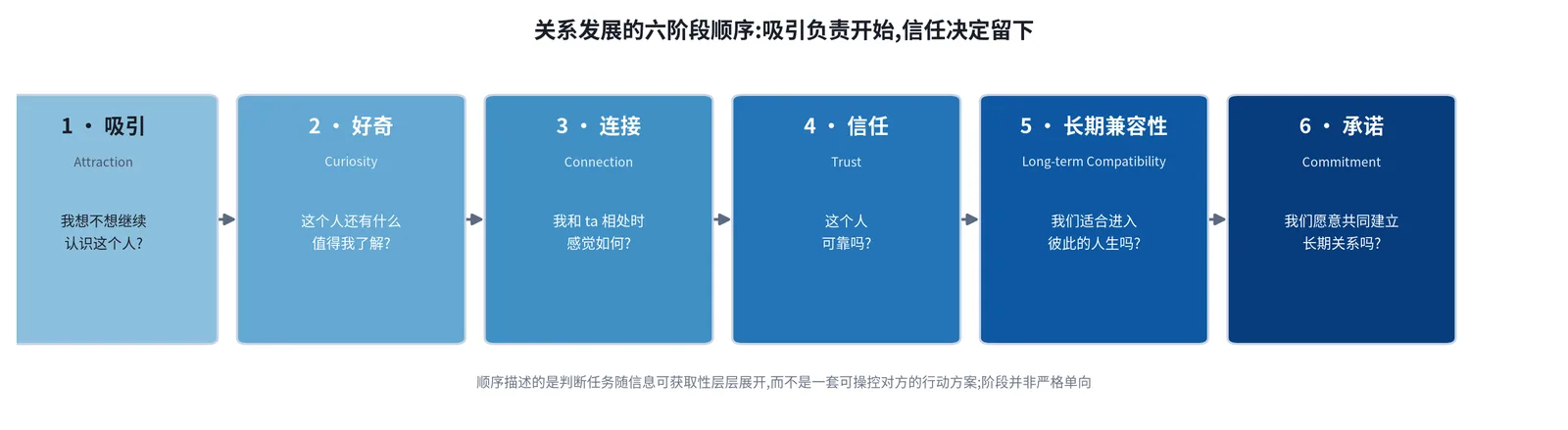
Attraction typically opens the door to a relationship, while long-term value decides whether both people are willing to stay.
It should be said that this six-step micro-sequence remains an observational framework: among the verified studies, none has directly tested it. What we do have: short-term and long-term contexts evoke different standards (Young et al. 2005; Pisanski et al. 2022), but that is a contextual difference, not evidence of sequence. Sternberg’s triangular theory of love — passion, intimacy, and commitment — now has a cross-cultural measurement basis across 175 countries and 117,000 people (Kowal et al. 2025), but that dataset is purely measurement and draws no conclusions about sequence. The closest longitudinal evidence comes from a roughly seven-year follow-up from age 14 to 21: the quality and duration of romantic relationships did develop in an ordered way with age, with “bonded romantic love” at 21 as the mature form (Seiffge-Krenke 2003) — but that is a sequence across developmental ages, not steps within a single relationship. More notably, trust does not always come “after” attraction: trust contains an automatic, implicit component, and in experiments, subliminal priming alone was enough to strengthen a person’s confidence in their partner’s love and commitment, without any route through explicit deliberation or accumulated time (Murray et al. 2011, research on impulsive trust in the Journal of Personality and Social Psychology; reasonably strong research support, with some experimental effects marginally significant). “Trust arrives late” is fine as an intuition; as a law, it is challenged by this evidence.
So using the six stages as a lens for observing relationships holds up — it describes how judgment tasks unfold layer by layer as information becomes available. Treating it as an operating manual for “manipulating the other person in this exact order” has neither evidence behind it nor any fidelity to the original point. A genuinely healthy relationship is not strategic deception, but rather letting the other person gradually see the different layers of a person’s real value as the relationship develops.
5. Why Premature “Long-Term Commitment” Backfires
First, separate two things the maxim runs together: premature commitment and long-term value. Wanting a long-term relationship is not itself a problem and is not the source of any backfire; what backfires is investing too early, over-committing, or projecting intense neediness before any real knowledge exists.
Why does excessively early commitment make people back away? There are at least three layers of mechanism (what follows is theoretical interpretation and folk observation; direct evidence is absent). First, it scrambles the information sequence: before the other person has had a chance to answer “do I want to keep getting to know this person,” a “for the rest of our lives” proposal lands on them. What they receive is not security but an unverified debt — for instance, talk of marriage two weeks in, or planning a shared future before ever meeting. Second, it is the inverse of the scarcity effect: betting everything instantly signals that the commitment is cheap and anyone could obtain it. Third, it closes a loop with the mechanisms of the previous section: extreme push-pull gets read as “you are not serious” and prompts withdrawal of interest (consistent with the mutual inhibition finding of Houle et al. 2023), and an extreme all-in bet gets read as “you are not really looking at me.” Both extremes share the same error: never letting the other person participate in the judgment.
“Premature commitment carries risk” currently has no verified direct experimental test. SST lists “seeking versus avoiding commitment” as one of the core adaptive problems (Buss & Schmitt 1993), which is theoretical interpretation. The closest thing to direct evidence, the research on “sliding vs deciding” (whether at key transitions like cohabitation and marriage people consciously decide together or slide in by inertia), falls outside the verified evidence base and can only be listed as an open question. In other words, this section covers what is theoretically coherent and commonly observed but still lacks direct empirical support, and should be weighted accordingly.
If someone has no long-term relationship intent yet deliberately promises marriage, love, or a future purely to obtain sex or short-term gain, that is deception, not sophisticated relationship strategy. The most dangerous part of the maxim hides on the reverse side of that sentence — it implies that “displaying long-term intent” is a tool you can switch on at will, and treating another person’s heart as a tool is precisely the hardest starting point to repair in intimate life.
6. Mature Relationships Need No Reverse Impersonation
Social Penetration Theory (Altman & Taylor 1973) uses an “onion model” to describe self-disclosure (the extent and depth to which one actively reveals personal information): a relationship begins at the outermost layer of surface information and is peeled back toward the core layer by layer (theoretical interpretation; the theory falls outside the verified evidence base, but its description points in the same direction as everyday observation). Intimacy is built through gradual and reciprocal disclosure, not by wagering everything at once, and certainly not by performing in reverse.
This is the healthy version of the “natural order”: not “first fake short-term, then fake long-term,” but “first generate attraction, then gradually build trust, and finally judge whether both people are suited to a long-term relationship.” The problem with impersonation is not only moral but also practical: manufactured coldness gets exposed once the other person’s patience runs out, and manufactured devotion falls apart at the first conflict of interest. Real value carries no performance cost and does not suddenly vanish one day. A person who reveals themselves gradually as they actually are naturally possesses that so-called “order of disclosure” — attraction, trust, and commitment are simply different layers of one person’s truth, not three costumes.
7. To Male Readers: Study Reality, Not Manipulation
This seventh section is written directly to male readers. Content of this kind appears mainly in male-oriented discussion communities, and men are also encouraged to perform more in the early stage of a relationship.
The first piece of advice is grounded in evidence, not moral posture. A machine-learning comparison across 29 laboratories, 43 longitudinal dyadic datasets, and more than ten thousand couples found that the strongest predictors of long-term relationship quality all come from the dynamics of the relationship itself: perceived partner commitment (how invested the other person is felt to be in the relationship) ranked first, followed by appreciation, sexual satisfaction, perceived partner satisfaction, and conflict. Individual-difference variables — including attachment (an individual’s habitual expectations around closeness and distance) anxiety and avoidance, and negative affect — added no incremental predictive power beyond the relationship variables themselves (Joel et al. 2020; reasonably strong research support, though the “no incremental prediction” claim is disputed). This means that faking “high value” and manufacturing scarcity both target “personal image,” a variable that barely affects relationship quality at all. What actually determines relationship quality is the investment and appreciation the other person perceives in the interaction. Spending your effort where it can be perceived is the only direction the research can give.
Set side by side, two paths diverge sharply. The crude logic: wanting a certain kind of relationship, you impersonate a different kind of person — act short-term when you want long-term, act long-term when you want short-term. The mature logic: raise your real attractiveness while genuinely possessing long-term partner value. An ideal adult can hold both sets of traits at once — attractiveness: independent, confident, interesting, with boundaries, having a life of one’s own, not excessively dependent on a partner; long-term partner value: integrity, emotional stability, consistency, responsibility, problem-solving ability, long-term planning, respect for a partner, reliability.
In daily terms, this comes down to some plain things: build an independent life, develop a career and interests, let emotional stability become an observable fact; learn to set boundaries and keep distance from people irrelevant to you — which is, in research terms, the inverse application of “selective availability” (Walster et al. 1973). Express interest clearly and gracefully to the person you actually want, leave them room to decline, and do not press after being turned down. Learning to express interest is a crucial lesson many men are trained in far too little growing up, and it demands two things at once: courage, and integrity.
8. Conclusion: Attraction Opens the Door, Trust Decides Who Stays
Back to the maxim we started with. Its error is not a naive one, precisely because it is half true: short-term and long-term mating really do engage different psychological mechanisms, and attraction and intent really are easy for an observer to conflate. Its real mistake is wringing these genuine phenomena into a guide to impersonation.
The order it obscures is, in fact, a plain thing. Attraction brings two people closer. Connection makes them willing to keep learning about each other. Trust lets the relationship stabilize. Compatibility decides whether they can walk together. Commitment is the outcome of a free choice made by both. Not one step here needs to be faked, and not one step can be replaced by faking.
So the answer is this: attract genuinely first, then open up gradually, build trust through time spent together, and finally judge honestly whether the two of you are suited to a long-term relationship. The risk in this process lies in revealing what is real, not in appearing insufficiently clever. But only what is real can be used to build trust — and trust is the thing in a relationship that best withstands time.