
Robot Brain Development Enters a Critical Inflection Point

Last week’s Actuate developer conference drew 1,500 attendees—an enterprise that has tripled since its 2023 inception—revealing a shared industry consensus: physical AI remains in its “GPT-2 era,” a蓄水池期(bottle-nec phase) preceding major breakthroughs. As Antioch’s Harry Mellsop put it, the field needs more data and compute, especially GPUs optimized for ray tracing, to cross the technological chasm.
Data Crisis and Deployment Paradox: Valuation Booms Amid Utility Lags
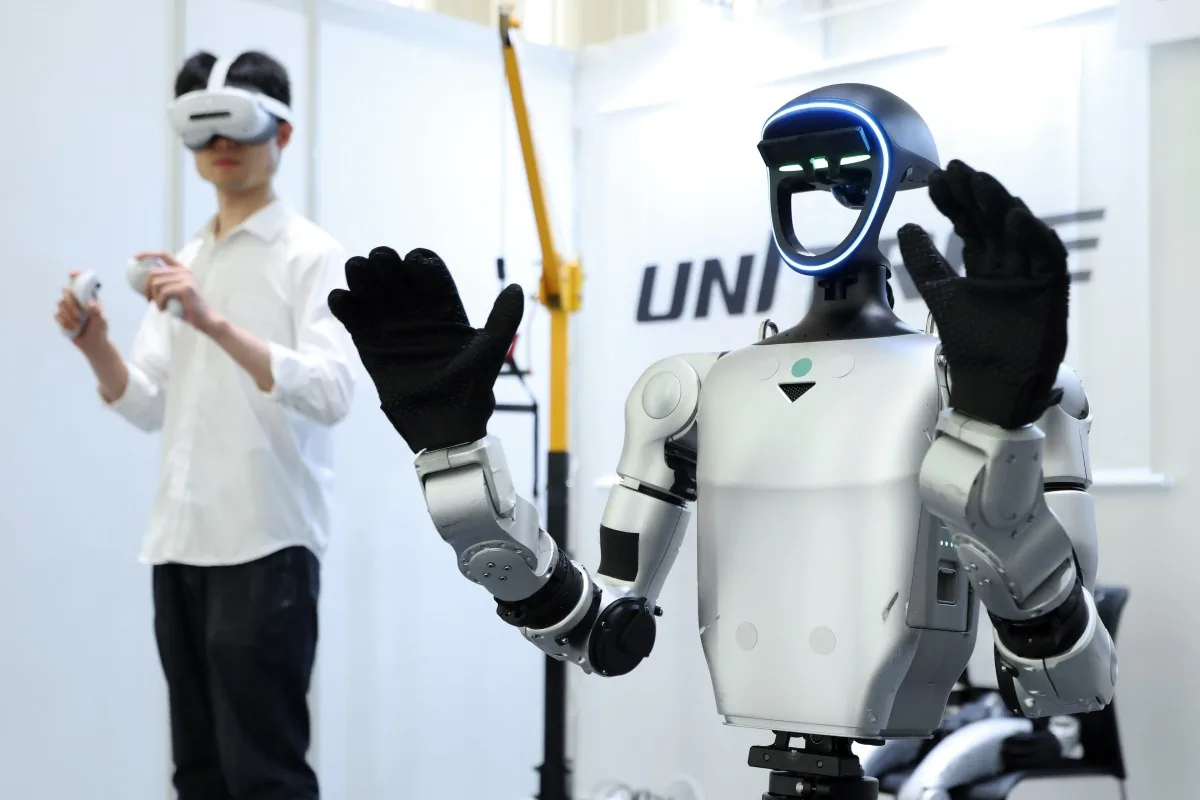
Industry fervor contradicts operational realities. Unitree’s $66 billion valuation following its IPO sharply reversed this week, with analysts pointing to a fundamental gap: robot bodies evolve rapidly while AI brains still lack capacity to execute value-creating tasks. Autonomous vehicles stand as the exception—their lead stems from leveraging human driven data and a simpler core task (collision avoidance vs environmental manipulation).
Pragmatic robotics firms have pivoted to vertical applications for survival. Gritt builds solar farms, Agility deploys in industrial settings, and Bedrock operates excavators autonomously. Bedrock CTO Kevin Peterson notes excavation serves as a “mindful entry point” to understand manipulation challenges in unstructured environments, with intelligence layers eventually spanning multiple construction machines. This focus delivers both revenue and deposition data—critical for closure of task-specific datasets.
Shared Infrastructure, Differentiated Models
Robotics tooling infrastructure is converging. Foxglove’s founders emerged from Cruise’s autonomous team; its new product built on NVIDIA’s Cosmos open-weight world model enables natural language search across lidar and visual data, accelerating debugging cycles. Yet embodiment-specific simulations remain essential.
Wayve CEO Alex Kendall likens current manipulation robotics to autonomous driving five years ago: “The data infrastructure, simulation, ML ops infrastructure, will probably be shared, but the specific world model for the simulator will be a different post-training.” Uber and Wayve have launched humanoid robotics labs, testing hardware-agnostic brain strategies.
Key Hardware and Trajectory Comparison
| Company/Product | Funding | Valuation | Core Focus | Embodiment Strategy |
|---|---|---|---|---|
| Unitree | Undisclosed | $6.6B IPO valuation | Quadruped manufacturing | General-purpose body |
| Genesis AI | $105M seed round | Undisclosed | Vertically integrated humanoid | Co-designed hardware-AI |
| Wayve | Undisclosed | Undisclosed | AV model migration | Cross-platform brain |
| Bedrock | Undisclosed | Undisclosed | Construction machine autonomy | Vertical-specific |
Delivery Path Recommendations
addEventListener: Vertical- focused teams (energy, construction, industrial ops) should deploy current tech to capture real-world data. Developers should adopt Foxglove’s natural language retrieval to speed up data triage.
Wait-and-see: General humanoid deployment awaits reliability. Unless 80% success meets risk tolerance (per Gervet’s “out-of-box” benchmark), enterprise buyers should await mature solutions.
Final Thoughts
Foxglove CEO Adrian Macneil offers the most grounded assessment: there won’t be a ChatGPT moment for robotics—real-world distribution dwarfs digital adoption speed. His vision? An Apple II or IBM PC equivalent: a home robot performing useful, fun tasks reliably. Physical AI’s inflection point won’t be viral; it will be visible in factories, farms, and eventually living rooms—gradually, reliably, finally useful.