
One News Story That Almost Made Me Start a Project on Impulse
A few days ago, I came across a news story: Business Insider reported that robot dogs in the United States are entering the security industry—patrolling data centers, guarding high-value crops, and monitoring stadiums. The most eye-catching figure was this: using a robot dog to cover a 24/7 security post can save $80,000 to $130,000 per year compared with hiring a human guard.
My first reaction was: this business could make money. And with China’s leading technology and mature supply chain, plus all the factories around me that I could connect with, building a one-person robotics company suddenly seemed like the natural thing to do.
For a moment, I even felt like I could start that very day.
Fortunately, I have a rule for myself: new ideas must pass through the gate first—research before action. So I threw the idea into three parallel AI research tracks. Today’s post is about why, after that research, I talked myself back down.
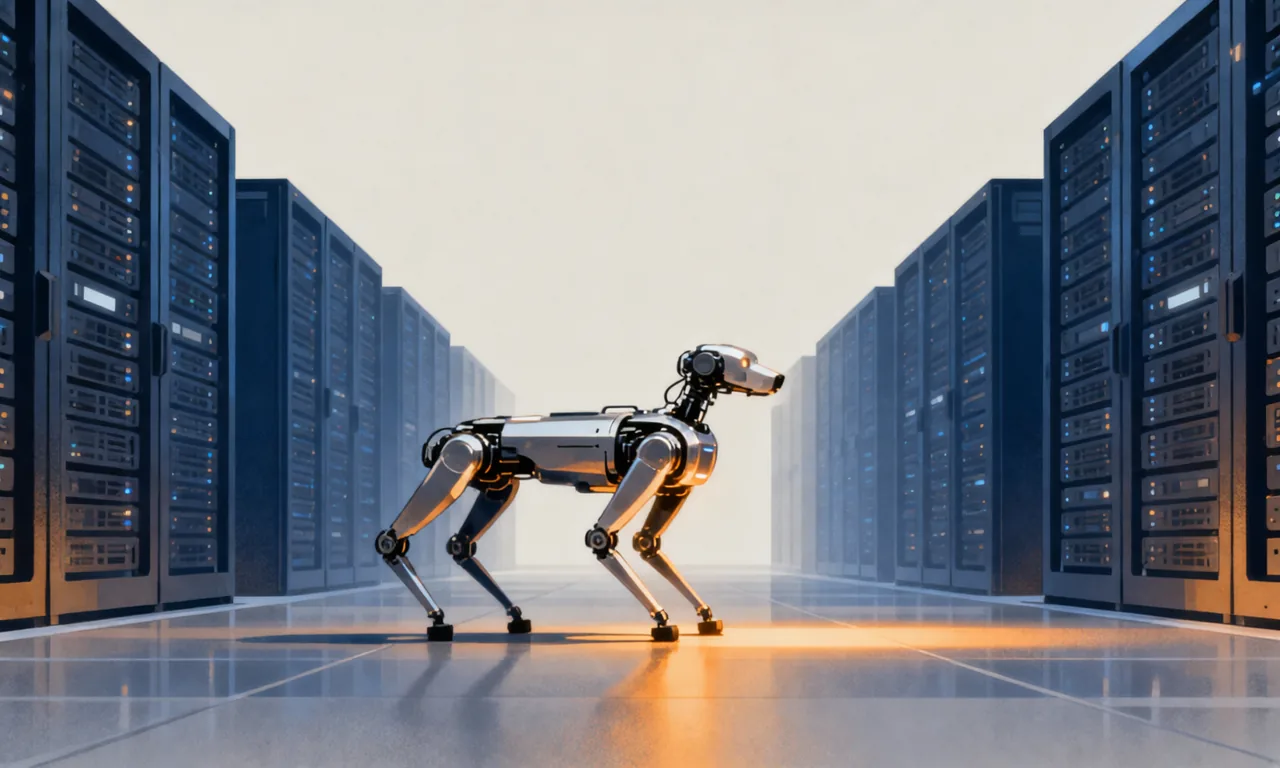
Fact One: Building Robot Dogs Is a Dead-End Business, Not Something You Can Just Decide to Do
The first bucket of cold water is pricing.
Unitree, located in Hangzhou right next to my city, sells its entry-level Go2 Air starting at RMB 8,452; Blue Whisper Technology’s BabyAlpha starts at RMB 6,699; DEEP Robotics’ education edition starts at RMB 16,900. In 2025, China’s quadruped robot market is expected to reach around RMB 8.5 billion, with Unitree alone taking roughly 60%—and it is already preparing for an IPO in Shanghai.
What does a mature supply chain mean? It means you have no right to talk about “manufacturing.” Whatever component quotes you can get, Unitree can get them too—and at lower effective cost because it spreads them across global shipment volume. Competing with it on assembly and price in its own backyard is not a question of courage. It’s a question of math.
Fact Two: The U.S. Math Simply Does Not Work in China
The logic behind the “$80,000 to $130,000 in annual savings” in the news works like this: a robot dog subscription costs $120,000 to $170,000 per year, replaces a security guard making $38,000 a year, and saves the customer $80,000 to $130,000.
That math works in the United States—Asylon has already won 25 customers and deployed around 50 units under a “robotics-as-a-service” model.
But once you bring that model to China, the numbers flip completely. A security guard in China costs around RMB 50,000 to 60,000 a year. An industrial-grade robot dog—such as DEEP Robotics X30 at around RMB 287,500—plus the system around it quickly runs into the hundreds of thousands. Ask a park owner to do that math, and he will only think you’re insane.
And the U.S. market itself is becoming harder to enter. By 2026, the United States has begun restricting imports of “advanced robots,” and new products from Chinese manufacturers must pass FCC approval. Taipei also recently abandoned mainland-made robot dogs due to cybersecurity vulnerabilities. Compliance and political risks are rising year by year, and this is not muddy water a one-person company can wade through.
Fact Three: What Chinese Buyers Are Really Paying For Is Not the Dog, but the “Complete Solution”
So are people in China actually buying robot dogs? Yes—and at a meaningful scale. But they are not buying the dog.
- Substation inspection: This is the most mature market. Power systems purchase thousands of units every year, but what they buy is a complete inspection system—RMB 800,000 to 1.38 million per set—including multiple machines, software, deployment, and after-sales support. A single robot dog is only one component.
- Firefighting reconnaissance: Fire brigades in Ningbo, Nanjing, and Qingdao have already deployed them. Emergency-response scenarios require heavy customization; explosion-proof models cost over RMB 1 million each, but also require special equipment qualifications.
- Industrial park pilots: Hangzhou Binjiang already has pilot projects.
What these customers buy is a packaged solution: “patrol capability + software + service.” The dog itself is a standardized off-the-shelf product. The real profit and defensibility are in the solution and the software.
I Froze for a Moment When I Wrote That Judgment Down
If someone happened to already have a complete software stack for “video patrol + object detection + human-in-the-loop adjudication,” then wouldn’t the software layer for robot dog security simply be that system with a different pair of legs?
As it happens, I had just frozen and archived a project called LynxMarven last week. What it does is: ingest video sources, use AI to detect targets, let humans confirm in the loop, approve tasks, and audit the full workflow. That is highly isomorphic with the software layer of robot dog security.
So if I really were to do this, the right path would not be my initial idea of “building dogs.” It would be: first become an authorized Unitree distributor—they already have a distributor system, with Xiaohongshu and Jingtian Robotics as existing examples—test the market through daily rentals at RMB 800 to 2,000 per unit, and then build software on top of their SDK: patrol scheduling, AI recognition, alarm adjudication. Unitree has public developer documentation and ROS2 support, none of which is locked down.
In the End, I Archived It in the Drawer
The research conclusion was clear: building robot dogs is a dead end; building software is a real opportunity, but the timing is wrong.
I have a much more urgent hard deadline these days—a cash-flow rescue project that has to be cold-started this week. Robot dogs are a textbook example of a “heavy-asset, long-cycle, not-immediately-monetizable” idea. Under the project discipline I set for myself, it belongs on the frozen list right now.
So I archived the full research report, suppressed the impulse to start the project, and wrote the route into the report: first, talk to a Unitree distributor and ask about distributor requirements and rental revenue sharing; second, verify whether industrial parks in Hangzhou actually have real willingness to pay for inspection; third, extract the patrol capabilities from LynxMarven into reusable components for robot dogs.
If one day I really decide to take it back out, I can just follow these three steps—without burning money.
Appendix: Research Method and Sources
This research used three parallel AI search tracks, with cross-validation between Tavily and Grok, covering Chinese manufacturer pricing, the U.S. market model, and China’s deployment ecosystem. Main sources:
- Unitree pricing: Unitree official website / 21st Century Business Herald (2026-06)
- DEEP Robotics pricing: DEEP Robotics official website
- Market share and IPO: Reuters (2026-03), Sina Finance (GGII data)
- Asylon business model and deployment: Business Insider (2026-08)
- Knightscope subscription pricing: Wikipedia
- U.S. restrictions on advanced robot imports: Beijing Daily (2026-07-31)
- Substation / firefighting / industrial park deployment cases: Xinhua News Agency, CCTV, Sina Finance
The full research report, including all data and judgments, has been archived.