
Key Facts at a Glance
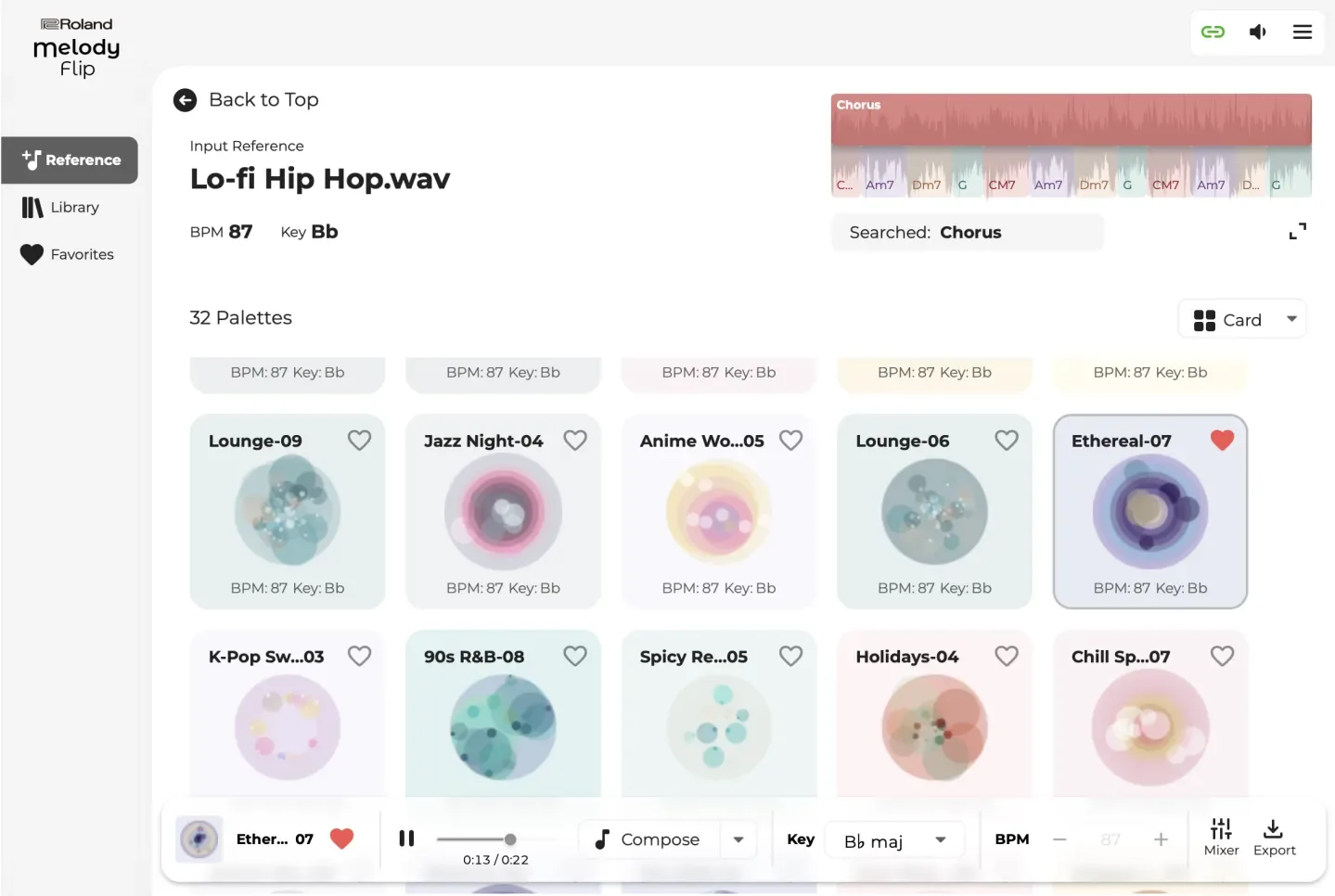
- Release Date: Announced September 5, 2024
- Product Type: Digital Audio Workstation (DAW) plugin
- Name: Melody Flip
- Core Functionality: Generates combinations of melody, chord progressions, basslines, and drum patterns as music loops
- Built-in Content: Approximately 250 curated music style packs called “Palette”
- Reference Import: Users may import reference tracks for the system to extend musical ideas
- Export Format: Generates MIDI data directly importable into DAWs for further editing
- Availability: No release date or test access mentioned
- Pricing: Not disclosed
Positioning: A Sketchpad for Melodic Ideas
Roland’s Melody Flip is neither a consumer-grade “sing me a song” AI nor a replacement for full-featured DAWs. Instead, it targets working musicians with a melodic incubation mindset:Generate starter loops with four core layers—melody, harmony, bass, and drums—that users then export and expand within their existing production pipeline.
Unlike Suno and Udio, which output finished MP3s with vocals and complete arrangements, Melody Flip provides raw, editable MIDI segments suitable for further sound design and mixing. Notably, it does not accept text prompts—a deliberate divergence from the current market trend where LLM-based models prioritize natural language input.
Users can only control four parameters: genre, note density, BPM, and key. This limited control surface reflects Roland’s understanding of its core audience: producers who already understand chord scales and arrangement structure and merely need inspiration, not automation of entire creative decisions.
The Palette content library spans mainstream retro styles (“80s Disco,” “90s R&B”) to niche subgenres (“Kawaii Future Bass,” “Anime World”), suggesting Roland’s intent to serve both broad commercial needs and specialized fan-base production.
Contrasting with Existing Tools
| Feature | Melody Flip | Suno / Udio | Traditional Synth Plugins |
|---|---|---|---|
| Output | Editable MIDI loops | Finished MP3 (vocals + mix) | Single preset sound or program |
| Input | Category/parameter selection; no text prompt support | Natural language prompts | Knobs, sliders, GUI controls |
| Workflow | Requires DAW import for editing | Ready to use/export | Same as left |
| Target User | Professional/semi-pro musicians | Creators + general users | Electronic music producers |
Rather than racing to match vocal synthesis fidelity or prompt flexibility, Roland positioning positions Melody Flip as a productivity tool within established workflows—appending AI as a “quick sketch” phase rather than a black-box endpoint.
Practical Usage Guidance
Consider Melody Flip if you:
- Work regularly in a DAW and need rapid melodic/harmonic starting points
- Produce jingles, game music, or other commercial audio requiring genre-accurate templates
- Already own Roland hardware and seek tighter ecosystem integration
Wait before buying if you:
- Lack foundational music theory knowledge and expect one-click finished songs
- Require vocal synthesis, advanced lyrics control, or mastering-ready outputs
- Are awaiting official pricing details (currently unavailable)
The rising crowded AI music landscape increasingly rewards integration over Novelty. Roland’s bet is that working制作者 value studio continuity over flashy one-click features.
Final Thoughts
With over 50 years of hardware heritage, Roland’s plugin-first approach to AI reflects a mature vendor’s strategy: augment existing strengths rather than reinvent the product stack. By focusing on MIDI generation—where its decades of instrument design expertise still matters most—it avoids the high-cost race toward end-to-end song synthesis while staying culturally relevant.