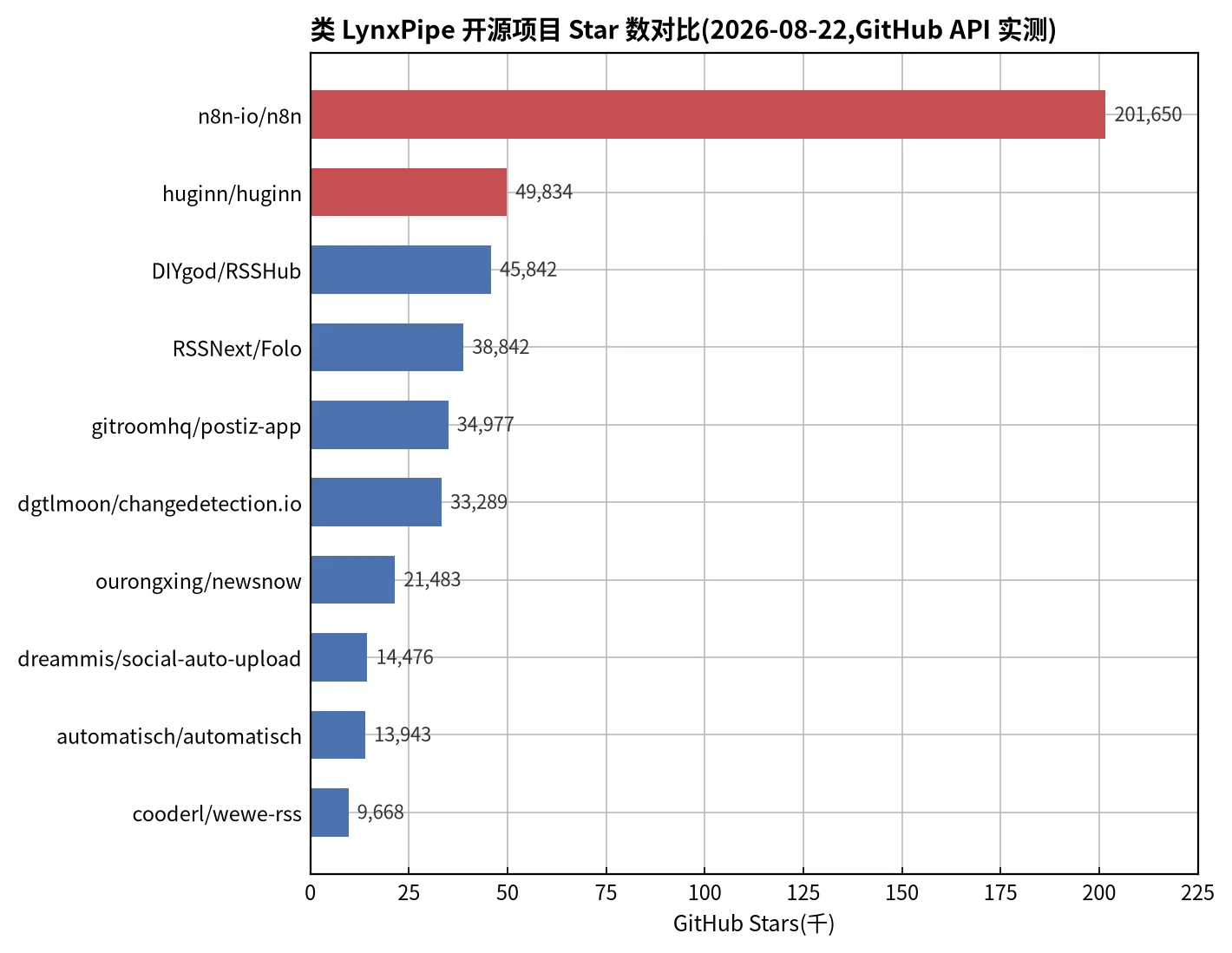
TL;DR: There’s no single open-source project that handles “RSS aggregation → processing → social distribution” end-to-end, but every layer has mature tools. The combination closest to LynxPipe’s full form is RSSHub (sources) + Huginn/n8n (processing) + Postiz (distribution), with a combined star total exceeding 280k. Here’s the full research: each project’s star count (measured via GitHub API on 2026-08-22), RSS capabilities, and supported social channels.
Context: What Is LynxPipe
My self-hosted content pipeline hub. The chain is: 12 RSS sources → LLM review/rewrite → Hugo static site deployment → WeChat Official Account / Telegram distribution, with token-bucket rate limiting, bilingual sync, and deduplication via a seen set. Cron runs three shifts daily at 9, 15, and 21. I previously wrote about its architecture migration.
I’ve always wondered: does this pattern already exist in the open-source world? If so, what’s worth borrowing, and what parts of my own stack are actually well-justified? That’s what this post is about.
I’ve organized the research into four layers—which also forms the structure of this article:
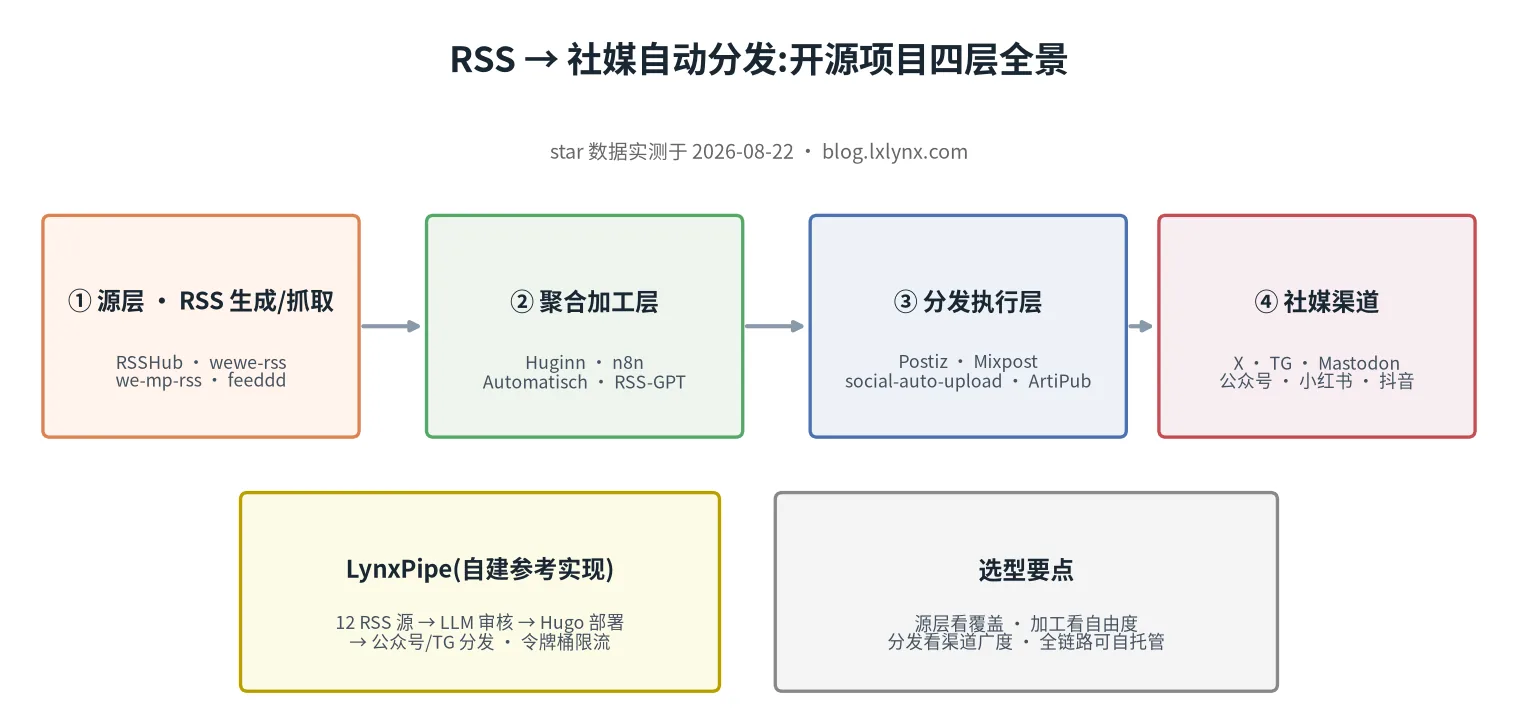
- Source layer: Turning non-RSS content into RSS (or scraping directly)
- Aggregation & processing layer: Subscriptions, filtering, AI enrichment
- Distribution layer: Pushing content to social platforms
- Social channels: Publishing difficulty on each platform
Star counts: all measured today via the GitHub API (gh api repos/<owner>/<repo>), not copied from READMEs or third-party leaderboards—guaranteed freshness.
Source Layer: Turning Everything Into RSS
The consensus in this layer is clear: the gaps in the RSS ecosystem are Chinese platforms and SPA sites, and the projects filling those gaps are themselves large projects.
DIYgod/RSSHub — 45,842 ⭐
The undisputed king of this赛道, slogan: “Everything is RSSible.” 4,000+ routes that convert Weibo, Bilibili, Zhihu, Douban, NetEase Cloud Music, and other services that don’t offer RSS into standard feeds. The work my vendor_watch does with Playwright rendering Z.ai/Anthropic blogs, RSSHub handles as a community-maintained public good.
- RSS capability: Generation (4,000+ routes, most comprehensive coverage of Chinese internet)
- Distribution capability: None, source layer only
- Takeaway for me: My 12 fixed sources are all English-language outlets with built-in RSS—I haven’t connected RSSHub. But if I ever need to monitor Weibo/Bilibili, self-hosting an RSSHub instance is the shortest path.
cooderl/wewe-rss — 9,668 ⭐
WeChat Official Account to RSS. Clever approach: uses the WeChat Read API to fetch official account articles, supports self-hosting. WeChat Official Accounts are one of the most walled content ecosystems online, and this project provides a stable workaround.
- RSS capability: Generation (WeChat OA exclusive)
- Risk: Depends on the WeChat Read interface—an unofficial channel with breakage risk
rachelos/we-mp-rss — 4,366 ⭐
Similar project, more feature-complete: OA-to-Markdown/PDF, scheduled updates, OPML export. Pick one between this and wewe-rss; this one puts more weight on “subscription management.”
feeddd/feeds — 2,098 ⭐
Free WeChat OA RSS, with a twist: “supports extending to any app”—not just OAs, but other app content sources too.
Summary
Every project in this layer follows a “reverse-engineering + generation” approach. No one does distribution. Chinese platform RSS-ification is already quite mature (RSSHub alone covers more than half), so there’s no need to rebuild here.
Aggregation & Processing Layer: LynxPipe’s True Peers
huginn/huginn — 49,834 ⭐
A veteran agent system, YC-backed, running since 2013. Core concept: a network of “Agents”—RSS Agent subscribes to sources → Filter/Transform Agent processes → Twitter/Telegram Publisher Agent pushes out. This is conceptually the closest project to LynxPipe—data pipeline + conditional triggers + multi-output.
- RSS capability: Consumption (RssAgent) + generation (SiteAgent scrapes pages into RSS)
- Distribution channels: 20+ built-in agents covering Twitter/X, Telegram, Email, Slack, Webhooks, etc.
- Shortcomings: Written in Ruby, UI looks like 2014; no built-in LLM processing (you write a WebsiteAgent to call an API yourself); poor mobile experience
- Takeaway for me: My “LLM review + seen dedup + per-channel rate limiting” logic maps to a combination of Huginn’s FilterAgent + a Memory Agent. It validates the reasonableness of my pipeline, but also shows that pure configuration-based agent systems still require significant custom code for complex logic.
n8n-io/n8n — 201,650 ⭐
The star count champion, but with a caveat: it’s a general-purpose workflow automation platform (fair-code license, not strictly OSI open source), not an RSS tool. That said, it has a native RSS Feed Trigger node plus 400+ integrations (TG, Twitter, WeChat Work all covered). Building an “RSS → summary → multi-platform publish” workflow is literally an official tutorial-level use case.
- RSS capability: Consumption (RSS Trigger node)
- Distribution channels: Nearly every major platform has a node—Telegram, X, LinkedIn, Mastodon, etc.
- Shortcomings: The fair-code Sustainable Use License has commercial restrictions; exporting complex workflows as JSON is hard to maintain (I’ve felt this pain firsthand)
- Positioning: If you don’t want to code, n8n is the fastest path to build this kind of pipeline. If you want full control over details, stick with custom scripts.
automatisch/automatisch — 13,943 ⭐
An open-source Zapier alternative, similar positioning to n8n but lighter. Has RSS triggers, but fewer distribution integrations than n8n. The second choice after n8n; ecosystem still maturing.
yinan-c/RSS-GPT — 354 ⭐
Small but elegant, and the most “spiritually similar” to what I’m doing: uses ChatGPT to generate custom summaries for your personal RSS subscriptions, delivers results to email. Fully hosted on GitHub Actions, zero servers. It proves the “RSS + LLM processing” path has real users—it just stops at email for distribution.
Summary
This layer is LynxPipe’s main battlefield. The conclusion is somewhat counterintuitive: star count ≠ fit. n8n has the most stars but is a general-purpose engine; building an RSS distribution pipeline is just one of many use cases. Huginn is conceptually closest but technologically aging. There isn’t a single off-the-shelf project that does all three: “RSS in → AI processing → social out.” The three components I built myself—LLM review, bilingual sync, and token-bucket rate limiting—would all require custom nodes or scripts in any existing project.
Distribution Layer: Pushing Content Into Social Media
gitroomhq/postiz-app — 34,977 ⭐
The new king of this赛道, taking off in 2024—“agentic social media scheduling tool.” 20+ channels: X, LinkedIn, Threads, Mastodon, Bluesky, Telegram, Instagram, Facebook, YouTube, TikTok, Reddit, Pinterest… basically everything you can name. Also released postiz-agent (CLI), letting AI agents schedule posts directly.
- RSS capability: No native RSS input (needs to be fed by n8n/Huginn)
- Distribution channels: Broadest among open-source tools, officially claims 28+
- Shortcomings: More of a “scheduling calendar” mindset than an event-driven pipeline; Chinese platforms (WeChat OA, Xiaohongshu, Douyin) are not on the list
- Fit: Using Postiz for Western platforms and writing custom handlers for Chinese platforms seems like the pragmatic combo.
inovector/mixpost — 3,527 ⭐
A self-hosted social media manager written in Laravel, supporting 12 networks (Facebook, X, LinkedIn, Threads, TikTok, etc.). The open-source edition is functional; Pro tier is paid. Feels more like a “small team marketing tool”—a bit heavy for a personal pipeline.
dreammis/social-auto-upload — 14,476 ⭐
The essential answer for Chinese video distribution: automated video uploads to Douyin, Xiaohongshu, WeChat Video, TikTok, YouTube, and Bilibili. Playwright-driven browser automation, working around the reality that these platforms don’t offer public APIs. Anyone running a WeChat Video account matrix will inevitably encounter this or its derivatives.
- RSS capability: None
- Distribution channels: Douyin / Xiaohongshu / WeChat Video / Bilibili / TikTok / YouTube—the exact half that Postiz is missing
crawlab-team/artipub — 3,204 ⭐
One-click multi-platform distribution for text+image content: Toutiao, Zhihu, Juejin, CSDN, WordPress, etc. Browser extension + backend management format. Maintenance has slowed, but the approach has been widely replicated by later projects.
wechatsync/Wechatsync — 6,209 ⭐
Same positioning as ArtiPub—one-click article sync tool. Supports Toutiao, Zhihu, JianShu, Juejin, CSDN, Typecho. Chrome extension format, the lowest barrier to entry.
Summary
The distribution layer map is two分裂 worlds: Western (Postiz/Mixpost, using official APIs, broad but shallow channel coverage) and Chinese (social-auto-upload/ArtiPub/Wechatsync, using browser automation, narrow but deep). The reason is simple—Chinese platforms largely don’t expose personal publishing APIs, so browser simulation is the only path. LynxPipe’s direct WeChat OA publishing uses the official freepublish API, making it a rare happy case on this map.
Reading Entry Layer (Worth Mentioning)
RSSNext/Folo — 38,842 ⭐
“AI RSS Reader,” formerly Follow. Turns RSS reading into an AI-powered feed, with blockchain points and other mechanics driving rapid growth. It doesn’t do distribution, but it represents the latest evolution at the “RSS reading experience” entry point—the mirror opposite of my output side.
ourongxing/newsnow — 21,483 ⭐
Real-time trending aggregation—everything on every hot list in one screen, with a clean Zread-style interface. More of a “hot list aggregator” than an RSS pipeline, but a great reference point when choosing input-layer tools.
Cross-Sectional Comparison Table
| Layer | Project | Stars | RSS Capability | Distribution Channels | Notes |
|---|---|---|---|---|---|
| Source | DIYgod/RSSHub | 45,842 | Generation (4,000+) | None | Everything is RSS |
| Source | cooderl/wewe-rss | 9,668 | Generation (OAs) | None | WeChat Read channel |
| Source | rachelos/we-mp-rss | 4,366 | Generation (OAs) | None | With OPML/PDF |
| Source | feeddd/feeds | 2,098 | Generation (extensible) | None | Free |
| Processing | n8n-io/n8n | 201,650 | Consumption (trigger) | 400+ integrations | Fair-code |
| Processing | huginn/huginn | 49,834 | Bidirectional | 20+ built-in agents | Ruby, elder |
| Processing | automatisch/automatisch | 13,943 | Consumption | Medium | Open-source Zapier |
| Processing | yinan-c/RSS-GPT | 354 | Consumption | Email only | GPT summaries |
| Distribution | gitroomhq/postiz-app | 34,977 | None | 20+ (Western) | Agentic |
| Distribution | inovector/mixpost | 3,527 | None | 12 (Western) | Laravel |
| Distribution | dreammis/social-auto-upload | 14,476 | None | 6 Chinese video platforms | Playwright |
| Distribution | wechatsync/Wechatsync | 6,209 | None | 7 Chinese text platforms | Plugin |
| Distribution | crawlab-team/artipub | 3,204 | None | 6 Chinese text platforms | Maintenance slowing |
| Entry | RSSNext/Folo | 38,842 | Consumption | None | AI reader |
| Entry | ourongxing/newsnow | 21,483 | Aggregation | None | Hot lists |
Three Takeaways for My Own Decision-Making
1. Stay the course, but learn from others. Compared to the strongest combo (Huginn’s concept + RSSHub’s sources + Postiz’s distribution), LynxPipe’s unique value lies in full-chain control: LLM review criteria, bilingual sync, rate-limiting strategy—all written to my own taste. Switching to any off-the-shelf platform would mean downgrading. That said, two components are worth seriously evaluating for integration: the Z.ai/DeepSeek sources I monitor in vendor_watch might already have RSSHub routes (saving me from maintaining Playwright scripts myself); and if I want to expand beyond TG to X/Bluesky, self-hosting Postiz as a “distribution executor” at the tail of the pipeline would be more cost-effective than maintaining per-platform API wrappers.
2. The open-source gap for an all-in-one “RSS → AI processing → multi-platform distribution” tool still exists. After this research, I can confirm: no project occupies this exact niche. RSS-GPT stops at email, Postiz doesn’t ingest RSS, and n8n requires manual wiring. In theory, this is a viable open-source project space—but given that Chinese platform API封闭 remains the biggest uncertainty, I’ll treat this as an observation item for now.
3. Browser automation is the destined path for Chinese distribution. social-auto-upload’s 14k stars prove the demand is real and massive, but this path requires quarterly cat-and-mouse games with platform anti-bot measures. Whenever an official API is available (like WeChat OA’s freepublish), it should always be the优先 choice—that’s exactly what LynxPipe does today.
Research methodology: Tavily parallel search to discover candidate projects → gh api to verify star counts and descriptions one by one → official docs to cross-check channel support. Star data current as of 2026-08-22.