
Safari 27 Released: Key Updates Overview
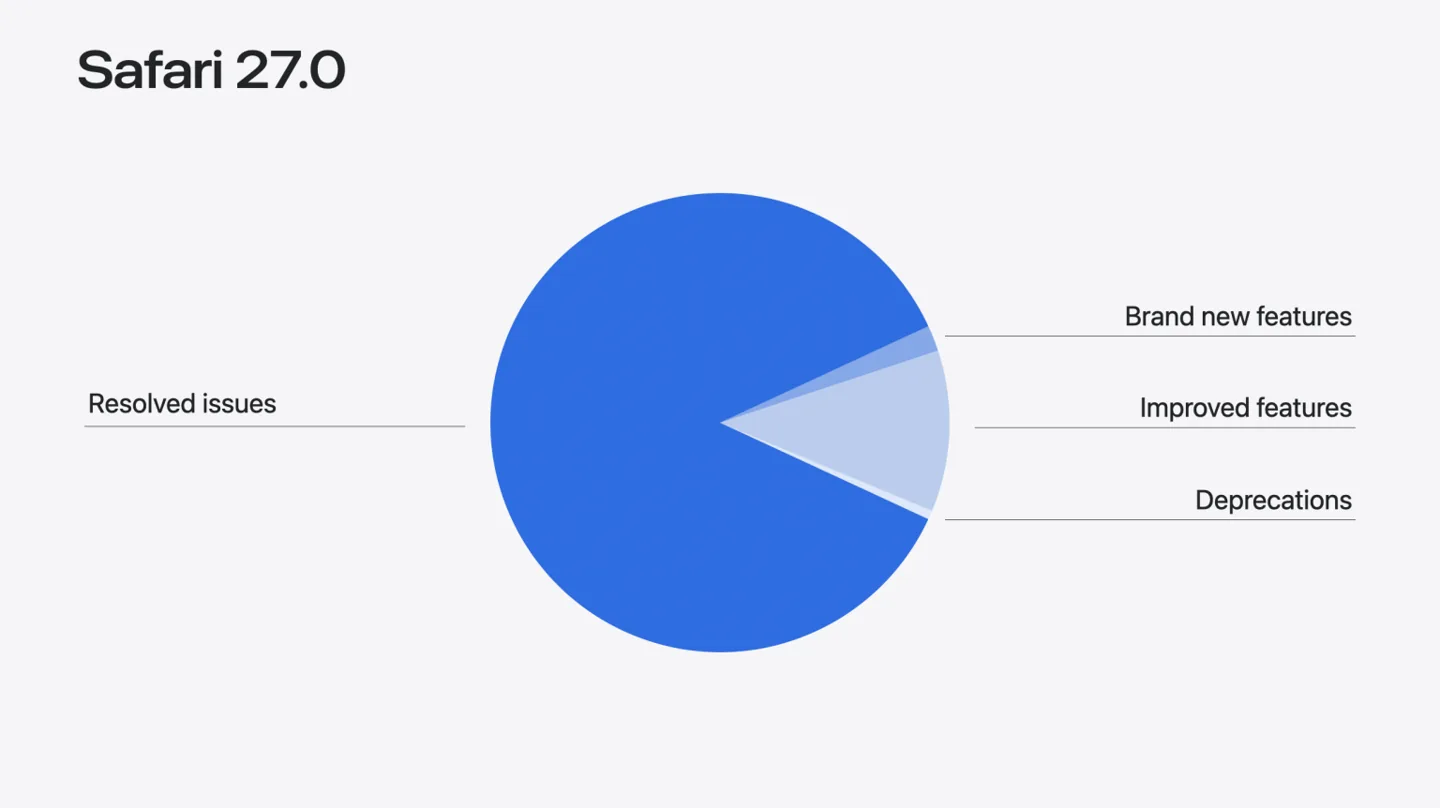
Apple officially announced Safari 27 on September 17, 2026, via the WebKit official blog. This update is pushed simultaneously to macOS and iOS/iPadOS devices as a core browser subsystem upgrade, requiring no separate installer. Key facts:
- Version: Safari 27.0
- Release Date: September 17, 2026
- Bugs Fixed: 844 (525 announced at WWDC 2026; expanded to 844 in the subsequent blog post, a ~60.76% increase)
- New Protocol Support: MCP (Model Context Protocol) server support
- Core New Feature: Scroll Anchoring
Scroll Anchoring: Ending the Page-Jumping Frustration
The most user-facing change in Safari 27 is scroll anchoring. This feature is controlled by the CSS property overflow-anchor, with a default value of auto. When new content loads dynamically (e.g., delayed images, ads, comments, or recommendations) while a user reads, Safari automatically adjusts scroll position to keep the current reading paragraph stable in the viewport.
This improvement greatly benefits news sites, forums, long-form blogs, and ad-supported sites. Readers will no longer experience sudden page jumps to unexpected positions mid-article. Developers may disable this via overflow-anchor: none for special cases such as full-page animations.
MCP Protocol Support: Developer Debugging Gets a Major Boost
For developers, Safari 27’s headline change is native MCP (Model Context Protocol) support. MCP is an open protocol enabling AI tools to deeply interact with the browser. Via MCP, tools like Claude Code and Codex can remotely control Safari windows and access live DOM structure, network request logs, screenshots, and console output.
This streamlines debugging: developers no longer need to manually capture screenshots, copy URLs, or repeatedly refresh pages. AI assistants can observe page state in real time and suggest precise fixes, significantly reducing debugging time. Apple did not discuss compatibility with other protocols.
Technical Updates and Ecosystem Impact
Safari 27 fixed 844 issues overall, exceeding the 525 originally announced at WWDC 2026. Though Apple did not disclose detailed bug categories, performance, stability, and security improvements are implied—particularly benefiting gaming, video, and highly interactive web apps.
Interestingly, Apple introduced MCP details in Safari—not WebKit—blog posts, suggesting Apple may mature features on an independent browser release cadence rather than waiting for full WebKit sync.
User and Developer Guidance
- End users: Update to Safari 27 on supported devices (macOS 15 / iOS 18) to automatically gain scroll anchoring benefits. If a site still jumps, it may intentionally use
overflow-anchor: none. - Front-end developers: If using Claude Code or Codex, Safari 27 enables full MCP support. Verify
overflow-anchorcross-browser behavior, as defaults vary across engines—explicit declaration in CSS is recommended. - Enterprise teams: Content-heavy sites (e.g., e-commerce, news) can reduce bounce rates leveraging client-side scroll anchoring, but test ad scripts for compatibility.
Final Thoughts
Safari 27 uniquely positions “reader experience” and “developer productivity” as parallel optimization pillars. As browsers increasingly take on context awareness and collaborative orchestration, the web platform is shifting from passive display to active coordination—Apple’s upgrade marks a step toward defining, not merely adopting, the next era of web interaction.