
Industrial AI Adoption Stalls: 63% of Enterprises Held Back by Deployment Costs

Siemens has positioned Xcelerator as the core platform for industrial AI as of mid-2026, with its flagship Eigen Engineering Agent commercially available in China and awarded the “SAIL-Star” at the World Artificial Intelligence Conference (WAIC) last month. Xcelerator does not end at product delivery; instead, it establishes a continuous growth loop of “validate—沉淀—develop—distribute—re-validate.”
Key facts:
- Eigen Engineering Agent supports ECAD file reading, automatic variable label generation, and natural language project export, boosting engineering efficiency by up to 50% and overall solution quality by 80%;
- Deployed across 19 countries and over 100 enterprises;
- Intelligence Center X (ICX) serves as an AI orchestration layer—a “dispatch hub” connecting PLM, ERP, MES, CRM, and OT data;
- As of July 2026, Xcelerator hosts 900+ products/solutions, 600+ ecosystem partners, and 600,000+ registered users.
A contrasting statistic underscores the industrial gap: while AI office agents see 60 million monthly interactions, the 2025 Industrial Agent Report finds only 8% of manufacturers achieve widespread adoption, with 43% not yet deploying at all—cost and talent shortages are primary barriers.
Three-Layer Architecture: Moving Industrial AI from Chat to Execution
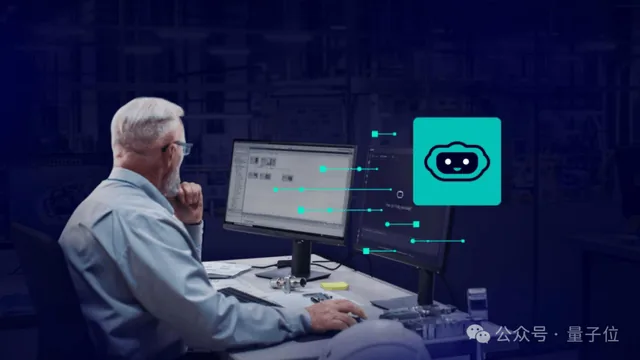
Xcelerator enables a closed-loop for industrial AI capabilities through three layers:
Layer One is the Product Portfolio, delivering deployable industrial Agents. Eigen Engineering Agent exemplifies this, handling repetitive coding, drawing parsing, and equipment configuration—freeing engineers, not replacing them. At Zhongke Motong, its deployment on EV EMB assembly equipment shortened programming and on-site commissioning by 30% while reducing labor and material waste by 10%.
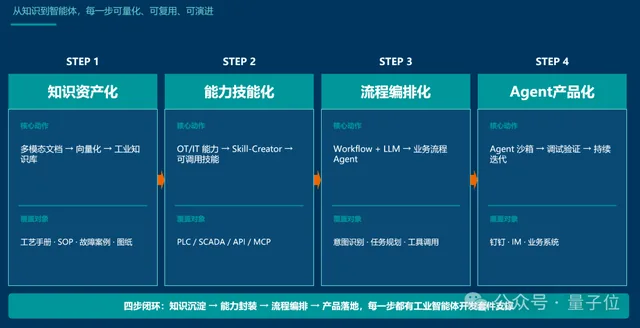
Layer Two is the Open Ecosystem, providing development kits including Skill Creator, Agent Framework, and Workflow. Enterprises reuse native capabilities: RAG-based knowledge retrieval, skill generation, and agent orchestration. Crucially, Siemens encapsulates OT engineering expertise—including PLC control, edge computing, and data acquisition—into callable “Skills”. The ECX Agent for energy-carbon management, built atop this kit, supports natural language handling and autonomous execution of energy optimization, equipment maintenance, and carbon monitoring-reporting-validation (MRV).
Third-party partners benefit: Beijing Zhidian Interactive repurposes knowledge base capabilities for document parsing, while Shanghai Quandian Information delivers customized agents such as automotive OBD testing and device maintenance solutions.
Layer Three is the Marketplace, open to third-party AI vendors. Aiqi Technology interfaces its AQ-VLM vision model and VisionAgent platform with Siemens X Data Hub and Teamcenter PLM via standard APIs; after security compliance, the joint “multi-dimensional industrial vision platform” becomes sellable. Sheshu’s 3D-to-2D drawing tool reduced design time from days to hours, saving over 7,000 man-hours annually for a 10-person team.
Unexpected Breakthrough: Industrial Agents Execute in Closed Loops

A key paradigm shift lies in industrial agents executing end-to-end workflows. Historically, electrical and automation design operated on separate tracks—ECAD for hardware, manual PLC programming for control logic—causing frequent errors. Eigen Engineering Agent, via ECAD integration, reads XML/AML files and generates compliant PLC variable labels and project structures.
This marks AI’s evolution from “assistant” to independent execution and validation—planning tasks, invoking tools, executing operations, and producing verifiable outputs. Siemens stresses this liberates human expertise, not automation at any cost.
Who Should Act Now—and Who Should Wait?
Enterprises ready to adopt Xcelerator include:
- Manufacturers facing clear engineering bottlenecks (e.g., EV, auto equipment), advised to trial Eigen Agent first;
- System integrators with solid OT/IT foundations seeking OT/IT convergence, leveraging dev kits for rapid skill build-up;
- Companies needing energy-carbon compliance and lean management, where ECX Agent provides a full MRV workflow.
Organizations advised to wait include:
- SMEs lacking data governance fundamentals, advised to solidify data infrastructure first;
- Asset-intensive firms sensitive to model opacity, requiring careful audit and rollback mechanism assessment for third-party agents;
- Enterprises without clearly defined AI use cases, recommended to wait as the Xcelerator Open Challenge adds more ecosystem solutions.
Final Thoughts
Industrial AI’s true barrier is not model sophistication, but embedding value into real workflows with measurable returns. Xcelerator’s advantage lies not in product count, but in building a self-evolving “capability growth system”—leveraging industrial expertise as the base, open ecosystem as the branches—for sustained innovation.
(word count: 1485)