
Launch Timeline and Platform Overview

Qualcomm recently previewed core technological upgrades of its upcoming flagship mobile platform, set for official debut at the 2026 Snapdragon Technology Summit. Confirmed要素 include:
- Release window: Second half of 2026 at Snapdragon Summit
- Primary target: Enabling efficient on-device execution of Agentic AI
- Core modules: Concurrent upgrades to Oryon CPU, Adreno GPU, and Hexagon NPU
- Developer readiness: Adreno Neural Fusion supports Unity and Unreal Engine and is entering commercial deployment
NPU Overhaul: Element Accelerator and Mixture-of-Experts Deployment
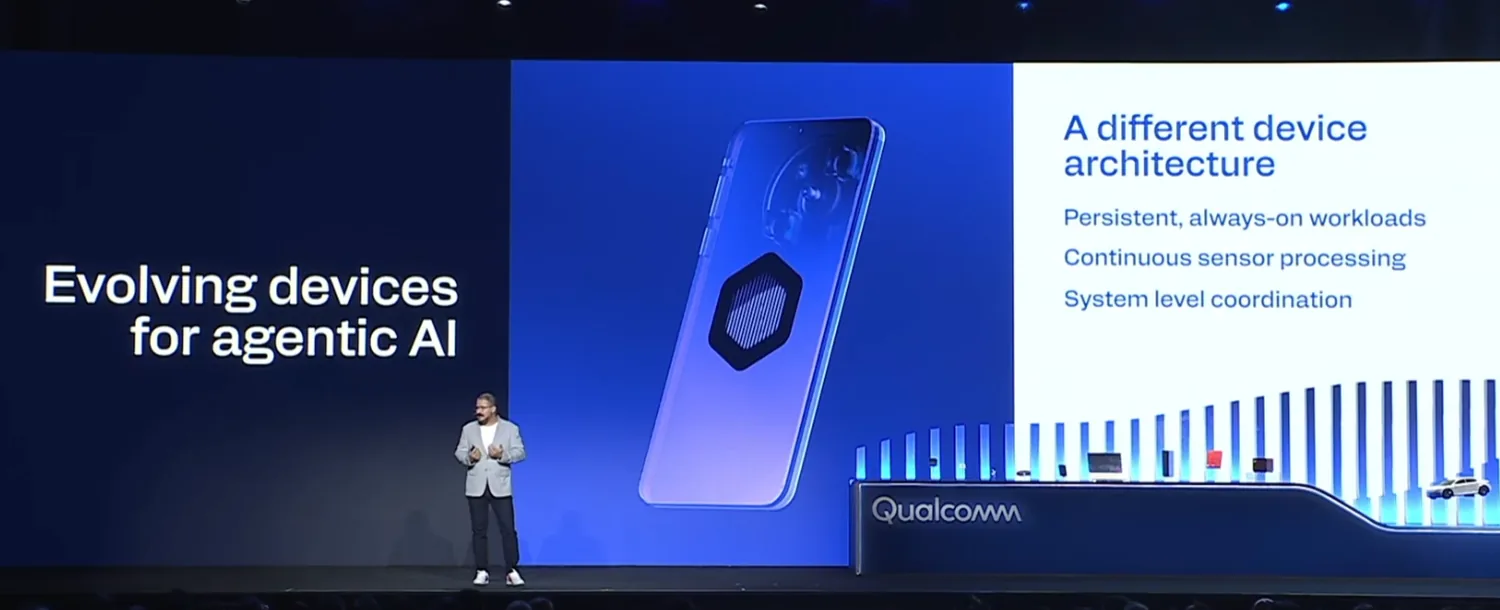
The Hexagon NPU represents the centerpiece of this generation’s AI leap. Qualcomm debuts the Element Accelerator, specifically architected for Transformer workloads in generative AI and Agentic AI, combining vector and scalar processing units to accelerate critical model operations while preserving energy efficiency.
Complementing this is the expanded shared memory subsystem, positioning model states, context data, and KV-cache closer to AI compute units—alleviating memory bottlenecks. Real-world impact includes up to 50% faster prefiling performance for INT4-quantized models, accelerated decode throughput, enhanced speculative decoding, and sub-1.5-second first-token generation times.
A lesser-hyped but pivotal advancement is the collaboration with industry partners to deploy Mixture-of-Experts (MoE). This dynamic routing mechanism allows a 30B-parameter MoE model to activate only ~3B parameters per token generation, dramatically trimming computation load and memory bandwidth. Combined with smart flash-to-memory loading and caching strategies, MoE enables large-model AI on the edge with markedly lower power and memory footprints.
CPU Advancement: Oryon FlexCache Architecture Debuts
The new Oryon CPU clocks in at 5GHz—the highest ever for mobile processors. Qualcomm clarifies this stemms not only from process technology but exhaustive microarchitectural redesign across cores, implementation, and subsystem design.
Equally critical is the debut of Qualcomm Oryon FlexCache, a flexible cache architecture where heterogeneous compute cores share a unified cache pool with dynamic allocation. When smart agent workflows hand off between cores, cached data persists—cutting memory-access frequency and sustaining performance even when system memory is constrained. The result: more responsive coordination for complex AI workflows.
GPU Revolution: Adreno Neural Fusion and Matrix Cores Enter the Fold

Adreno GPU introduces two breakthrough technologies:
- Adreno Neural Fusion: First unified integration of neural processing, AI upscaling, and frame generation within a single graphics pipeline to delivering higher visual quality with lower rendering overhead
- Adreno Matrix Cores: Purpose-built AI GPU cores operating directly inside the graphics pipeline on mobile—joining NVIDIA (2017) and Apple (2025) as industry pioneers
Paired with 18MB Adreno High-Performance Memory (HPM), embedded within the GPU subsystem, this architecture enables low-latency tile-based rendering and frame buffering. With native support from Unity and Unreal Engine, games implementing Neural Fusion promise sharper visuals, smoother frame rates, and extended battery life—commercial titles expected this year.
Who Should Buy and When

Early adopts to monitor:
- Users of 2026 flagship smartphones powered by this platform, expecting faster, more energy-efficient on-device AI responses
- Mobile AI/game developers leveraging Neural Fusion and NPU acceleration to optimize.publish apps
Buyers advised to wait:
- Budget-conscious users: The platform targets premium segment, likely commanding价 premiums at launch
- Professional users demanding ultra-strict multimodal fidelity: Wait for third-party validation post-device launch
Final Word
Qualcomm’s end-to-end re-engineering—from NPU through CPU to GPU—establishes a unified, co-designed AI acceleration stack. As Agentic AI transitions from “functional” to “flawless,” the chip’s foundational role has escalated from supporting actor to the defining determinant of user experience quality.