
AI Growth Shows Up as Platform Usage
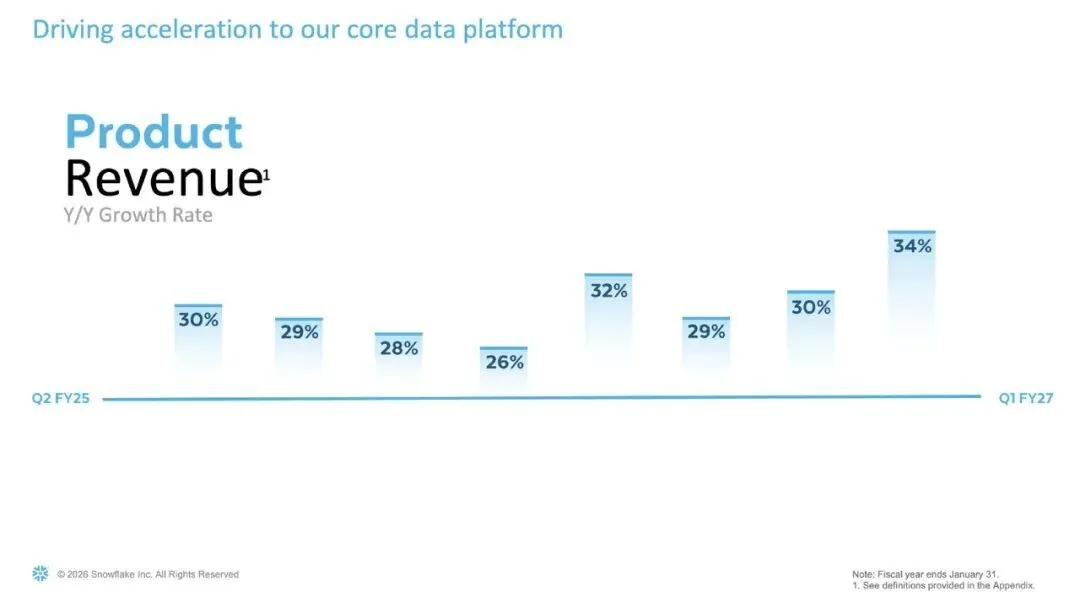
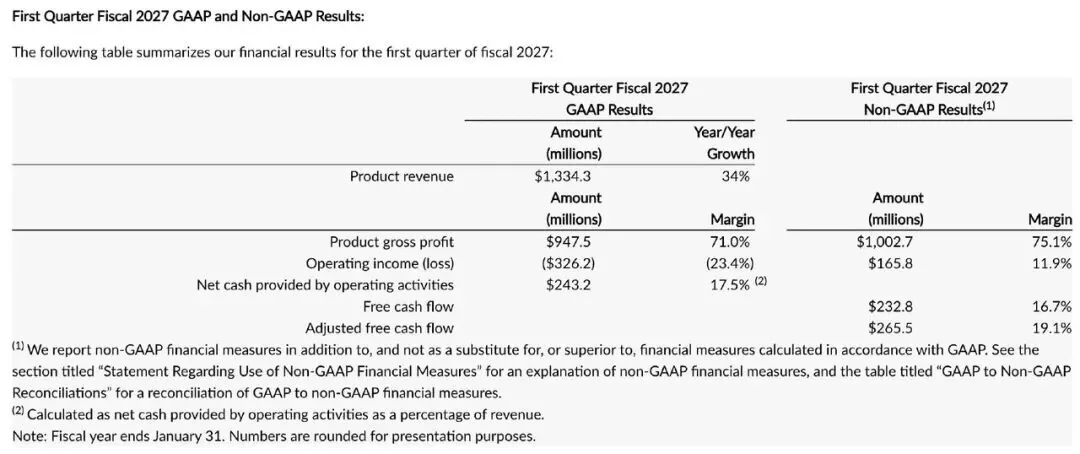
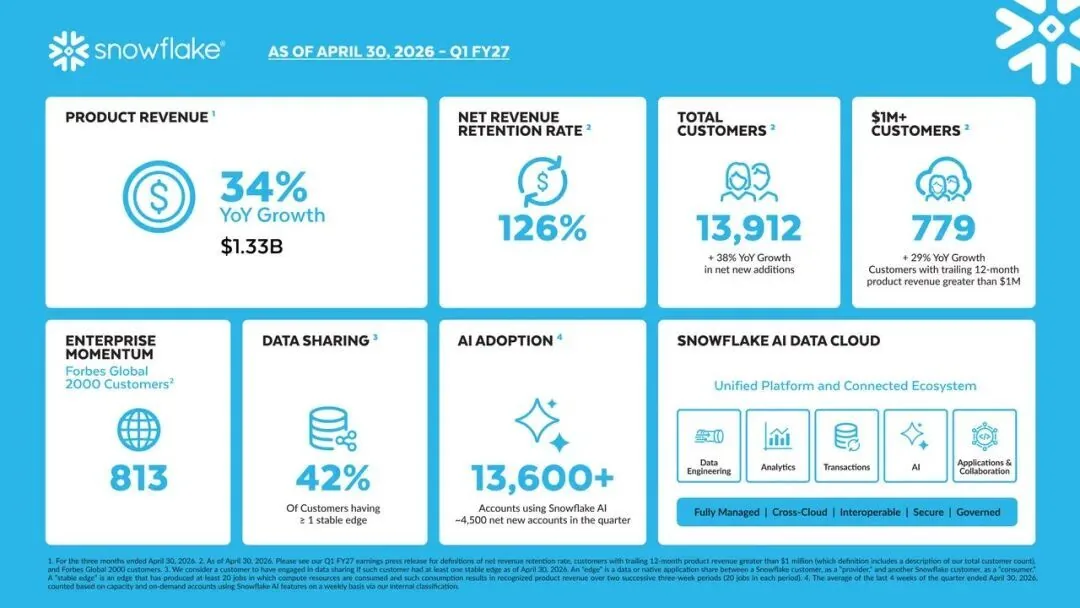
Snowflake’s latest results reframed its AI story as a consumption story rather than a standalone product launch. For the fiscal 2027 first quarter ended April 30, 2026, revenue reached $1.391 billion, up 33% year over year. Product revenue was $1.334 billion, up 34%.
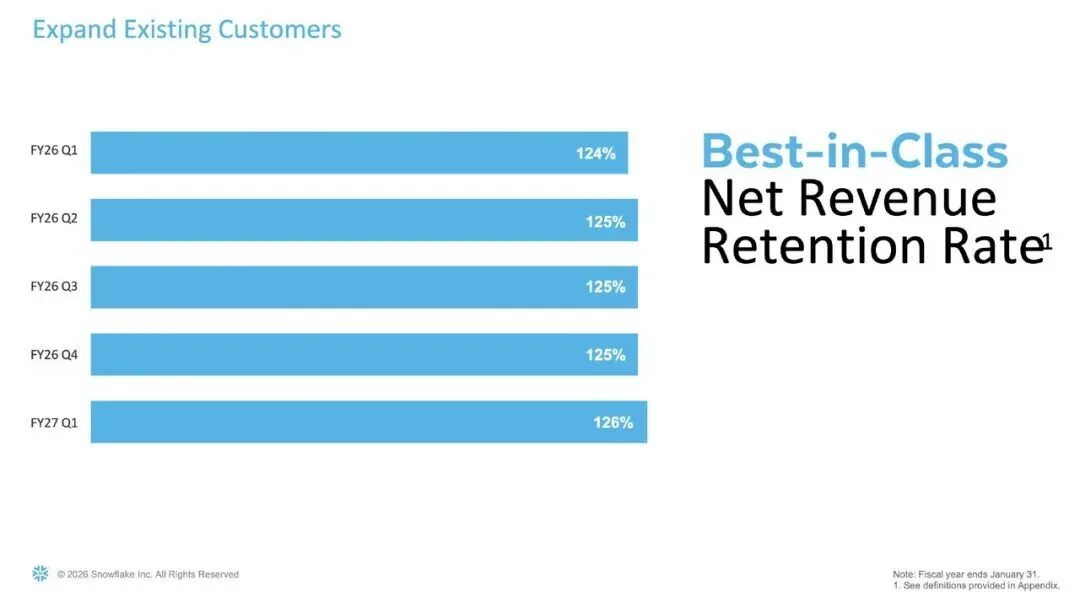
The company also reported 779 customers with more than $1 million in trailing 12-month product revenue, $9.21 billion in remaining performance obligations, and raised its full-year product revenue outlook from $5.66 billion to $5.84 billion. Most notably, net revenue retention reached 126%, showing that existing customers are expanding usage despite tighter enterprise software budgets.
AI adoption is already visible across the platform:
- More than 13,600 accounts use Snowflake AI capabilities;
- Snowflake CoWork accounts more than doubled sequentially;
- Snowflake CoCo is used by more than 7,100 accounts.
Snowflake Is Not Competing Mainly on Foundation Models
Snowflake has not positioned itself as a direct foundation-model rival to OpenAI or Anthropic. It also has not separately disclosed AI product revenue, so investors cannot precisely attribute the 34% product revenue growth to CoWork, CoCo, or Cortex Agent.
Its strategy is different: make AI part of the existing data platform. A generic coding assistant can produce SQL or Python, but enterprise deployment depends on business context—table meanings, access rules, governance policies, data lineage, and established logic. Since many enterprise datasets and permissions already live inside Snowflake, tools such as CoCo can operate closer to the governed data environment instead of forcing sensitive data into a separate system.
The closer AI gets to execution, the more important context becomes. A wrong answer in a chatbot is inconvenient; a wrong permission decision or metric definition in production can affect real workflows.
Ontology Becomes the Missing Cognition Layer
Snowflake’s recent discussion emphasized Ontology. In simple terms, ontology is a structured way to describe enterprise concepts, relationships, and rules so machines can understand how “customer,” “revenue,” “order,” and “department” relate to one another.
A traditional semantic layer often standardizes metric definitions, such as how revenue is calculated. Ontology goes further by defining relationships: customers buy products, employees belong to departments, orders connect to stores, and risk events trigger approvals. Knowledge graphs describe specific connections; ontology defines the higher-level categories and rules behind them.
In Snowflake’s envisioned stack, raw tables and entity relationships support categories, rules, abstract views, business semantic models, and finally AI applications such as Cortex Agent. When a user asks why quarterly sales declined, an agent should not blindly generate SQL across hundreds of tables. It must first understand which metrics define sales, how products, channels, and customers connect, and which patterns indicate seasonality versus channel loss.
This expands the meaning of AI-ready data. Enterprises also need AI-ready know-how: workflows, SOPs, expert knowledge, and playbooks that agents can call and apply.
Open Semantics and AI Governance Are the Hard Parts
Enterprise meaning rarely lives in one system. It may be embedded in data warehouses, ETL pipelines, BI tools, metric platforms, catalogs, and business applications. If every tool defines revenue, customer, or profit differently, semantic drift emerges—and agents operating across systems may receive contradictory instructions.
That explains Snowflake’s interest in open semantic standards. Open Semantic Interchange was accepted into Apache incubation in 2026 and renamed Apache Ossie. Its goal is to provide a vendor-neutral, machine-readable format for metrics, dimensions, datasets, and relationships. Like SQL for relational databases, it does not require identical implementations, but it creates a shared language.
Governance pressure is rising at the same time. As agents move from answering questions to taking action, controls must happen before execution, not only after data enters a warehouse. Who grants permissions, who audits actions, who reviews high-risk decisions, and who is accountable when something goes wrong become central AI governance questions.
Outlook: The Battle Is for the Enterprise Cognition Layer
Snowflake’s opportunity is not simply having the best model. Its advantage lies in proximity to enterprise data, permissions, tools, and workflows. The company is trying to move upward from storage and compute into semantics, ontology, agent orchestration, and action auditing—effectively competing to become a control layer for enterprise agents.
The path is not guaranteed. Customers must be willing to place core business semantics on the platform. Ontologies must stay current as the business changes. Agent actions must be traceable. AI spending must map to measurable business outcomes. Ontology will not magically fix inconsistent metrics; it may instead force organizations to make implicit rules explicit.
The broader direction is clear: model APIs will become easier to access, while durable advantage will come from turning enterprise knowledge into systems that machines can understand, govern, and execute. Snowflake’s financial results suggest customers are beginning to pay for that shift.