
Core Announcement: Snowflake Unveils Cortex AI Functions for Native Unstructured Data Processing
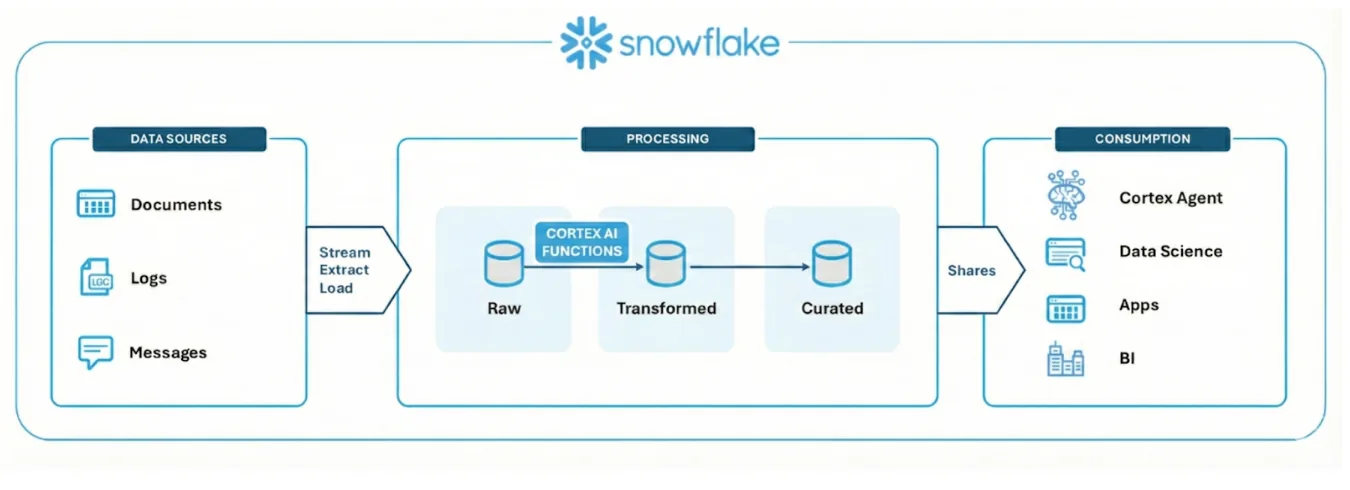
Snowflake has extended its Cortex AI platform to enable native structured processing of unstructured data—including call transcripts, support tickets, legal contracts, images, and videos—directly within the data warehouse without data egress. The functions are available to existing Snowflake customers as of 2026, with pricing tied to standard Snowflake compute resources rather than separate licensing fees.
Key hard details:
- Availability: 2026 (current context year)
- Target: Snowflake platform customers
- Processing scope: Fully internal to Snowflake; no external NLP services required
- Architecture: Adopts the established raw → transformed → curated → consumption pipeline
The Transformed Layer Reimagined: AI Embedded in the Data Pipeline
Previously, Snowflake’s transformed layer focused on cleaning and integrating structured data. Cortex AI Functions now add native unstructured text processing capabilities. Seven core function types are available:
- AI_TRANSCRIBE: Converts spoken audio into text for analysis
- AI_COMPLETE: Extracts key insights or generates summaries from single records (demo uses claude-3-5-sonnet)
- AI_CLASSIFY: Categorizes content into predefined business categories (e.g., billing_issue, technical_support)
- AI_FILTER: Flags records meeting specific business criteria (e.g., customer complaint)
- AI_SIMILARITY: Calculates semantic similarity to match against known issues
- AI_AGG / AI_SUMMARIZE_AGG: Aggregates insights across multiple records for executive summaries
- AI_EMBED: Generates vector embeddings for semantic search and similarity comparison
These functions can be combined in a single SQL query to transform raw text into actionable structured insights in one step. In a call center example, one query simultaneously outputs intent classification, escalation flags, issue match scores, and summaries from raw audio transcripts.
Real-World Application: Call Center Automation at Scale
Traditional approaches to call center analysis rely on ad-hoc scripts or external NLP services, resulting in fragmented insights and weak governance. With Cortex:
- Why customers are calling
- Which cases require escalation
- How customer sentiment evolves over time
- Which known issues recur most frequently
All questions become answerable through a unified workflow:
- Raw audio/text stored directly and transcribed via AI_TRANSCRIBE
- Transformed layer performs row-level enrichment using AI_CLASSIFY and AI_FILTER
- Curated layer uses AI_AGG to generate weekly executive summaries (e.g., top three customer issues)
- Final output feeds BI dashboards, ML pipelines, and Cortex Analyst natural language queries
A single aggregation query can summarize dozens of transcripts into one executive sentence, while row-level queries handle multiple extractions—classification, flagging, matching—in a single statement.
Three Strategic Benefits of the Structured Governance Framework
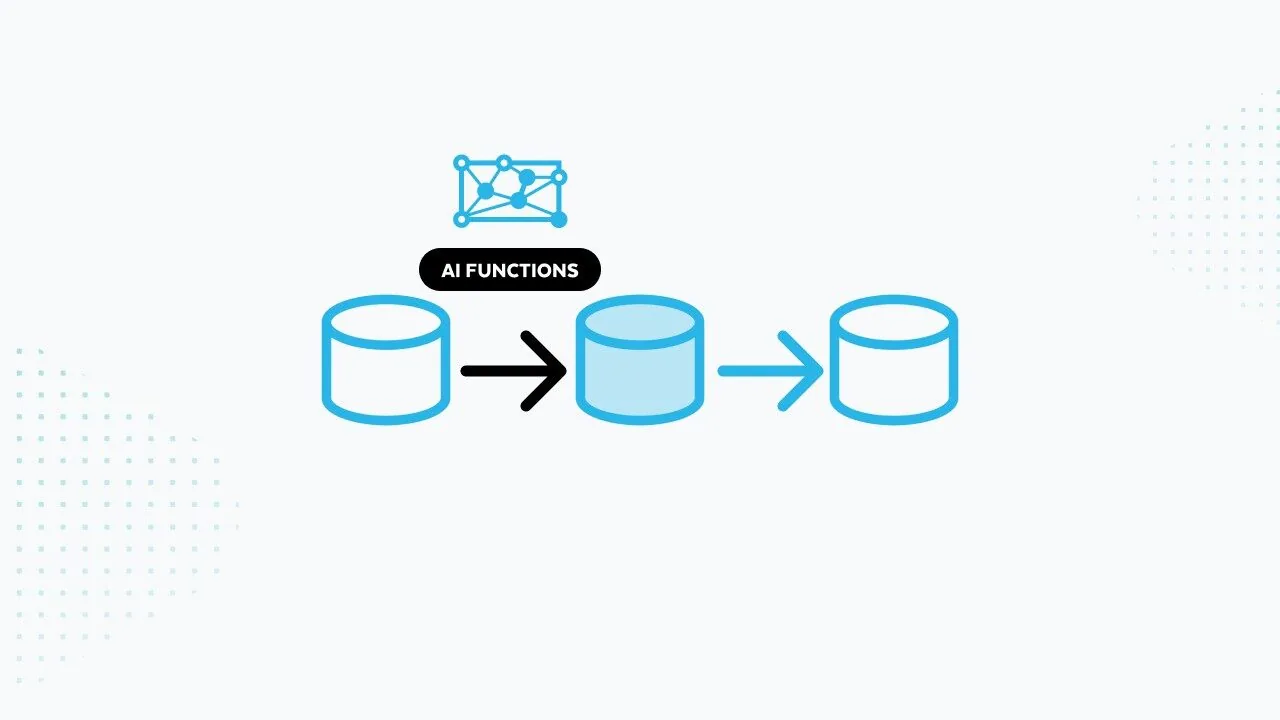
Adopting the classic Snowflake pipeline for unstructured data delivers:
- Governance and lineage: End-to-end audit trails from raw text to structured insights
- Consistency and reusability: Single enhanced pipeline serving multiple teams, eliminating silos and inconsistent definitions
- Scalability and trust: Framework extends across contracts, calls, and images; every insight traces back to source content
A key irony: unstructured data has long been treated as a temporary, ad-hoc concern whereas this approach grants it the same governance纪律 (discipline) and lineage traceability as structured data.
Implementation Guidance: Three Steps to Get Started
- Start now if: You use Snowflake, possess call recordings or text-based unstructured data, and have clear extraction goals (e.g., intent tagging, issue classification)
- Wait if: Your data governance foundation is nascent, or you prioritize low latency over analytical rigor (Cortex emphasizes accuracy and governance over real-time processing)
Recommend beginning with one high-value unstructured source (e.g., support calls), defining one or two core extraction objectives, then building the transformed layer incrementally.
In Closing
Unstructured data governance has traditionally lagged behind structured data management. By embedding AI capabilities natively in the warehouse layer, Snowflake signals a paradigm shift: enterprises move from “analyzing unstructured data” to “reliably, audibly, and reproducibly analyzing unstructured data”—a crucial step toward unified data operation.