
A Shift From Runnable Code to Playable Games
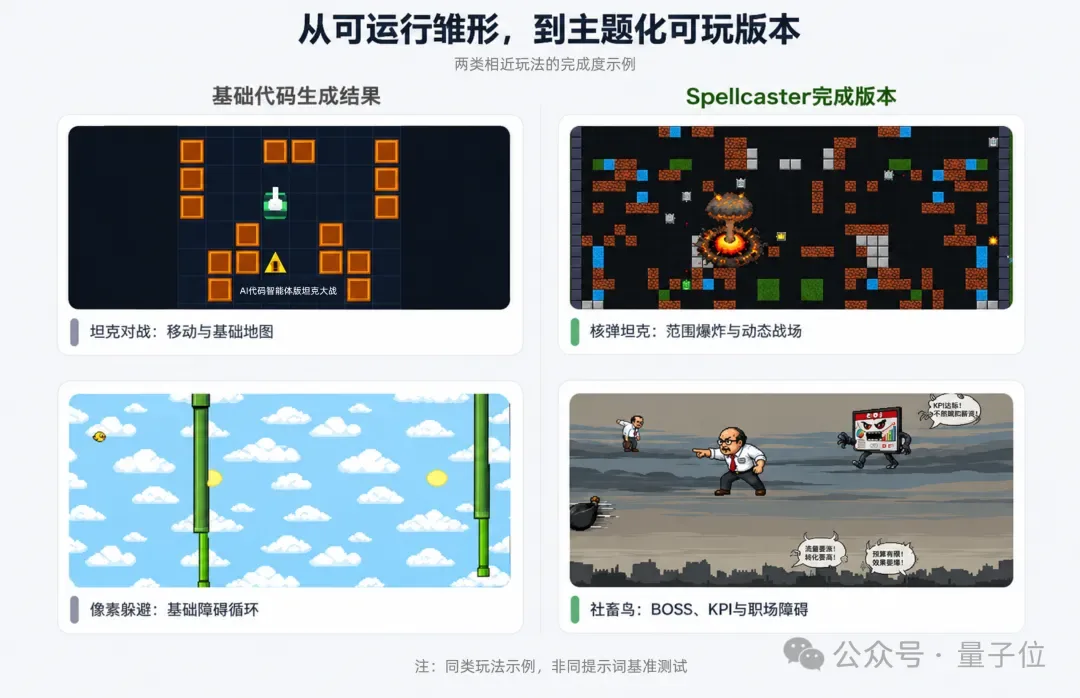
Spellcaster is positioning itself around a practical gap in AI game generation: producing code that runs is not the same as producing a game that can be played. According to the report, a prompt such as “generate a tank battle game” can quickly lead to a working project, with enemies appearing on screen and tracking the player. Yet in one example, the enemy tank did not fire shells as expected; instead, it swung its cannon at close range.
That behavior may look like a mistake at first. But when tested in context, movement, collision, attacks and damage detection all worked. The result was not a conventional tank shooter, but a coherent alternative mechanic. The case illustrates Spellcaster’s central claim: playability cannot be judged by whether the program merely launches.
Why Playability Is Harder Than Debugging
Large language models can already generate simple games such as Snake, platformers and shooters. But a web page opening and a character moving do not guarantee a complete gameplay loop. A platform may be placed above the character’s maximum jump height, enemies may animate without valid attack logic, or obstacles may spawn so densely that the player has no survivable path.
These failures are harder to handle than ordinary compilation errors. A code error often points to a file or line number; an unplayable game may involve rules, level layout, numerical balancing, visual feedback and player controls at the same time. In game development, “numerical balancing” refers to parameters such as speed, health, damage and spawn frequency, which collectively shape difficulty and pacing.
Spellcaster’s answer is to test the game as an interactive system, not as isolated code snippets.
Six Agents in a Closed Loop
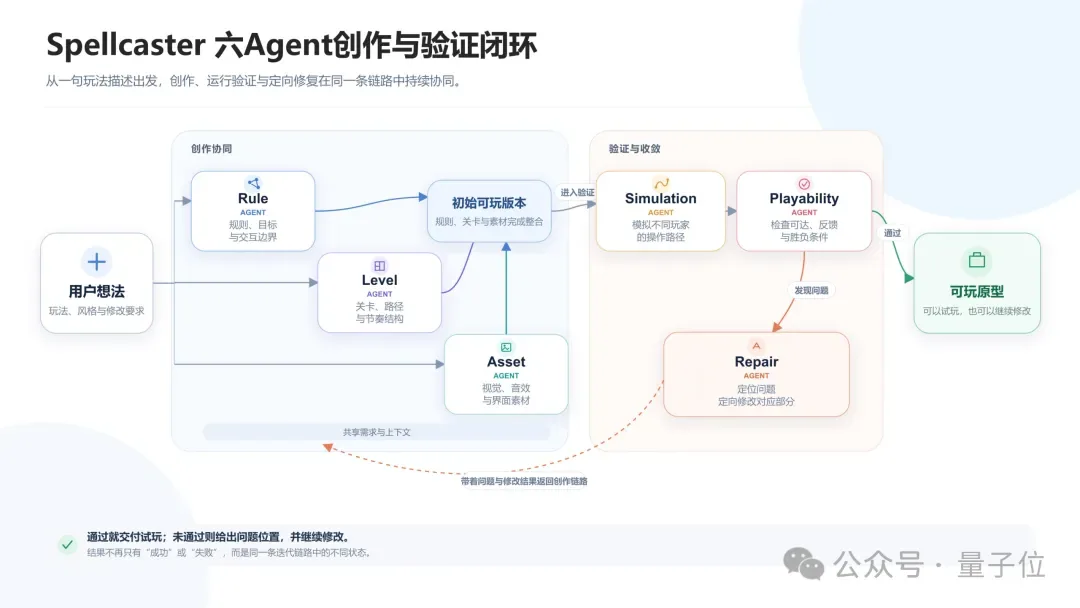
The system first turns a user’s description into structured elements: rules, character abilities, level goals, win and loss conditions, enemy behavior and key values. It then assigns tasks to multiple specialized agents.
The reported division of labor includes:
- Rule Agent for game rules;
- Level Agent for level design;
- Asset Agent for visual and other assets;
- Playability Agent and Simulation Agent for checking whether key paths are reachable, core interactions work, and unwinnable states exist;
- Repair Agent for locating whether a problem belongs to rules, values, levels, assets or code, then applying local fixes.
The important design choice is the loop: generate, run, inspect and repair. After receiving a first version, users can continue the conversation by changing movement speed, adding enemies, adjusting levels or switching visual style. The system is designed to modify the relevant part instead of regenerating the entire project from scratch.
Prototypes in About 15 Minutes
The report says that a prompt such as “generate a bullet-hell shooter with a starry-sky background” can produce a playable prototype in about 15 minutes. Current supported common genres include platformers, tower defense, runners, dungeon roguelikes and bullet-hell shooters.
This changes who can use game prototypes and how early they can be tested. Independent developers can validate whether a mechanic is worth further investment. Content creators can turn interactive stories or internet memes into playable forms. Non-programmers do not need to begin with a programming language or a game engine.
It also reframes AI mistakes. The close-range tank behavior might be removed as an error in a code-only workflow. With playability testing, however, it may be recognized as a valid gameplay path. For prototyping, unexpected but playable outcomes can sometimes be as useful as faithful execution of the initial prompt.
Toward World-Model-Based Game Generation
Spellcaster today still follows a familiar pipeline: AI generates code and assets, and a game engine runs the result. The team’s next direction, according to the report, is world models. In that approach, player movement, attacks, choices, the current image, character state and interaction history become model inputs. The model then predicts what happens next and directly generates the next visual feedback.
A world model is an AI model that learns how an environment behaves and uses that understanding to simulate future states. If this direction matures, AI games may move from automatically generating runnable projects to dynamically simulating worlds that respond to players.
For the industry, Spellcaster is less about replacing game development in one step and more about restructuring the prototype phase. Near term, it looks like a faster tool for testing ideas. Longer term, the combination of multi-agent workflows and world models could shift the bottleneck from writing code to designing rules, evaluating interaction and selecting what is genuinely fun.